
Two leaders, one tree
Two stems pulling apart. A cable to steady them.
Plenty of the trees planted along Hampton’s plan streets in the nineties and early two thousands have reached the age where two or three leaders are fighting for the top, with bark pinched into the seam between them. A cable set high in the crown limits how far those stems can swing apart in wind and ice. It does not glue a crack shut, and Chris will say so up front, and on some trees he will point you to thinning or a removal instead.

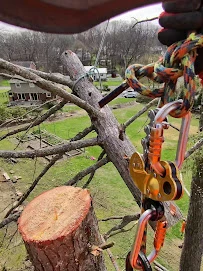
What a cable does, and what it never will
A cable is a line run between two stems high in the crown, well above the joint that worries us. On a calm day it hangs with a little slack. When a gust or a load of ice pushes the stems outward, the line takes up and stops them from spreading past the point where the union would tear. That is the whole job. It limits travel.
What it cannot do matters just as much. It does not heal a crack that is already there. It does not make included bark grow together. It does not stop decay, and it does not turn a tree with a rotten base into a safe one. What a cable buys is more years for a sound tree that happens to be awkwardly built, and that is worth a lot when the tree is the best shade on the lot.
Anyone who tells you a cable makes a split tree good as new is selling you hardware. More finished work from the crew is in the gallery.
Included bark, and why two leaders turn into trouble
When a young tree lets two stems grow up side by side at about the same size, the bark on the inside of the fork gets trapped as they thicken. That pinched bark is called included bark, and it is the weak spot. A strong union knits wood across the fork in a raised ridge. An included one has a seam of bark down the middle instead, holding nothing together.
For years it does not matter. Then the stems get heavy, the crowns get wide, and one windy afternoon the fork opens. That is the stage a lot of Hampton’s plan trees have reached: put in when the subdivisions went up, never pruned for structure, and now carrying two or three trunks with a dark line running down between them.
What to look for from the ground: a narrow V where the stems meet instead of a wide U, a vertical streak of bark running down from the crotch, and sometimes a swelling on each side where the tree is trying to build wood around the problem. Staining that weeps from the seam, or a crack you can see daylight through, means call soon. The tree cabling page covers the general method.
Cable it, thin it, or take it down
Chris sorts most two-leader trees into one of these on the first walk around.
- Cable it
- Both stems are sound, the fork has included bark but no open crack, and the tree is worth keeping right where it is. A cable holds the stems from spreading too far and lets the tree keep its full crown.
- Lighten it, then cable it
- The crown carries most of its weight out at the ends. Thinning some of that off first leaves the cable with less to restrain each time the tree moves in a storm, so the two jobs get paired.
- Prune it instead
- On a younger tree, a structural pruning visit can still choose one leader and slow the other, which heads the problem off with no hardware at all. When it is not too late, that beats a cable every time.
- Take it down
- A crack running through the union, rot in the fork or at the base, or one stem already dying back. A cable on a tree like that is false comfort, and you will hear so before you pay for one.
Ice and wind up the Route 8 corridor
Open crowns on the higher lots take the weather first. A plan tree standing taller than the houses around it, or one left alone at the edge of a cleared yard, catches every gust coming up the Route 8 corridor with nothing to break it.
Ice is the harder test. A glaze on every twig adds a load the crown was never built to carry, it comes when there are no leaves left to shed, and wind often follows right behind it. Two leaders with included bark between them get pried apart from the top, and the fork opens from the inside where nobody can see it start. Often the first sign anyone sees from the ground is a crack that has already opened.
That is the case for cabling before the season instead of after it. The best time to put a cable in is when the leaves are down and Chris can see the whole structure, which lands right before ice season. A cable on a sound fork going into winter is a far better spot to be in than a cracked one in February.
Ice is the hardest test a split fork gets, and it comes after the leaves are gone.
Checking on it as the years go by
A cable is not something you put in and forget. The stems keep thickening, the bark grows in around the anchors, and the fork under the line can change slowly enough that nobody living with it notices. So a cabled tree gets a fresh look every so often, and again after any bad storm or ice. Most of those visits end with good news. If one turns something up, Chris shows you what changed and what he would do about it.
Cabling rarely travels alone. Crown thinning usually comes along to take end weight off the stems. A cabled tree that later shows a dead leader or a crack the line cannot help is a dead tree removal conversation, and a fork that already gave way in a storm is storm-damaged tree removal. If the tree sits at the edge of a back acre gone to rose and locust, brush clearing can open that up while the crew is there. The rest of what we do in the township is on the Hampton Township page.
Hampton Township, where the hill lots meet the wind coming up Route 8.
Cabling questions from under the fork
Plain answers on cables, leaders, and the trees that should not get one.
What does a tree cable actually do?
It limits how far two stems can move apart. The line sits high in the crown with a little slack and takes up when wind or ice pushes the stems outward, so the weak union below is not pried open. It does not repair wood, close a crack or stop decay.
What is included bark?
Bark trapped inside a fork when two stems grow up side by side. Instead of wood knitting across the joint, a seam of bark sits in the middle and holds nothing. From the ground it looks like a tight V with a dark line running down from it, sometimes with bulges on both sides.
When is cabling the wrong answer?
When the union already has a crack through it, when there is decay in the fork or at the base, or when one of the stems is dying. A cable on a tree like that only delays the call. If it can reach the house, removal is the honest recommendation, and Chris will make it.
Do you thin the tree when you cable it?
Usually, yes. A crown that is heavy at the ends puts more load on the cable every time the tree moves. Taking out some of that end weight and any rubbing or crossing limbs first means the cable has less to hold back, and both jobs fit in the same visit.
Does a cabled tree need to be checked?
Yes. The tree keeps growing around the anchors and the union under the cable can change, so it should be looked at over the years and after any heavy storm or ice. Most checks find nothing wrong. That is fine. The ones that find something are the reason to keep doing them.
My plan tree is still young. Is it too early for this?
Maybe too early for a cable, which is good news. On a younger tree with two competing leaders, one structural pruning visit can pick the winner and slow the other down so the weak fork never forms. That is better than hardware later, and it is worth asking about now.
Is the fork starting to open?
Get a photo of the whole tree from the street, then stand underneath and shoot straight up at the spot where the stems divide. If you can see a dark seam, a crack, or anything weeping from the joint, mention it. Chris will tell you whether it calls for a cable, a thinning, both, or neither, and whether the tree is worth the hardware at all. The up-front number comes in writing before any work starts. The contact form takes photos, or call and talk it through.