
Plants, warehouses, yards
Industrial tree work that fits around a running shift
Nobody at a plant wakes up thinking about trees until the fence line is buried, a trailer clips a limb backing into the dock, or the roof drain plugs and the office ceiling starts dripping. Triple T handles the green stuff on working Pittsburgh sites: sign in at the gate, clear what needs clearing, load out, and let you get back to production.

The fence line is where the volunteer forest starts
Walk any industrial perimeter in Allegheny County and you can read its maintenance history in the fence. Tree-of-heaven and mulberry seed into the six inches of gravel nobody mows, and within four or five seasons they are growing straight through the chain-link. The fabric does not break, it swallows. Trunks close around the mesh, top rails bow outward, and by the time somebody notices, taking the tree out means taking a section of fence with it. Box elder does the same thing to camera poles and light standards, throwing a soft, fast, brittle canopy over exactly the sightline the camera was mounted for.
That is the work most people call us for first. Cutting a perimeter back to the property line, grinding what needs to stay gone, and handing the yard back so a truck can drive the fence road again without folding a mirror. It is unglamorous and it is the single highest-value hour we spend on an industrial parcel, because everything downstream of an overgrown fence line gets worse: the drainage swale, the camera coverage, the pest harborage, and the day a storm lays a mulberry across your only gate.
Docks, rail spurs, and the thirteen-six problem
A dry van needs thirteen feet six inches of clear height and a driver needs to see the dock while backing. Trees do not respect either number. The silver maple planted by the office thirty years ago now reaches over the approach lane at eleven feet, and every trailer that comes through drags its roof under it. Drivers stop complaining after a while and just start scraping, which is how a fleet ends up with a row of trailers with the same gouge in the same place.
We clear approach lanes, turnarounds, and dock aprons to real trailer height with margin on top, not to whatever looked fine from the ground. Rail spurs get the same treatment, tighter, because a spur that has not seen a car in two years grows a green tunnel fast and the railroad will not run into it. Around the loading area we work in whatever window keeps your doors open. Sometimes that means Saturday, sometimes it means the two hours between first shift leaving and the night crew coming in, and sometimes it means a spotter of ours standing in the lane so a Kenworth never has to wait on us.
Big flat roofs collect everything a tree drops
A warehouse roof is a giant, nearly level catch basin with a handful of drains, and a mature tree along the wall will fill it. Cottonwood is the worst offender in this valley. That fluff comes off in June, rides the wind onto the roof, and packs into rooftop unit intakes until the compressors are pulling against a felt blanket and the maintenance tech is up there every week with a shop vac wondering why the units are short-cycling.
Fall brings the other half of the problem. Leaves wash to the scuppers and roof drains, the drains choke, and a flat roof that was designed to shed an inch an hour is suddenly holding water measured in tons across a hundred thousand square feet. We have been called to plenty of buildings where the fix everyone was chasing was inside, and the actual cause was two maples overhanging the parapet on the north wall. Pulling the canopy off the building line does not make a roof maintenance-free, but it removes most of what the roof was choking on.
Cleared perimeters read differently on camera
Security is the reason a lot of industrial calls turn urgent. An overgrown treeline gives anybody who wants your copper, catalytic converters, or a trailer’s worth of freight a place to sit and wait, out of the light and out of frame. Cameras that had a clean run of fence three summers ago are now watching leaves move. Once we open the perimeter back up, the footage is worth something again, motion alerts stop firing on branches, and the pole lights actually put light on the ground where they were aimed.
Chris has been doing this twenty five years and can tell you within a walk which trees are structural risk, which ones are just a sightline problem, and which ones you should keep because they are the only thing screening your yard from the neighbors. Not every tree on an industrial site is a problem. The ones that are, are usually obvious once somebody points at them.
What shows up at your gate
Climbers, a grapple loader for wood so nobody is dragging trunks across your yard, a chipper, and crane support when a pick has to come over a building or a live lane.
Insured, certificate of insurance on request before anybody walks the site.
See past work in the gallery, or read the broader commercial tree services page and lot clearing for vacant parcels.
“Christopher and his crew arrived on time, worked safely and efficiently, and handled the entire process with real professionalism.”
Felicia Provenzano, Google reviewFitting a tree crew into a safety culture
Your site has rules. We would rather learn them at the gate than argue about them in the yard.
What you hand us
The gate procedure, whatever site orientation you require, and a name to call when something changes. Tell us where the hot work happens, where the flammables live, and which lanes cannot be blocked at any hour. If you have a contractor packet, send it and we will fill it out.
Then point at the trees. Most site managers walk us around once and we have what we need.
What we bring to it
Crew signs in like everyone else. Hard hats, eye and hearing protection, chaps, and high-vis are the floor, not the exception. Saws and chippers are ignition sources and we treat them that way, so we ask about hot-work rules and stay clear of anything that should not be near a running engine.
We cone and spot our own work zone, keep the traffic pattern moving, sweep the lot before we leave, and haul the wood out the same day. Storm damage that blocks a gate or a dock gets our emergency response at whatever hour it happens.
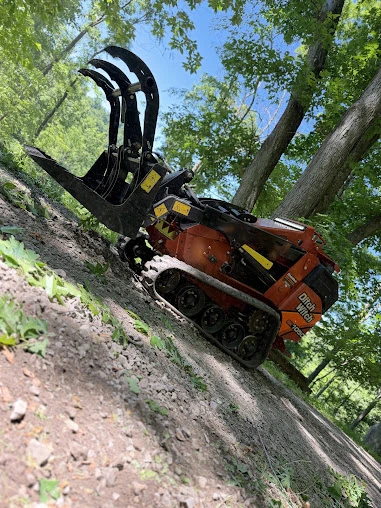
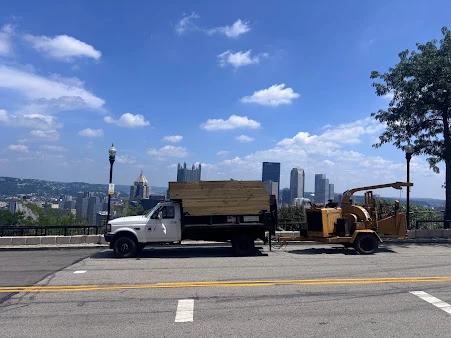
Our own equipment on our own jobs around Pittsburgh. The wood leaves with us.
Thirty years of volunteer growth along the rivers
The industrial spine of this region runs the Allegheny and the Ohio, and a lot of those parcels have been half-idle since the mills changed hands. Give a riverfront yard three decades without a mower and you get a genuine young forest: knotweed and box elder first, then cottonwood and silver maple with root plates sitting in fill dirt and slag. In McKees Rocks and along the flats through Braddock we regularly clear ground where the last cut was somebody else’s business plan. Up in East Pittsburgh the hillside parcels add slope to the same problem, so what grew in above a building has to come down without ending up on it.
Those sites usually split into two jobs. The first is a reclaim, a once-a-decade push that takes a parcel from woods back to usable ground, opens the fence line, and hauls out a real volume of wood. After that, an annual perimeter pass in the dormant season keeps it that way for a fraction of the effort, because the second-growth stuff cuts easy when it is three years old and turns into a project when it is fifteen. Plenty of plant managers do the big one once, put us on the calendar every winter after, and never think about it again.
Asked at the gate
What plant managers and facilities people want to know before they let a saw on site.
Trees have grown into our chain-link. Can that be fixed without replacing the fence?
Usually, if you catch it before the trunk has closed all the way around the mesh. We cut and remove the stem in sections and free the fabric by hand rather than pulling it. Where a trunk has fully engulfed the fabric, that panel is already compromised and you will need a fencing contractor after us. We will tell you which panels those are during the walk so nothing is a surprise.
What clearance do you cut to over our dock approach?
We clear approach lanes and turnarounds to full trailer height with working margin above it, so a loaded dry van never touches anything. Rail spurs get cut wider than the car itself because equipment sways. Tell us your tallest regular vehicle and we cut to that, not to a guess.
Can you work without shutting the yard down?
Almost always. We stage in one corner, cone off a work zone, and move it as we go, keeping your traffic pattern intact. On tight sites we put a spotter on the lane so trucks are never waiting on us. If a dock or gate genuinely has to be closed for an hour, we schedule that hour with you instead of announcing it.
Our rooftop units keep plugging with cottonwood fluff. Does removing trees actually help?
It helps a lot, though fluff travels. The trees within a hundred feet upwind of your roof are the ones filling your intakes and scuppers. Pulling those canopies off the building line and taking out the worst offenders cuts the volume dramatically. Your maintenance tech will still visit the roof in June, but with a rake instead of a plan.
Do you carry insurance and can you meet our contractor requirements?
Fully insured, and we send a certificate of insurance before we schedule anything. Site orientations, contractor packets, and sign-in procedures are all normal to us. Send whatever your safety department needs and we will have it back before the crew shows up.
Is this a one-time job or something we should budget every year?
Both, in that order. Overgrown parcels need a reclaim first, which is the heavy visit. After that an annual dormant-season pass around the perimeter, docks, and roofline holds the line cheaply. Set up a site walk and you will get an up-front number for the reclaim and a separate one for the yearly pass, so you can see the difference before deciding.
Get the treeline off your facility’s problem list
One walk of the property, one written price, one crew that signs in and gets out. Chris answers the phone himself, and the wood leaves with us the same day. In sawdust we trust.