
Penn Hills, Allegheny County
Taking trees down in Penn Hills
Chris takes every call here himself. Twenty-five years in the trade, insured, PA HIC #163598, and the truck leaves with the wood and the stump both gone. One visit.
Penn Hills gives us four different removal jobs depending on which part of the township the address is in, and they need four different plans. A plan-street maple with a driveway beside it is a morning. The same tree at the bottom of a hollow with no way in is a different day entirely, and the honest number reflects that.

The four removals we do here
Not a menu. These are genuinely the four calls that come out of this township, and the price and the plan change depending on which one you have.
The postwar plan maple
Rodi Road, Frankstown Road, and every street that filled in behind them. A builder put a shade tree in each front yard the same season the walks were poured, which means an entire block of silver and Norway maples hit sixty-five years old simultaneously. They outgrew the lot decades ago. The crown is over the roof, the surface roots have lifted the walk, and there is usually a co-dominant union eight feet up with bark trapped in it. These come down between the house and the road with rigging, and it is the most common removal we do in Penn Hills by a wide margin.
The hollow-edge blowdown
Every plan in the township eventually backs onto a ravine. Trees along that edge grew sheltered on three sides, so they never built low anchor roots on the downhill face. A wet spring and one gusty front and they go over whole, root plate lifting a slab of hillside with them. What is left is a trunk lying downhill and a wall of dirt standing up at the top. That job is rigged off standing trees and the wood has to come back up the slope, which is why it is not a street-removal price.
Standing dead ash toward the Plum line
Out where the lots get bigger the woods get closer, and the emerald ash borer went through years ago. Dead ash does not stay climbable. The wood goes brittle fast, and a tree that would have taken a climber two summers ago is now something nobody should be tied into. We take those from the ground or off a lift. If you have a standing dead ash leaning anywhere near the house, that is the one to move on rather than watch.
The forest edge behind a dead-end street
Half the plans here stop at a treeline instead of a cul-de-sac, so the last few houses have woods for a back yard. Those edge trees lean toward the light, which is to say toward the houses, and nobody ever planted or pruned them. When one of these comes in we look at the whole edge, because the tree leaning at your roof is usually propping up two behind it and taking it alone can make the situation worse.
How a removal actually runs
Chris walks the job before anything gets cut. Access decides most of the price, not the height of the tree. Can a truck get to it, is there a spot to drop wood, what is underneath, and how far does everything have to be carried. Two identical maples can be a two-hour job and a full day depending on the answers.
Then it comes apart top down. On a tight lot that means climbing and rigging each piece to a rope so nothing free-falls. Where there is room and the drop zone is clean we take bigger sections. If the tree is over the house and there is no good rope angle, that is when a crane earns its cost, because it lifts the weight straight up and out instead of swinging it across your roof.
Wood and brush leave the same day. The stump gets ground below grade before the truck goes unless you have asked us to leave it. You should not be looking at a pile in the yard a week later, and you should not need a second contractor to finish what we started.
What we need to know first
- Whether anything is touching a wire. Duquesne Light gets that call before we do.
- What is under the tree. Septic lid, gas line, pool, patio, the neighbor’s fence.
- Whether we can get equipment into the back, or if it is all coming out by hand.
- Whether the ground is soft. A hollow lot after a wet week changes the plan.
- If there is a fence or gate, how wide the opening is.
Why nobody can price this on the phone
People ask, and it is a fair thing to ask. The reason we do not give a number sight unseen is that the number would be wrong, and a wrong number helps nobody.
Height is the thing homeowners lead with and it is rarely the driver. A sixty-foot maple standing alone in a front yard with the truck twenty feet away is straightforward work. That same tree behind a fenced back yard, over a sunroom, with a hollow dropping away behind it, is a different job with different gear and a different crew size.
Send photos through the contact form and include one from far enough back to show what is around the tree, not just the trunk. That is usually enough to tell you whether you are in the range you were expecting. For anything on a structure or near a line, Chris comes and looks. You get an up-front number in writing before any work is booked, and it does not move afterward.
If the tree turns out not to need removing, we say so. Plenty of Penn Hills maples that look finished are a reduction and a deadwood pass away from another decade.
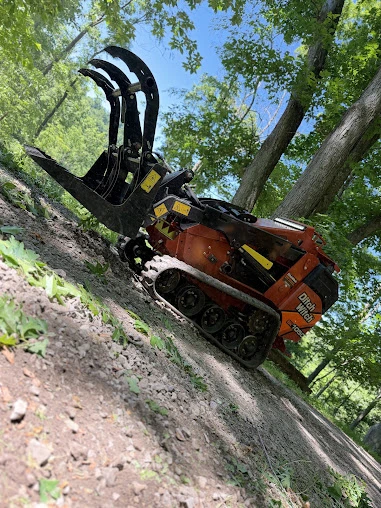
On a forest edge, one tree is rarely one job. Take out the leaner on its own and you hand the wind to whatever was standing behind it.
Chris, on forest-edge removals in Penn HillsAround the township, and what else runs with a removal
Most removals here finish with the stump ground out the same visit, and after a bad front a removal is usually part of a wider storm cleanup rather than a single tree. If something is on the house or across the drive right now, that is an emergency call, not a scheduled one.
We work the whole of Penn Hills weekly, from the plans off Verona Road out to the Plum line, and across Allegheny County generally. Neighboring work in Monroeville, Plum and Verona runs on the same schedule, so if your street has two or three trees due it is worth mentioning when you call. Photos of past work are in the gallery.
Penn Hills, Allegheny County. Plan streets, hollow edges, and the woods toward the Plum line.
Removal questions we get from Penn Hills
The ones that come up on nearly every walk-around here.
How fast can you get a tree out?
Scheduled removals in Penn Hills usually land within a week or two depending on the season and the weather. Anything on a house, a car, or a wire moves to the front of the line the same day. After a real storm the whole township calls at once, so structures and wires get stabilized first and yard trees follow. You will be told which of those you are.
Do you take the stump too, or is that separate?
Same visit unless you tell us otherwise. The grinder is on the truck. Most Penn Hills removals finish with the stump below grade and the hole backfilled before we pull out. If you are planning to replant or pour something over it, say so and we will take it deeper.
The tree is right on my property line and I am not sure it is mine.
This comes up constantly here, more than anywhere else we work. Ownership follows the trunk. If the trunk is on their ground it is their tree, but you have the right to cut what crosses onto your side. Chris will walk it with you and tell you plainly what can legally come off from your property, and if the only real fix is on their ground he will tell you that instead of selling you half a job.
My back yard drops into a hollow. Can you even get to it?
Usually yes, and this is a large part of the work here. It gets rigged off standing trees rather than dropped, and the wood comes back up the slope rather than out the drive. It takes longer than a street removal and the number reflects that, but a hollow lot is not a reason we turn work down. It is most of what we do on the ravine edges.
Is a dead tree cheaper to take down since it is smaller?
It is often the opposite. Dead wood, especially ash that the borer went through, is brittle and unpredictable. A climber cannot trust it, so the job may need a lift or a crane where a live tree the same size would have been climbed. Dead trees also fail without warning while you are waiting, which is the real argument for moving on them early.
Will your trucks tear up my yard?
We plan for it. On soft ground, and hollow lots here stay soft well into spring, we mat the route or carry wood rather than drive it. Anything that does get marked gets raked back. If the ground is too wet to work without wrecking it, we say so and come back, rather than leaving you a lawn worse than the tree.
Do you do the whole street if the neighbors want the same work?
Frequently, and it is worth asking. It is genuinely common on these plan streets for us to do three houses in a row because the neighbors watched the first job. Trees planted the same year come due the same year. Mention it when you call and we will look at the block together.
Have a tree in Penn Hills you want gone
Call Chris directly and describe it, or send a couple of photos with one taken from far enough back to show the access. You will get an up-front number in writing, and when the truck leaves the wood and the stump go with it.