
Lot clearing, McCandless
The woods took the back of the yard. We take it back.
Half-acre lots off Babcock and Cumberland were cut out of forest, and the forest never quite agreed to it. Saplings, brush and thin leaning trees creep in from the edge every year until the lawn stops well short of the property line. We clear that ground by saw and grapple, leave the good hardwoods standing, and hand you back an edge you can actually mow to.
Pick the keepers first, then cut
The quickest way to ruin the back of a lot is to clear it without deciding what it should be when we are done. Before a saw starts, Chris walks the tree line with you and sorts it one tree at a time.
The edge creeps for a simple reason. The last few feet of lawn sit in the shade of the woods, the grass thins out, the mower stops a little short, and saplings claim that strip the following summer. Let that repeat long enough and a yard that once ran to the property line ends at a wall of brush, with good trees buried somewhere inside it.
Every keeper gets marked, so nobody is deciding anything with a saw running. A good hardwood in a cleared yard looks far better than it did in a thicket, because you can finally see the trunk and the shape of the crown. If one of them has grown heavy over the house after years of crowding, crown reduction takes care of that, and a dead one leaning toward the roof gets handled as a hazardous removal on its own terms.
Usually stays
- Sound oaks, maples and other hardwoods with good form
- Trees giving you shade or privacy you would miss
- Anything holding a slope or a bank in place
Usually goes
- Saplings and brush crowding in from the edge
- Dead and dying trees, especially ash
- Vines pulling the canopy down
- Thin trees that grew up crooked fighting for light
One way in, the same way out
Clearing makes a lot of material, and every bit of it has to travel from the back of the lot to the street. That trip does more harm to a yard than the cutting ever does, so we lay it out before the first tree comes down.
The drop zone comes first: an open patch where trees can land without touching a keeper, the shed or the fence. Then the drag path, one route from there to the curb, as straight and level as the ground allows. Where the turf is spongy, plywood goes down along that route before the grapple loader or any wood crosses it, and the crew keeps to it all day.
Sometimes the only sensible route to the street runs along a neighbor’s side yard. When it does, we ask them before clearing day and tell them what will pass by and for how long, so the first they hear of it is not a loader idling next to their hedge.
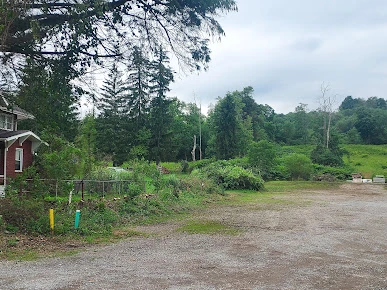
Brush feeds the chipper, logs are cut to length, and all of it leaves on the same line it came in on. By evening there is a single strip of lawn to rake. We hold to the same order on commercial ground, like the cleared lot in the photo, where the wood gets stacked at the edge for loading.

Grind it, or leave it in the tree line
Every tree that comes out leaves a stump, and a big clearing leaves a lot of them. Neither answer is right everywhere, so the call gets made stump by stump.
Ground below grade
Anywhere you plan to mow, walk, plant, set a shed or dig fence posts, the stump goes. The root flare on an old forest oak spreads far wider than most people picture, and no mower or post-hole digger gets along with it. The grinder takes it down under the surface and the hole gets backfilled with chips and soil. The stump grinding page covers the machine side.
Left where nobody will see it
Stumps back inside the tree line you are keeping are another matter. If nothing is going over them and nobody will ever look at them, leaving them costs you nothing, and they slowly rot away under the leaves. We will tell you that honestly instead of grinding every stump on the property because the machine happens to be on the truck.
Whatever you pick goes on the up-front number, so what you pay matches the stumps you actually chose.
McCandless, Allegheny County. The deep lots up here are a short drive up McKnight from our base in 15223.
Clearing for a fence, a shed, or just the yard back
Most clearing jobs up here start with a reason, and the reason sets how far we go.
A fence line
A fence needs a clean strip on both sides for the post holes and whoever is building it. We clear the strip, grind the stumps in it, and leave the woods beyond it alone.
A shed or a garden
Here sun matters as much as space. We look at which trees shade the spot through the afternoon and decide with you whether they come out or just get their crowns lifted.
An addition or a bigger patio
We clear the footprint plus the working room the builder will need and grind everything underneath. A large tree close to the house on that spot usually comes out by crane, which the crane removal page explains.
Just the yard back
The most common one. Nothing is being built, you are simply tired of the lawn shrinking every year. We push the edge back to where it used to be and leave a line you can keep with a mower and an occasional Saturday.
Leaving ground you can mow
Clearing is not finished when the last log leaves. The ground underneath has been shaded for years and torn up by roots coming out, and it needs some attention before it looks like part of the yard.
We rake out the leftover brush and small debris and fill the grind holes. The chips can be spread across the cleared strip as a mulch edge if you like the natural look, or they leave with the truck if you want grass. Ruts and low spots where roots came out get smoothed so the ground drains instead of holding water.
If the new ground is going to be lawn, we spread topsoil and seed before we pack up. Fresh seed on just-cleared ground comes in thin at first and fills in as it settles, so give it some patience. More finished work is in the gallery.
The keepers tend to notice the change before you do. Hardwoods that spent years shaded on one side start filling in toward the new light, and the ground under them dries out faster after a rain now that air can move through. That is one more reason we clear around them by hand and leave their root zones alone instead of scraping the whole back of the lot flat.
What people ask about the back of the lot
Most of these come up at the walk-through, standing in the brush.
Do I need to be home while you clear?
We need you for the walk-through, when we mark what stays and settle the stumps. On the day itself it is up to you. Most people check in at the start and again at the end, and Chris calls if anything turns up that would change the plan you agreed to.
Can you clear right up to my property line?
We clear to the line you can show us, from survey pins or your plot plan. If the line is unclear, we stop short of it rather than guess, because cutting a neighbor’s trees cannot be undone. Getting the line settled first is your call, and we are happy to wait for it.
What happens to all the wood and brush?
Brush goes through the chipper. Logs are cut to length and hauled away, or stacked out of the way if you want firewood. Chips can stay as mulch along the edge of the woods or leave with the truck. You choose before we start, and the choice goes on the paperwork.
Will the equipment tear up my lawn?
The loader travels one route we plan in advance, with plywood down wherever the ground is soft, and the crew keeps to it. Wet weeks are hardest on a yard, so if the ground is saturated we would rather move the date than leave ruts you will be looking at all summer.
Can you clear around a tree I want to keep without hurting it?
Yes, and that is most of the skill in this work. We drop trees away from the keepers, keep the loader off their roots as much as the lot allows, and avoid scraping their bark. A tree that spent years crowded by brush can also use a pruning visit once it has room.
When is the best time of year to clear?
Late fall through winter is easiest on the yard, because the leaves are down, you can see through the brush, and frozen ground holds weight better. We still clear all year, and a spring job leaves time to get seed down while the weather is mild.
Walk the back line with us
Send a photo of the tree line from the lawn through the contact page, or call and tell us how far the woods have come in. Chris will walk it with you, mark the keepers and put the up-front number in writing before anything gets cut. The full lot clearing service is described on its own page, everything else we do in town is on the McCandless page, and if the trees bothering you are the small ones by the patio, ornamental tree pruning is the gentler job.