
Wires change everything
Getting a tree back out of the line, once
A limb resting on the wire to your house is not a wait-and-see problem. Triple T is EHAP certified for line clearance awareness, we coordinate with the utility before anybody goes up, and we do not touch their energized conductors. Ever. What we do is get your tree off their equipment and keep it off.

Three different wires, three completely different rules
Almost nobody looking up at their backyard can tell you what they are looking at, and that is fair, because the pole above your alley might carry four separate things. The highest wires are primary distribution, usually thousands of volts, owned and maintained by Duquesne Light or West Penn Power depending on which side of the county you sit on. Below those runs the neutral. Below that, the service drop: the single triplex cable that leaves the pole and lands on the mast on the side of your house. And under all of it, sometimes, the cable and phone lines that carry no meaningful voltage at all.
Those are not versions of the same wire. They are four different jobs with four different sets of rules, and the entire reason this page exists is that most homeowners, and frankly a lot of tree crews, treat them as one hazard called “the wires.” Minimum approach distances are written per voltage class. A qualified line clearance crew keeps a specific distance from a primary conductor, and a general tree worker like most of the trade keeps a much larger one. We know which category we are in on any given day and we work to it.
The part we will never do, stated plainly
We do not cut, move, lift, tie back, or lean a ladder against an energized utility conductor. Not the primary, not the neutral, not your service drop while it is hot. That is the utility’s equipment and their crews’ work. There is no price that changes that answer and no schedule that makes it a reasonable idea. Anybody who tells you otherwise on your property is either unqualified or hoping you cannot tell the difference.
What we do instead is more useful anyway. We read the situation, tell you exactly which utility owns which wire above your yard, and then either coordinate a de-energization so the work becomes safe or tell you honestly that this one belongs to the utility’s own line clearance contractor and hand you the number to call. Chris has made that call for homeowners plenty of times. It costs you nothing and it beats guessing.
Coordinating a drop, then putting the power back the same day
Here is the move that most people do not know exists, and it is the reason this service is worth a page of its own. If the problem tree is tangled with the service drop feeding your house, that drop can usually be disconnected at the pole, laid down out of the way, and reconnected once we are finished. You call the utility, request a temporary disconnect for tree work, and they schedule a truck. The line comes down in the morning, we work the tree with the cable dead and on the ground, and their crew re-hangs and re-energizes before dinner.
You lose power for part of one day. That is the whole cost. In exchange, a climber gets to work a tree with real clearance instead of tiptoeing around a live cable, and the job gets finished properly instead of half-pruned around an obstacle. We help you make that request, we hold our schedule to whatever window the utility gives, and we are packed up before their truck comes back. It is the least dramatic way this kind of job ever goes.
The tree already lying on your service drop
This is the call we get most. A limb came down in a thunderstorm, it is draped across the cable to the house, the lights still work, and everyone wants to know why nothing has happened yet. The honest answer is that a triplex service drop is insulated, so a branch resting on it often does nothing visible for weeks. What it does do is abrade. Wind moves the limb, the limb sands the jacket, and somewhere between a month and a year later the insulation opens up and you have a live conductor touching wet wood in the rain.
It is also pulling. Sustained weight on that cable works the mast and weatherhead loose from your siding, and if the mast tears out, the repair stops being the utility’s problem and becomes yours, because everything from the weatherhead down is the homeowner’s equipment. That is a genuinely expensive surprise. So: do not pull on it, do not throw a rope over it, do not send anyone up a ladder. Call the utility and report a tree on the service line, then call us and we will be there for whatever the wire situation allows.
Who owns what
Utility: the pole, the primary, the neutral, the drop up to the weatherhead. Yours: the weatherhead, the mast, the meter base, and the tree.
EHAP certified, fully insured, PA HIC #163598, military discount, twenty five years of watching what wires do to trees around here.
Clearance work in the gallery. For the yearly cycle instead of the one-time fix, read power line tree trimming, and for a limb on the wire right now, emergency tree service.
“Christopher and his crew arrived on time, worked safely and efficiently, and handled the entire process with real professionalism.”
Felicia Provenzano, Google reviewSplitting a clearance job between three parties
You, us, and a utility that has its own truck schedule. Everybody has a lane.
Your part
Send a photo from the ground, wide enough that we can see where the wire leaves the pole and where it lands on the house. Tell us who bills you for electric. If a disconnect is needed, you place that request since the account is in your name, and we will tell you exactly what to say.
Then keep everyone away from it until somebody with the right training is standing under it.
Our part
Identify every conductor above the work and set the approach distance we are held to. Decide honestly whether this is our job or the utility’s. Coordinate the drop window if there is one. Then dismantle the tree away from the corridor, piece by piece on ropes, so nothing swings toward the line on the way down.
Chip, haul, rake, and give the mast and weatherhead a look before we leave so you know what condition your own equipment is in.

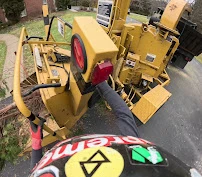
Our crew, our chipper, Allegheny County jobs. No stock library anywhere on this site.
Rural lanes, old poles, and the outage nobody had to have
The further out from the city you get, the longer the spans between poles and the more tree the wires travel through. Up in Glenshaw and Allison Park, a lot of service drops cross forty or sixty feet of mature canopy before they reach the house, and in Hampton Township plenty of them run down a shared drive under trees that were fifteen feet tall when the drive was cut. Every one of those crossings is a candidate for a January ice storm.
Clearing before the season is the cheapest thing on this whole list. When a loaded limb takes your drop down in an ice event, you are waiting behind every other outage in the county, in the dark, in February. When the same limb comes off in October, it is a morning of work and a bucket truck. Freeze and thaw here is relentless, wet snow loads silver maple and pin oak worst of all, and the limbs that break are almost always the ones you could already see leaning toward the wire.
The second reason to do it early is choice. Ahead of the storm we can prune for the tree’s health and still get the clearance, which usually means the tree keeps its shape. After the storm, whatever is left is what we work with. We would rather show up in the fall with a plan than in the dark with a saw, and either way you get an up-front number before anything starts.
Wire questions, answered straight
The ones people ask standing in the driveway pointing at their own roofline.
Do I call the utility or call you first?
If a tree or limb is touching a wire right now, the utility first, every time. Report it as a tree on the line, then call us. If the tree is only growing near the wires and nothing is touching, call us first and we will tell you whether a disconnect is worth requesting before we start.
What does EHAP certified actually mean for my job?
The Electrical Hazard Awareness Program is the tree industry’s training on how electricity behaves around trees: what conducts, what step potential is, how far away a worker has to stay from each voltage class, and how to recognize which wire is which from the ground. It means we know where the boundary is, and it means we stop at it instead of finding out the hard way.
Can you just move my service drop out of the way for an hour?
No. That cable is the utility’s up to your weatherhead, and moving it hot is exactly the kind of shortcut that gets people hurt. The legitimate version is a scheduled disconnect: they drop it, we work, they re-hang and re-energize the same day. We will help you set that up.
Who pays for the utility to come drop the line?
For a residential service drop, most local utilities do a temporary disconnect and reconnect for tree work at no charge to the customer, though policies change and the wait for a slot varies by season. Ask them directly when you request it. Our pricing does not change either way, and we work around whatever window they give us.
Is trimming the trees along the road the power company’s responsibility?
Along their right of way, yes, and Duquesne Light and West Penn Power both run cycle programs with their own line clearance contractors. Those crews clear the corridor around primary distribution, not the tree in your backyard hanging on the cable to your house. That gap between their corridor and your house is where our work lives.
What if the limb is on the cable and phone lines instead?
Communication lines carry no meaningful voltage, so the risk profile is different, but they hang on the same poles and can be difficult to tell apart from a service drop when you are looking up from the yard. We identify what we are dealing with before anything gets cut, and if it turns out to be a telecom line, the work is straightforward and the company gets a courtesy call.
Get it off the wire and be done with it
One walk-around gets you the up-front number, the map of who owns which wire above your yard, and a plan that either includes a scheduled disconnect or does not need one. One crew visit gets it finished. In sawdust we trust.