
A crew at your house all day
Taking a tree out of a yard people live in
Removing a tree at somebody’s home is half sawing and half being a decent houseguest. There are kids at the window, a dog who wants a job, a car in the driveway, and a lawn somebody mows on Saturdays. This page is about that side of it: what the day sounds like, where we put the trucks, how your yard gets covered, and what you and I walk over together before anybody drives away.
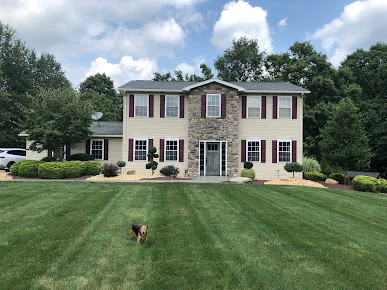
Strangers with chainsaws, in your yard, for eight hours
Most people hiring us have never hired tree work before. They found the number, they got a price, and now four guys they have never met are going to be twenty feet from the kitchen window with running saws while somebody’s toddler naps upstairs. That is a strange thing to agree to, and pretending otherwise does nobody any favors. So here is how we try to earn the eight hours.
Everybody on the crew wears the orange shirt. You will know at a glance who belongs in your yard and who wandered in off the street. Chris owns the company and Chris is on the job, not dispatching from a truck across town, so the person who gave you the number is the person you can grab mid-morning and ask a question. We do not sub the work out to whoever is free that week. Same faces, same standards, and if something in the yard gets bumped, the guy who bumped it is standing right there telling you about it.
Twenty five years in this trade teaches you that the sawing is the easy part. Being trusted around somebody’s house is the part that takes practice. Boots come off if we need to step inside. Cigarettes stay in the truck. Nobody parks on the grass without asking first. The radio stays off unless you tell us you want it on. Small things, but they are the difference between a crew you would call again and one you tolerate until they leave.
Before we roll in: five minutes of prep on your end
The night before, move whatever you would hate to see scratched. Cars out of the driveway and off the street directly under the tree, because we need the driveway for the chipper and the loader and we need room to swing the truck. If you park on the street in Oakmont or one of the tighter borough blocks, tell us and we will figure out the logistics beforehand rather than at seven in the morning.
Patio furniture, planters, the grill, garden gnomes, the good hose. Anything light and breakable within about thirty feet of the trunk should go in the garage. We move things ourselves when we have to, but you know where your stuff belongs and we do not.
Dogs and cats stay inside for the whole day, not just the loud part. A chipper is a lot of noise for an animal and gates get propped open when we are hauling brush. Same for the chickens, if you are one of those blocks. Tell us at the walk-around if a pet has the run of the yard and we will make sure the gate discipline is tight.
You do not have to be home. Plenty of removals happen while everybody is at work, and we text photos when it is done. But if this is your first time and being there would settle your nerves, be there. Watch from the window, come out between cuts, ask whatever you want. Nobody minds.
The short version
Cars moved, pets in, patio stuff stowed. That is your whole job. Everything else has a motor and belongs to us.
Insured, military discount for anyone who served, and an up-front number in writing before a saw starts.
Photos of finished yards live in the gallery. If the tree is the reason you are here but you are not sure it has to go, residential tree trimming is often the better answer, and the mechanics of the takedown itself are covered on tree removal.
“Chris was wonderful to deal with, beginning to end. He was excellent at communicating what he was going to do.”
Kellie Walker, Google reviewThe day, hour by hour, from your side of the glass
Roughly how a one-tree residential job unfolds. Yours will shift by an hour either way.
Morning
We show up between seven thirty and eight and the first twenty minutes are quiet. Trucks get positioned, the drop zone gets cleared, and somebody lays plywood or mats over the ground the loader will cross. Then the climber goes up and the saws start. This is the loudest stretch of the day, usually a couple of hours of limbs coming down and the chipper running in bursts.
If you work from home and have a call you cannot move, say so at the walk-around. We can often front-load the quiet work and push the chipper later.
Afternoon
Limbs gone, the trunk comes down in sections and the noise drops off fast. The last two hours are cleanup: wood on the truck, brush chipped, driveway blown, lawn raked, mats pulled up. Quieter than the morning by a wide margin, and by then most of the sky above your yard has changed.
Storm damage does not follow this schedule at all. That is emergency tree service, and it runs whenever the tree decides.
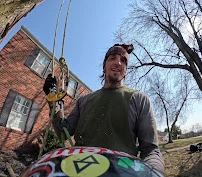

Left, Chris in the saddle, which is where he usually is. Right, the shop dog, who has never once helped and is welcome anyway.
Yards worth protecting, in neighborhoods built tight
Protecting the ground is most of what separates a good residential removal from a bad one. Wood is heavy and machines have tracks, so anywhere the loader travels gets plywood or mats first, and on soft spring ground we plank a road across the lawn rather than trust it. Sprinkler heads, septic lids, French drains, that one soft patch by the downspout: point them out during the walk-around and they get flagged before the first machine moves.
Then there is everything we work around. Swing sets, raised beds somebody has been fussing over since March, a fence the neighbor just paid for, the flagstone path, the koi. We rope pieces down into a drop zone we picked on purpose instead of dropping them where gravity would prefer. It is slower. It is also the reason we get called back to the same street.
The tighter borough lots shape all of this. In Blawnox a driveway is often the only staging we get, and in Aspinwall houses sit close enough that a limb has to come down on rope or it does not come down at all. The hillside properties around Oakmont add slope to the math, since wood rolls and a drop zone on a grade is not the same drop zone it would be on flat ground. We read all of that before we cut, not during.
At the end, before anyone gets in a truck, we walk it together. Around the base, along the fence line, across the lawn, down the driveway. If something got marked up, you hear it from us standing in front of it rather than finding it Sunday afternoon. That walk is the whole point of one and done.
What homeowners actually ask us
First-timers ask better questions than people think. These are the ones that come up on the porch.
Can my kids watch?
From inside, absolutely, and most of them do. A window seat is the best show on the block. Outside is a hard no while saws are running, because limbs bounce in ways nobody can promise, and a chipper is not something to be curious near. Between phases we are happy to come over and show them a saw with the chain off. Kids remember the day a tree came down, so we try to make it a good memory rather than a scary one.
How loud does it get, and for how long?
Loud, and mostly in the morning. Climbing saws are the constant sound and the chipper is the one you feel through the floor, but it runs in bursts of a few minutes rather than all day. Figure two to three noisy hours, then a long quiet tail while we clean up. If somebody in the house works nights or a baby naps at a set time, tell us and we will shuffle the order.
Where do all the trucks park?
The chip truck wants the driveway and the loader wants to be within reach of the wood. On a normal lot that is easy. On a tight borough street we may need a spot at the curb for part of the day, which we sort out at the walk-around, not by surprise on the morning. We never park on the lawn without asking, and on soft ground we would rather carry wood a little farther than leave you ruts.
What if something in the yard gets damaged?
You hear it from us the moment it happens, and we are fully insured with Honestly, most jobs end with nothing worse than flattened grass that stands back up in a week. Where things go wrong is when a crew hides it, so we do not. If a fence board cracks or a paver shifts, it goes on the walk-through at the end and we make it right.
Do I have to warn my neighbors?
A heads-up is a kindness and it costs you a text. If we need to rig over a shared fence or set a rope in their yard for an hour, we will ask them ourselves before we touch anything. Around here the neighbors usually wander over to watch anyway, and a fair number of our jobs come from the person two doors down who liked how the last one went.
How do I know what it will cost before I commit?
Chris comes out, walks the yard with you, looks at the tree and everything under it, and hands you an up-front number in writing. It does not move later and there is no charge for the visit. Set up a walk-around and you will usually have the number within a day or two, with no pressure to say yes.
One day at your house, then your yard back
Cars moved, dog inside, kids at the window. We come, we work, we walk it with you, and we go. You get a clean yard, a written number that did not move, and a crew you would let come back. In sawdust we trust.