
Paperwork, from the saw side
Insurance claim help from your tree crew, not an adjuster
Start with the part nobody else says out loud. We are not adjusters, we are not agents, and we do not negotiate anybody’s claim. We are the tree contractor. What we control is the evidence and the paperwork on our end of it, and done properly that is most of what makes a tree claim go smoothly instead of sideways.

The photos you will never be able to take again
Here is the single biggest thing a tree contractor contributes to a claim, and it happens in the first ten minutes on site, before one cut. Your adjuster is going to look at pictures. If the only pictures anybody has were taken after the crew left, then what the adjuster sees is a stack of firewood, a tarp, and your word about what used to be up there. That is a much harder file than one that opens with the tree still lying across the roof.
So we shoot it first. Wide frames that put the whole failure in one picture with the house for scale. Tight frames on the point of contact, where the trunk is actually resting on the structure. The root plate lifted out of the ground, which tells the story of a wind event rather than a rotten tree somebody ignored for a decade. The break itself, because torn fiber looks nothing like a saw cut and any adjuster who has worked storms knows the difference on sight. Then progress frames as the tree comes off, because the condition underneath only becomes visible once the weight is gone.
Those images go to you in a plain folder. You send them to your carrier, or you sit on them and never file at all. It is your file and your decision. We just make sure the evidence exists, because there is no version of this where you get to go back and photograph the tree on the roof after we have already hauled it away.
Writing a scope the way a carrier actually reads it
The second thing we contribute is how the work is written down. A one-line paper that says tree work with a single number at the bottom is a terrible document to hand a claims department. It gives an adjuster nothing to match against their own numbers, and vague paper gets slow-walked.
Ours breaks the job into the pieces the industry separates anyway. Lifting or cutting the tree off the structure is its own line. Felling and processing what remains standing is its own line. Debris haul is its own line. Stump grinding is its own line, and it is usually treated as landscaping rather than damage repair. Emergency make-safe work, tarping, and board-up are their own lines with their own dates. That split matters because in most homeowner policies the piece connected to getting the tree off the building is the piece the carrier engages with, while the yard cleanup and the stump often sit outside it. That is general homeowner knowledge, not policy advice from us. Your policy language and your adjuster decide what applies to your loss, and we will never tell you otherwise.
The invoice matches the scope line for line, and it carries what a claims file needs: your name and property address, the date of loss, the date we performed the work, per-task lines with their own numbers, and our license, PA HIC #163598. Chris has been in this trade 25 years and has watched the difference between a file that closes in ten days and one that drags into a second month. Usually the difference is the paperwork, not the tree.
Working around the adjuster’s clock instead of against it
Timing is where good intentions wreck claims. Two things are true at once: your policy expects you to prevent further damage, and your carrier wants to see the loss before it disappears. Those pull in opposite directions, and the resolution is sequence.
The genuinely dangerous part gets handled immediately. A trunk pinning a roof, a limb over the front door, an opening where rain is pouring into the house. That is emergency tree service, it runs 24/7, and it gets photographed to death on the way through so that nothing we do erases the record. Tarping and board-up get their own before and after frames plus a timestamp, because that specific work is often the easiest thing in the whole file to substantiate.
Then everything not dangerous waits. The brush pile in the side yard, the stump, the second tree with a cracked union, all of it can sit a few days until the adjuster has looked or told you to go ahead. Nothing is lost by waiting, and plenty is lost by clearing the scene at nine the next morning because it felt productive. When your carrier gives the word, we come back and finish it in one visit. One and done still applies, it just runs on two trips when a claim is in play. The bulk of that second visit is ordinary storm damage cleanup.
When filing is the wrong move, we say so
Not every tree that falls belongs in a claim, and pretending otherwise would be an easy way to sell bigger jobs. If the tree came down in the open yard and touched nothing, the work is usually cleanup and hauling, which lands in the same neighborhood as a lot of deductibles. Filing a claim to recover a couple hundred dollars over your deductible, and carrying that on your loss history, is frequently a bad trade for the homeowner.
When the arithmetic looks like that, Chris tells you plainly, hands you a straight up-front number in writing, and you decide with real information instead of hope. Ask him to compare your out-of-pocket figure against what the work costs and he will do it standing in the yard. Sometimes the honest answer is that the claim is worth every bit of the trouble, and then we get you documented properly. Either way you are getting the read of somebody who does this for a living and has nothing to gain from steering you.
What we hand you
Dated photos taken before any cut, from wide context down to the point of contact. Progress frames. A finished set once the property is clear.
An itemized written scope and a matching invoice: date of loss, address, per-task lines, license PA HIC #163598.
What we do not do: interpret your policy, tell you what is covered, or speak to your carrier on your behalf. That lane belongs to you and your adjuster. Insured, military discount, and the work itself is in the gallery.
“Christopher and his crew arrived on time, worked safely and efficiently, and handled the entire process with real professionalism.”
Felicia Provenzano, Google reviewTwo lanes, and we stay in ours
The claim is yours. The evidence and the paperwork are ours.
Your lane
Call your carrier and open the claim. Get the claim number and the adjuster’s name. Read your own policy or ask your agent what applies, because those are the two people qualified to answer it.
Take your own phone pictures too, from safe open ground. More angles never hurt a file. Then tell us what your adjuster wants and by when, and we will work to that date.
Our lane
Photograph everything before a saw runs. Make the property safe if it is not, and document that separately with times. Write the scope in itemized lines and price each one.
Invoice to match, with the detail a claims file needs. Answer factual questions about what we found and what we did, in writing, if your adjuster asks. Reach Chris here and he will send the whole packet over.

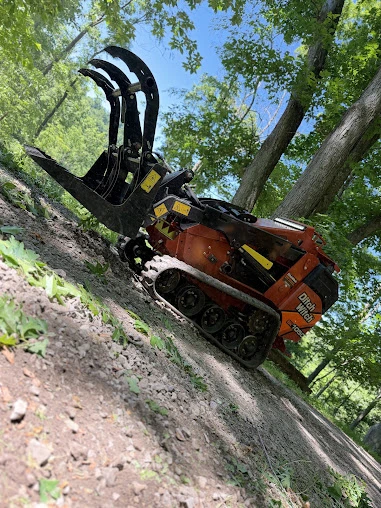
Every job that touches a claim gets shot at this range too: what was found, what moved, and what it looked like when we left.
Allegheny County claims have a local accent
Adjusters working this county see a specific set of tree losses, and knowing the pattern helps us write the file. Older boroughs east of the city put full-grown trees within a rope length of the roofline, so failures here tend to be direct structure hits rather than yard drops. That is the version where documentation matters most, because the covered piece and the cleanup piece have to be told apart clearly.
We document tree losses for homeowners across the area, Forest Hills and Churchill included, where hillside lots and mature canopy stack the odds toward something landing on something. Down in Swissvale the lots run narrower, so a single failure often crosses a property line, and then two carriers are looking at the same tree from opposite directions. Photos that clearly establish where the tree stood before it moved are worth a great deal on that kind of file.
Soil is part of the record too. Wet clay across this county lets a root plate tip on a wind that would not have bothered the same tree in August, and a photograph of the lifted plate with a boot next to it for scale reads as a weather event at a glance. That is the sort of frame a homeowner does not think to take at seven in the morning with a tree on the porch, and it is exactly the sort we take without being asked. If you would rather talk it through before anyone schedules anything, send us the details or call and Chris will tell you what he would document if it were his house.
Documentation questions
Answered as a tree contractor. For anything about your policy, ask your agent or adjuster.
Do you handle the claim for me?
No, and anybody in this trade who says they will is out of their lane. We are not adjusters, agents, or public adjusters, and we do not negotiate with carriers. We photograph, we write an itemized scope, we invoice with the right detail, and we answer factual questions about what we found. You and your adjuster run the claim itself.
Should I call you or my insurance company first?
If somebody is in danger or the house is open to the weather, call us first, because make-safe work cannot wait on a phone queue. Otherwise it is a coin flip, and plenty of people call both within the same hour. What matters more is that nothing gets cut or cleared before it is photographed.
Will my policy cover a tree on the house?
We genuinely cannot answer that, and it would be irresponsible to try. As a general matter people find that a tree striking a structure is treated differently from one that lands in the open yard, but your policy language, your deductible, and your adjuster decide your loss. Ask your agent. Our part is making sure the documentation is there for whatever they decide.
What exactly is in the packet you send?
Dated photos from before the first cut, through the work, to the finished property. An itemized written scope with tree-off-structure, felling, debris haul, tarping, and stump broken out separately. A matching invoice with your address, the date of loss, the work date, per-task lines, and PA HIC #163598. Plain files you can forward without editing anything.
My adjuster wants to inspect before anything moves. Can you wait?
Yes, and that is the normal rhythm. We do the dangerous part immediately with photos, then stop and leave the rest exactly as it is until the inspection happens or your adjuster releases you. When the word comes, we come back and finish the property in one visit.
What if the work costs less than my deductible?
Then filing may cost you more than it returns, and we will tell you that rather than let you find out later. Chris walks it, gives you an up-front number in writing, and you compare that figure to your out-of-pocket amount before deciding anything. Set up the walk-around and you will have a real number to work from.
Before you move that tree, let us shoot it
Ten minutes of photographs and an itemized scope written the way carriers read them. We stay in the contractor lane, you keep the claim in yours, and the property gets cleared once your adjuster says go. In sawdust we trust.