
Room underneath
Crown raising: lift the bottom limbs, keep the tree
You duck under the same branch every time you cut the grass. You back down the driveway with your neck craned because a limb sits right where the street should be. Crown raising fixes the underside of the tree and leaves everything above it alone, so you get your yard back without losing the shade you bought the house for.
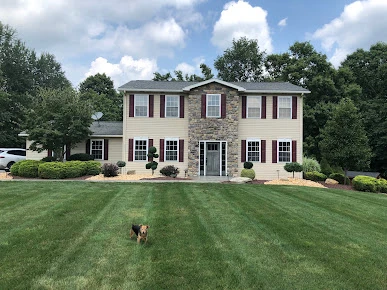
The lowest limbs are the ones ruining your week
Nobody calls about the top of the tree. They call because the mower deck hits a branch on the same pass every time, because a delivery driver has to walk sideways up the front walk, because the porch rail is slick with sap from something hanging four feet over it. All of that lives in the bottom eight or ten feet of a canopy, and all of it comes off in one visit.
Crown raising means exactly what it says: we take the lowest branches off the trunk and lift the whole underside of the canopy to a working height. Head clearance over a lawn usually lands around eight feet. Over a driveway or the apron where cars pass, we go higher, generally thirteen or fourteen, because a box truck and a wet spring branch have an ugly relationship. Street side, the borough usually wants clearance over the cartway too, and we cut to that number so the tree stops being a compliance problem.
Sightlines are the part people underrate until they live it. A single low limb on a corner lot can bury the whole approach when you are backing out, and drivers who know the street start swinging wide around your driveway. Lifting that one branch turns a blind exit into an ordinary one. Same story where a hedge line, a mailbox, and a maple all crowd the same ten feet of frontage. You do not need the tree gone. You need the bottom four feet of it gone.
Raise it too far and you build a top-heavy tree
Here is the rule the whole job rides on. A healthy tree keeps live branches on at least two thirds of its total height. If a sixty-foot oak has canopy starting at twenty feet, that is a two-thirds live crown and it is fine. Lift it to thirty and you have taken the tree past the line, and the tree pays for it: less leaf area feeding the roots, more weight concentrated up top, a taller lever arm every time a Pittsburgh gust comes across the ridge. Storm-damaged trees around here are frequently trees somebody lifted too aggressively a decade ago.
So we work to that ratio and tell you when your request crosses it. Sometimes you want fourteen feet of clearance and the tree can only give you nine without going top heavy, and the honest answer is nine now, more in three years once the tree has put on height. Twenty five years in the trade is mostly this: knowing which cut you can make today and which one has to wait for the tree to catch up. Chris will say it out loud on the walk-around rather than quietly overcutting to hit a number you asked for.
Young trees are the opposite problem and the better opportunity. Lifting a fifteen-year-old maple a little at a time, one or two limbs a season, gets you a tree with clean trunk clearance at maturity and no wound bigger than a coffee cup. Doing it all at once when the tree is forty is where the big scars come from.
Big bottom limbs are old wood, and old wood does not forgive
The branch closest to the ground is often the oldest branch on the tree. It has been there since the tree was a sapling, it has been thickening every year since, and on a mature silver maple it can weigh a few hundred pounds by itself. Cut that with one pass from underneath and it peels a strip of bark down the trunk when it goes. Cut it from the top and it snaps early and does the same thing.
The fix is old, simple, and non-negotiable on our jobs: three cuts. An undercut a foot out from the trunk, a top cut past it that drops the weight clean, then a final cut back to the branch collar with nothing left to tear. The collar is the raised ring where the branch meets the trunk, it holds the tissue the tree uses to seal a wound, and leaving it intact is the difference between a wound that closes in two seasons and a hole that goes soft. Flush cuts look tidier for a month and rot for twenty years.
On anything hanging over a roof, a fence, or a car, the piece gets roped and lowered instead of dropped. That is the boring version of the work and the version you want. Every raise ends with the brush chipped, the limbs hauled, and the lawn raked back to how you left it. One and done, in sawdust we trust.
What the crew brings
Climbing saddle and rope for anything above ladder height, pole saw for clean collar cuts on smaller stems, rigging line for limbs over a roof or a car, and a chipper so the brush leaves with us.
Fully insured, PA HIC #163598, military discount for those who served.
Lifted canopies and cleared walks are all over the gallery. If the whole canopy needs work rather than just the underside, start with tree trimming or crown reduction.
“Chris was wonderful to deal with, beginning to end. He was excellent at communicating what he was going to do.”
Kellie Walker, Google reviewA patio tree and a street tree get raised differently
Same technique, two completely different target heights and two different reasons.
Shade tree over a patio
Here you are buying usable space under the canopy. Eight to ten feet of clearance lets people stand, walk, and carry a tray without ducking, and it stops the low interior branches from dumping sap and seed onto the furniture. We keep the lift shallow on purpose, because taking too much off a patio tree trades the shade for headroom you did not need, and shade is the reason the tree is there.
The other half of a patio raise is picking which limbs go. Two limbs at the same height on opposite sides can look balanced and still leave you ducking. We take the ones actually in the way and leave the ones that keep the tree looking like a tree.
Street side and driveway
Clearance over pavement is a safety number, not a comfort number. Vehicles need roughly thirteen to fourteen feet, and municipal rules along the cartway around Allegheny County generally push the same direction. Sidewalk side we hold about eight feet so nobody walks into a branch in the dark.
Street trees also carry the sightline job: stop signs, corner approaches, the view up the block when you pull out of the drive. If wires run anywhere near the work, we sort out the utility side before a saw comes off the truck. Storm work jumps the queue day or night.
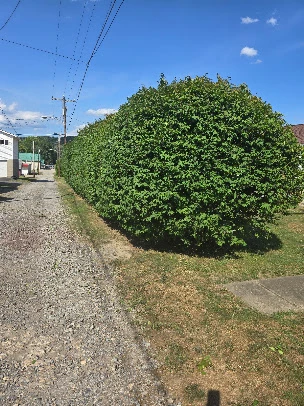

Our own crew, our own jobs. The cut face shows how heavy a low limb gets on a mature tree.
Narrow streets, deep porches, big old street trees
The east-end boroughs were laid out when trees were planted right at the curb, and a hundred years later those canopies hang over sidewalks that were never widened. In Churchill the lots are deeper and the problem is usually a shade tree that has closed in over a patio or a back walk. Down in Edgewood and Swissvale the houses sit close to the street and the low limbs end up over parked cars, over the mail carrier’s route, and over the corner where you need to see traffic.
Steep grade makes it worse. A branch that clears ten feet on the uphill side of a Pittsburgh lot can be at head height twenty feet downslope, which is why we measure clearance from the ground under the branch and not from the trunk. Tell us where you actually walk, mow, and park, and that is the map we cut to.
Crown raising questions
The ones that come up on the walk-around, answered straight.
How high can you lift the bottom of my tree?
As high as the live crown ratio allows. Live branches have to stay on roughly two thirds of the tree’s total height, so a forty-foot tree can carry clearance up to about thirteen feet and a young twenty-footer maybe six or seven. If your number is above what the tree can give, we tell you the honest ceiling and what it will be in a few years.
Will raising the crown hurt the tree?
Done at the right height with proper collar cuts, no. The tree keeps most of its leaf area and seals the wounds over a couple of seasons. Done too aggressively, yes: it starves the roots, makes the tree top-heavy, and sets you up for storm failure years later. That ceiling is the whole reason we measure before cutting.
Why not just cut the branch flush with the trunk?
Because the branch collar, that raised ring where the limb meets the trunk, contains the tissue the tree uses to close the wound. Cut through it and the tree cannot seal, so decay walks straight into the trunk. We cut just outside the collar every time, even though it leaves a small bump.
The lowest limb is huge. Is that a problem?
It is the reason we do it in three cuts instead of one. Big bottom limbs are usually the oldest, heaviest wood on the tree, and a single cut lets the weight tear bark down the trunk as it falls. Undercut, top cut, then a final trim to the collar. If it hangs over a roof or a car, it gets roped and lowered rather than dropped.
Can I get clearance for a truck or a camper?
Usually. Thirteen to fourteen feet is the working target over a driveway and most mature trees can carry it. Very often the fix is one or two limbs rather than a full lift around the whole trunk. Bring us the height you need to clear and we will tell you on the spot whether the tree can do it.
What does crown raising cost in Pittsburgh?
It depends on tree size, how many limbs come off, and what is sitting underneath them. Chris walks the property, reads the tree, and hands you an up-front number in writing before anything starts. Set up a visit and you will usually have that figure within a day or two.
Stop ducking under your own tree
One walk-around, one written figure, one crew visit, and the underside of your canopy is at a height that works for the mower, the driveway, and the front walk. In sawdust we trust.