
Big lots, big timber
McCandless has older trees than it has houses
The plans off Ingomar Road and Perry Highway were cut into standing forest, and a lot of what shades those backyards was already full grown when the foundations went in. That changes the work. In 15237 we are usually dealing with a white oak or a red maple that has been growing since before anybody drew a lot line, and there is a house sitting under it now.
Home base is in 15223, a short run down McKnight, so this town is on the regular route rather than a special trip. Removals, preservation pruning, stump grinding, storm response. Insured, military discount, and one crew that finishes what it starts.
What we do in McCandless
Every service on the truck runs here weekly. The links go deep on each one.
Removal
Large tree removal · Tree removal · 24/7 emergency response · Storm damage cleanup
Care
Tree pruning · Tree trimming · Cabling · Bracing
Health
Tree health · Disease treatment · Arborist services
Groundwork
Land clearing · Lot clearing · Brush clearing · Forestry mulching · Stump grinding · Stump removal
Commercial
Forest trees with houses under them
Drive the wooded plans between Ingomar and Perry Highway and you can read the history off the canopy. Builders in the sixties, seventies and eighties dropped colonials and split-levels into existing woods and left as much of it standing as the grading would allow. Those white oaks and red maples were mature timber then. Two generations later they are enormous, and the difference between a McCandless job and an inner North Hills job is usually forty feet of height and a trunk you cannot get your arms around.
Bigger lots also mean homeowners here keep trees longer, which we like. A tree that would have crowded a small postwar parcel still has room to breathe on a half acre off Babcock or Cumberland, so it stays, and it keeps adding wood. The tradeoff is that when one finally has to go, it is a serious piece of work. That is why so much of our schedule in this town is crane-supported removal rather than climb-and-rope alone. Setting a crane on a plan street takes planning, a look at the driveway and the turnaround, and a conversation with the neighbor whose curb we might borrow for two hours. We do that part before the day of, not during it.
Weather here has its own pattern. Cells track up the McKnight corridor and hit a whole plan at once, so the phone does not ring with one call, it rings with six from the same three streets. Original forest trees make that worse in a specific way: they grew up inside a closed canopy, sheltered by neighbors, and then the neighbors got cleared for lots. A tree that spent forty years leaning on the wind protection of the woods around it can be surprisingly exposed once it is standing alone in a side yard.
North Park sits right on the town’s shoulder, and people who walk it every weekend know what a healthy stand of mature hardwood is supposed to look like. Nobody in McCandless is impressed by a tree that has been topped. So a real share of the work here is preservation pruning: clearing deadwood, reducing end weight over the roofline, opening structure so a big crown moves with a storm instead of fighting it. Done right, it buys a good tree another twenty or thirty years, which is cheaper and better looking than replacing it. We work this way across Allegheny County, but the trees up here reward it the most.
The split-levels get their own version of the problem. On a split, the low roof off the back is often the closest thing to a mature crown on the whole property, and it collects everything the tree drops. We see gutters packed solid with oak tassels every spring, moss on the shingles that never dries because the canopy never opens, and limbs that have grown down to meet the roofline because that is where the light was. Lifting the crown off that low roof is a small job with a large payoff, and it is worth doing before the shingles start telling the story for you.
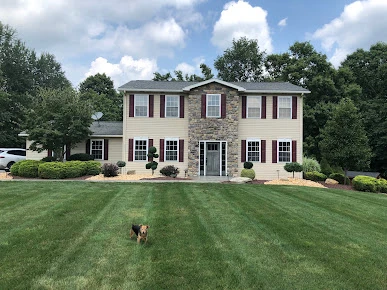
Access on these properties is its own puzzle. Deeper lots mean the tree we are after is often a hundred feet behind the house with a deck, a fence, a shed and somebody’s raised beds between it and the street. We plan the drop zone and the drag path first, put plywood down where the turf is soft, and take the brush out the way we came in. A rutted lawn is not a finished job. The photo at the top of this page is what we mean by that: the tree work is over and the only evidence left is that something used to be standing there.
Stumps get treated the same way. On the bigger parcels up here people often have room to leave one, and every so often that is the right call if it is out of sight in the tree line. But a forest-grown oak leaves a stump with a root flare wider than a patio table, and that is not something you mow around or plant over. Most McCandless removals finish with the grinder taking it well below grade the same visit, chips raked back into the hole, topsoil and seed if you want the lawn closed up. One trip, whole job, done.
“Chris was very responsive and transparent with the work scope and price. Work was executed according to the defined scope.”
Matthew Salac, Google reviewMcCandless questions
The things homeowners up here actually ask us. There is more finished work in the gallery.
My backyard oak is older than my house. Does that change anything?
It changes how we read it. A tree that came with the woods spent decades inside a closed canopy, so it often has a tall narrow trunk, a high crown and roots that never had to anchor against open wind. We check the root plate, the union of the main leads and how much the crown has spread since the lot was cleared. Some of those trees are in beautiful shape and need nothing. Others have been quietly overextending for years.
Can you get a crane into a plan street back here?
Usually yes, and we figure that out before the crew shows up. Chris walks the approach, the driveway grade and the turnaround, checks the overhead service drop and picks the set point. On the tighter cul-de-sacs we sometimes reach a backyard tree from the neighbor’s side with permission, which is a phone call we make in advance. If a crane genuinely cannot get in, we say so and we climb it out in pieces instead.
A storm just came through and half the street has limbs down. How does that work?
Cells coming up the McKnight corridor tend to hit whole plans at once, so we triage. Anything on a house, a car, a driveway or a wire gets stabilized first, and we photograph the damage for your insurance while we are there. The rest gets scheduled. Call (412) 526-2028 any hour, including the middle of the night, and you will get a real answer about when we can be on your street.
I would rather save the tree than lose it. Will you tell me that honestly?
That is most of what we recommend in this town. Deadwood out, end weight reduced over the roof, structure corrected, and a big healthy hardwood goes back to being an asset instead of a worry. We do not top trees and we will not pretend a removal is necessary when careful pruning solves it. Half the trees people call us in a panic about turn out to need one good visit and then nothing for years. If it does need to come down, you will hear the reason in plain words, and you will hear it before you are asked to decide anything.
What does a big McCandless removal cost?
Too many variables to guess over the phone. Height, spread, what is underneath it, whether a crane is coming and how far the debris has to travel all move the number. Send photos or book a walk-around and you will have an up-front number in writing before anybody starts a saw, with no surprises added later.
Got a McCandless tree you are watching too closely?
Call Chris or send a few photos. You get a straight read on the tree, the number up front, and a crew that leaves the yard cleaner than it found it. One and done. In sawdust we trust.