
Defect plus target
Hazardous tree removal, planned around the failure
A hazardous tree is a tree with a defect pointed at something you would hate to lose. The roof. The kids’ swing set. The service drop feeding your house. Triple T takes those trees down by working away from the weak part instead of through it, so the failure never gets to happen on its own schedule.

Three things have to line up before a tree counts as hazardous
People use the word hazardous for any tree that makes them nervous. In the trade it means something narrower, and the difference decides whether you should spend money on it. A tree qualifies when three conditions stack: there is a structural defect, there is a target the defect would land on, and the odds of that defect letting go are real rather than theoretical. Miss any one of the three and you have a tree that looks scary but is not actually a hazard.
The target part surprises homeowners the most. A hollow silver maple standing alone at the back of two acres is a wildlife habitat. Move that same hollow trunk twenty feet from a bedroom wall and it becomes a removal. Nothing about the tree changed. What changed is what sits inside the fall radius, and that includes the things that are only sometimes there, like the car in the driveway and the grandkids on the patio in July.
Likelihood is where honest experience earns its keep. Twenty five years on the saw teaches you which defects are patient and which ones are on a clock. A sealed old pruning wound on a healthy oak can sit there for another thirty years. A fresh crack running vertically out of a codominant union after a wind event is a different sentence entirely. We tell you which one you have, and we have talked plenty of people out of removals when the third leg of that triangle was not there.
The defects that put a tree on the list
Included bark is the quiet one. When two stems grow up tight against each other, the bark folds inward at the union instead of the wood knitting together, so the joint has no real fiber holding it. It looks like a strong V from the ground. It is a seam. Silver maples and Bradford pears all over the North Hills split right down that seam, usually in a summer storm when the canopy is fully leafed out and catching wind like a sail.
Cavities and hollows tell you the tree already lost the argument with decay somewhere. What matters is not the size of the hole but how much sound wood is left in the shell around it, and whether that shell is open on one side. A trunk with a strip of missing wall bends where the opening is. We sound the trunk with a mallet and read where the tone goes dull, because the visible hole is almost never the full extent of what the fungus took.
Root plate lift is the one people walk past for months. The soil on one side of the trunk cracks, mounds, or pulls away from the base, sometimes with a hairline gap you could slide a pencil into. That means the anchoring roots on the opposite side are already tearing. Pittsburgh clay holds water through spring, softens the grip, and then a saturated soil plus a good gust does the rest. A tree that has started to lift its own plate is not stable, and it will not settle back down.
Dead leaders over a target are the fourth pattern we see constantly. Pin oaks and ash die from the top down while the lower canopy still looks fine, so the homeowner sees a green tree and the crew sees forty feet of brittle wood suspended above the driveway. If the whole tree has gone, that is a different job with its own mechanics, and we handle it on the dead tree removal page. Here we are talking about live trees carrying a lethal part.
How the crew works around a defect instead of through it
Standard removal logic says climb the tree, tie into it, and use its own structure to lower the pieces. A hazard removal throws part of that out, because the structure is the thing we do not trust. The whole plan gets built around one question: if this defect fails while somebody is up there, what happens next?
So we rig away from the weak point. Rope anchors go above and beyond the defect on sound wood, or they go into a neighboring tree entirely, or they come off the crane hook and skip the tree’s own fiber completely. Loads get taken in smaller bites so the shock never travels down into the union we are worried about. On a trunk with a seam, we take weight off both sides evenly rather than unloading one side and letting the other one lever the crack open, which is exactly how a well-meant DIY cut turns a cracked maple into a fence problem.
Sometimes the honest answer is that nobody climbs it. A trunk that reads hollow on the mallet, or a root plate that has already lifted, cannot be trusted to hold a climber and a saw and dynamic rope loads at the same time. That tree comes down from a crane or a bucket, with the climber never putting weight on the failure path. Deciding that in advance is the actual craft, and it is why the walk-around matters more on a hazard tree than on any other job we do.
What Chris looks at
Union geometry, mallet tone up the trunk, soil around the root flare, deadwood over the target, and which way the whole thing wants to go without a rope on it.
Fully insured, and a military discount for those who served.
If you want the defect documented before you decide, that is a tree risk assessment. See the crew’s work in the gallery, or read large tree removal for the heavy-iron version of the same discipline.
“Chris is a real stand-up guy! His professionalism and honesty are exceptional. Just a great guy to work with.”
John Smith, Google reviewReading the tree, then taking it apart
A hazard job is mostly decided before anybody starts a saw.
Your part
Tell us what you have noticed and when. A crack that appeared after the last storm is different information from a lean that has been there since you bought the house. Photos of the base and the union help. Then move the vehicles and keep pets inside on the work day.
If the tree is touching a wire or already partly down, skip the walk-around and call. That is an emergency, day or night.
Our part
Walk the whole tree and the whole target zone. Sound the trunk, check the flare, judge the union, and find the failure path. Pick the method the defect allows, not the one that would be fastest. Set anchors on sound wood or off the machine, dismantle in controlled pieces, chip and haul, and rake the yard before we pull out.
You get the up-front number in writing after the walk-around, with the reasoning attached. Book the visit and we will show you what we are seeing.
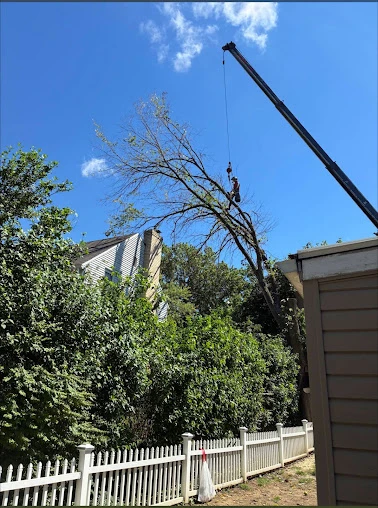
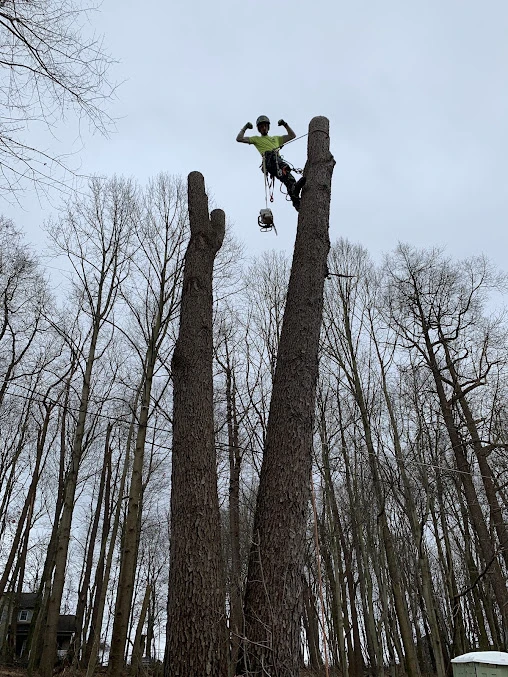
Left: the crane carries the load so the defective trunk never has to. Right: anchor set above the problem, not on it.
Why so many Allegheny County trees end up on this list
Two things stack against the trees here. The hillside lots put root plates on slopes where the downhill side has less soil to grip, and the neighborhoods built out in the fifties and sixties got planted heavily with fast species that develop weak unions as they age. In West View and Glenshaw we see the same silver maples reaching the end of that structural runway, one street after another. Up in Fox Chapel the trees are older and taller, so a single dead leader carries a lot further than it would on a smaller lot.
Add the freeze-thaw cycle working cracks open a little wider every winter, spring saturation loosening the anchor roots, and summer storms hitting a canopy in full leaf. That sequence is why so many failures here happen in June and July on trees that survived February fine. If something on your property has cracked, lifted, or started dropping wood on the driveway, have Chris look at it before the next round of weather votes on it for you.
Hazard tree questions
The ones that come up at the base of the tree, answered straight.
My tree leans. Does leaning make it hazardous?
Usually no. Plenty of trees lean their whole lives because they grew toward light or off a slope, and the trunk built extra wood on the compression side to handle it. The lean that matters is the new one. If the angle changed, or the soil at the base cracked and mounded, that is a root plate moving and it is a different conversation entirely.
Can a tree be hazardous while it still looks healthy?
Yes, and that is the most common version we get called for. Included bark at a union, internal decay behind sound-looking bark, and a lifted root plate all sit under a full green canopy. Health and structure are separate questions. A vigorous tree with a seam in its main union is more dangerous than a thin one with a solid trunk.
Do I have to remove it, or can it be reduced instead?
Sometimes reduction works. Taking weight and sail area off a defective leader lowers the load on the weak point and can buy real years, especially on a tree with sentimental value. It depends on where the defect sits and how much sound wood surrounds it. We will say so when that is the honest option instead of selling you a removal.
The tree is near power lines. Who handles that?
Depends on which wires. The service drop running to your house is generally yours, and we work it with the proper clearance and coordination. The primary distribution lines on the poles belong to the utility, and we get them involved before anything starts. We will tell you which category your tree falls into on the walk-around.
My neighbor’s tree is the one threatening my house.
Then the conversation starts with your neighbor, since the tree owner controls the work. What helps is documentation of the defect in writing, which is what a risk assessment gives you. Plenty of our hazard removals end up getting scheduled after two neighbors read the same report and split the job.
How fast can you get to a hazard tree?
If it is threatening a structure right now, call and we will move. Most non-urgent hazard removals get walked within a day or two and scheduled inside the same week. You will have the up-front number in writing before anything is booked, and one crew visit finishes it. One and done.
Let the tree come down on your day, not its own
Chris walks the property, points at the defect, tells you what it is aimed at, and hands you a number in writing. Then the crew shows up once and finishes it. In sawdust we trust.