
Out past the airport, where the map thins out
Findlay Township trees, from farm rows to loading docks
Findlay is the far end of our run and it looks like nowhere else we work. A mile of Imperial farmland with a hundred year old maple standing at the corner of a fencerow, and then you crest a rise and there is a million square foot distribution building with a landscape strip along the property line that nobody has touched since it was planted. Both of those are our phone calls. Both take different gear, and we roll out here with enough truck to do either one without a second trip.
Removals, pruning, acreage clearing, stump grinding and storm work in 15026 and 15108. Insured, twenty five years in the trade behind every read, and a military discount that gets used out here more than most places we go.
What we do in Findlay Township
Every service on the truck runs here weekly. The links go deep on each one.
Removal
Large tree removal · Tree removal · 24/7 emergency response · Storm damage cleanup
Care
Tree pruning · Tree trimming · Cabling · Bracing
Health
Tree health · Disease treatment · Arborist services
Groundwork
Land clearing · Lot clearing · Brush clearing · Forestry mulching · Stump grinding · Stump removal
Commercial
Farm trees meet freight country
The airport takes up a serious piece of this township, and what is left is a strange and honest mix. Imperial still has its village core with old shade trees over narrow streets. Around it sits the leftover farm ground, some of it still worked, most of it sold off in pieces over the last thirty years. And then along the Route 576 and the US 22 and 30 corridors you have the warehouses, the truck courts, the gravel yards and the parking fields that arrived in a hurry. A tree service that only knows suburbs gets confused out here. We do not, because we have been running this end of the county long enough to know which driveway will take a chip truck in March and which one turns to soup.
The farm remnants are the trees that surprise people. When a field gets sold and a house goes up on two acres of it, the trees that came with the ground are usually the biggest ones for a mile: a lone hedgerow oak that spent its whole life with no competition, a pair of hard maples that used to shade a farmhouse porch that is not there anymore, a black walnut that a farmer let stand. Open grown trees like that put on enormous low limbs because nothing ever forced them upward. That makes them gorgeous and it makes them heavy, and when a limb the size of most people’s trees decides to come off, there is now a garage under it that was not there in 1960. These are the calls where Chris walks it first, because half the time the answer is reduction and cabling rather than a removal, and the other half it is a genuine crane job.
Then there is the commercial side. Warehouse and campus properties out here carry tree lines nobody accounted for after the ribbon cutting: buffer plantings along a property line, a screening row between a truck court and a neighboring farm, volunteer growth crowding a retention basin or a fence. Five or eight years in, those turn into a liability item. Limbs over a trailer parking area, roots lifting a section of asphalt, dead ash still standing next to a loading dock. We handle that work as a scheduled maintenance run, done off shift so the docks keep moving, with photos and one invoice for whoever manages the site. That is what our commercial tree services actually look like out this way, and it is a solid share of our Findlay week.
Wind is the other Findlay fact, and it is the one people underrate. Out in the boroughs closer to town the hills and the housing break a storm up before it reaches you. Findlay has neither. You get long open runs of field and pavement, a front comes across with nothing in its way, and a tree that has never had to brace against much of anything catches the whole thing at once. Windthrow out here does not look like a broken limb. It looks like a full root plate tipped up out of wet ground with the tree lying across a driveway or a fence line. After every real blow we get calls from this township, and we answer them at any hour.
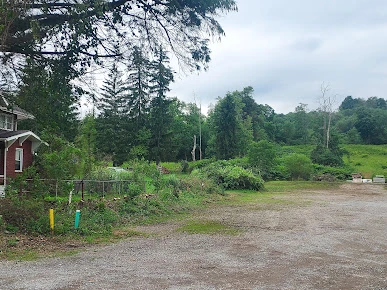
Acreage is the last piece. Plenty of Findlay properties run three, five, ten acres, and the back half is usually whatever grew in after the last time somebody mowed it. Homeowners call us wanting a pasture back, a building site opened up, a trail cut, or a fence line freed from thirty years of locust and multiflora rose. That is land clearing, and it is real machine work rather than a chainsaw and a good attitude. We walk the ground with you, agree on exactly what stays, and give you the number up front so there are no surprises when the tracks show up. Same one and done standard we hold everywhere else in Allegheny County, just with more room to work.
“I had a tree damaged by wind and close to falling. Triple T came out within an hour and cut it down.”
Peter Cardone, Google reviewFindlay Township questions
What folks out this way ask before we roll a truck. Plenty of finished work sits in the gallery.
You are based up in 15223. Do you actually come all the way out to Imperial?
We do, and we will be straight with you about how it works. Findlay is the far west edge of our run, so routine jobs out here get grouped rather than squeezed in. That usually means we give you a couple of days to pick from instead of a same afternoon slot, and it keeps the number down for you. Storm work is the exception. If something is down or leaning on a structure, call (412) 526-2028 and we come, distance included, no travel line tacked on the bottom.
We manage a warehouse property. Can you keep the tree line handled without shutting the docks down?
That is most of our commercial work out here. We schedule around your shift, stage off the truck court, keep the drive aisles open and clean up as we go rather than at the end. You get photos of the problem areas, an up front number for the whole scope, and one invoice. Dead ash next to a dock and limbs over trailer parking are the two we get called about most, and both are cheaper to handle on a schedule than after something lands.
There is a giant old maple left over from the farm on our property. Does it have to come out?
Not necessarily, and Chris would rather look at it than guess. Trees that grew up in an open field carry huge low limbs because nothing ever crowded them, and that weight is usually the real issue rather than the tree being unsound. A lot of these get end weight reduced and cabled and go on standing for decades. When the trunk union or the root flare says otherwise, we tell you that too, and we bring the equipment to take it down properly instead of dropping it and hoping.
A storm tipped a tree over roots and all. Why does that keep happening out here?
Open ground. There are fewer ridges and less housing to break wind out this way, so a front hits your trees at close to full strength, and saturated field soil holds a root plate about as well as wet sand. Tipped trees are our most common Findlay storm call. We secure whatever is threatening a building first, photograph the whole thing the way an adjuster wants it, then clean up on a schedule that suits you.
I want a couple acres opened back up. How do you price something that size?
By walking it. Acreage work depends on what is standing, how thick it is, whether the wood leaves or gets mulched on site, and whether a machine can reach without tearing up ground you care about. We flag what stays, agree on where the line is, and you get an up front number in writing before anything starts. Send photos or set up a walk of the property and we will get you sorted.
Got a Findlay Township tree or tree line to deal with?
Call Chris or send a few photos of what you are looking at. Honest read, the number up front, and a crew that finishes the whole thing in one go whether it is a farm maple or a half mile of property line. In sawdust we trust.