
Keeping the irreplaceable one
Preserving the tree that was here before the house
Every street has one. The white oak that shades three yards, the beech nobody could replace in a lifetime. Those trees almost never die of old age around Pittsburgh. They die because something happened at their roots and nobody noticed for three years.

Backhoes kill more old trees around here than storms do
People assume the danger to a big tree comes out of the sky. Wind, ice, lightning. In twenty five years of doing this the pattern is much duller than that. The tree that dies is the one somebody built next to. An addition, a new driveway, a pool, a French drain, a garage pad. The tree stands there through all of it looking untouched, and then it starts thinning from the top and by year four the crown is half gone and everybody wonders what disease it caught.
It caught a skid steer. A mature tree’s working roots are not a deep taproot going down into the ground, which is the picture most of us carry from a kids’ book. They are a wide, shallow plate, most of it in the top foot or so of soil, spreading out past the edge of the branches. That’s where the tree breathes. Drive loaded equipment across that ground a dozen times and the air spaces close, water sheets off instead of soaking in, and the roots suffocate slowly. Nothing bad happens the summer of the project, which is what makes this so hard to sell in advance. Year five you’re paying to take down a tree that a few hundred dollars of fencing would have saved.
Drawing the line before the equipment shows up
The protected area has an actual size, and it’s bigger than most people guess. The working rule in the trade is a foot of radius for every inch of trunk diameter, measured at chest height. A thirty inch oak wants a thirty foot circle around it left alone. On a typical Allegheny County lot that’s most of the backyard, which is exactly why the conversation has to happen before anybody is standing there with a machine and a schedule.
Then the fence has to be real. Orange plastic mesh on flimsy stakes gets flattened by the second delivery, because everyone on that site knows it means nothing. We set fencing that reads as a boundary, staked to hold, with the line explained to whoever is running the equipment. A contractor who understands why the line is there will respect it. One who found it there when he arrived will park inside it.
Inside that circle there are three rules and they are all absolute. Nothing drives on it or stacks material on it. The grade does not change, because a few inches of fill over roots smothers them just as effectively as compaction. And nothing gets trenched through it. If a gas line, a downspout drain, or a conduit has to cross the root zone, it gets bored underneath instead of dug through. A directional bore three feet down passes below the working roots and the tree never knows it happened. An open trench severs everything in its path, and that’s the side that dies back first. Where the excavation genuinely can’t be moved, cutting the root edge clean with a saw before the machine reaches it leaves a wound the tree can grow past. This pre-construction work sits alongside what we do on site preparation jobs, and on most projects the two get handled in one visit.
Pulling a stressed veteran back from the edge
Plenty of people find this page too late, because the tree is already thinning and the addition went up in 2021. That’s still workable more often than not. A tree in decline is running a deficit, and the job is closing that gap faster than it widens.
Compaction relief comes first, because it’s usually the actual injury. Compressed soil can be fractured open again, air and organic matter worked back into it, without tearing up the roots that are left. Then mulch, and here’s where almost everyone gets it wrong: a wood chip layer a few inches deep spread out to the drip line and beyond, kept well clear of the trunk itself. Not a volcano piled against the bark, which holds moisture there and rots it.
Then water, on a plan, through the dry stretch. A stressed mature tree in a Pittsburgh August needs a long slow soak out at the edge of the canopy every week or two, not five minutes of sprinkler on the lawn near the trunk. Feeding belongs in the sequence too, but only where the soil test says the tree is short on something, which is what deep root fertilization is for.
The last tool is pruning, and it’s the one that saves the most trees people had written off. When an old tree gets top heavy or starts dropping limbs, the reflex is to take the whole thing out. Retrenchment pruning does the opposite: it shortens the tree deliberately, over several visits across years, bringing the crown down and in toward a smaller, sturdier frame the tree can actually supply. It will keep a two hundred year old tree alive when the alternative was a stump. Where a specific weak union is the concern rather than overall size, hardware handles it, and that’s tree cabling rather than this.
The part where we tell you it isn’t worth it
Not every big old tree is a preservation candidate, and pretending otherwise would just be taking your money slowly. The honest checklist is short: how much live crown is left, whether the base is sound or hollow, whether the roots survived on all sides, and what’s standing underneath. A hollow tree in the middle of a field is a wildlife habitat. The same tree over your bedroom is a decision.
When the answers line up wrong, I say so. But a lot of trees that look terrible are simply thirsty, buried under too much fill, or choking in soil that got run over. Those come back, and nobody can tell which one you own from a photograph. Have Chris come look at it and you’ll get a straight answer along with what it’ll run.
What preservation work involves
Root zone mapping and staked protection fencing before construction, compaction relief and drip line mulching after, a watering plan through drought, and staged crown reduction on trees that need to get smaller safely.
Fully insured, 25 years in the trade, and a military discount for those who served.
Mature trees we’ve kept standing show up throughout the gallery. If what worries you is the tree’s overall condition rather than a specific threat, start at tree health care.
“Christopher and his crew arrived on time, worked safely and efficiently, and handled the entire process with real professionalism.”
Felicia Provenzano, Google reviewSplitting up the work of saving a tree
Preservation runs over years instead of one afternoon, so the division of labor matters more here than on any other job we do.
Your part
Tell us what the tree has been through. Was there a project? When? Which side of the yard did the machines come in from? Did the grade change? People forget the driveway got widened in 2019, and that one detail explains everything the tree is doing now. Then hold the line you paid for, and keep the watering going in a dry August, because that part only works if somebody actually does it.
Our part
Measure the trunk, map the root zone it needs, mark it on the ground where everybody can see it, and set fencing that holds. Talk to your contractor directly about what crosses that line and what gets bored under it.
On trees already in decline: relieve the compaction, mulch to the drip line, set a watering schedule, stage any crown work, then come back and check it.
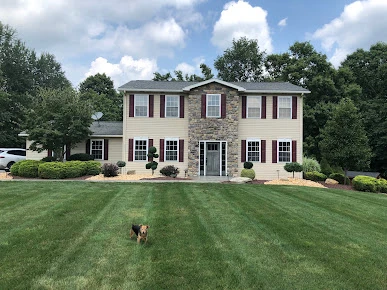
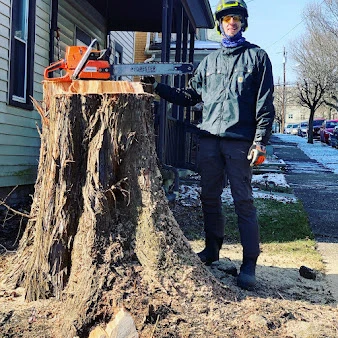
One yard where the big trees stayed, and one reminder of what these trunks measure when they don’t. Both our jobs, no stock library.
Riverfront boroughs, tight lots, hundred-year canopy
The older river towns north of the city are where this work matters most, because the trees are old and the lots are narrow enough that any project lands inside a root zone. Aspinwall is the clearest case: streets laid out over a century ago with sycamores and oaks nearly as old, on lots where a garage or rear addition sits well within thirty feet of a trunk.
Up the river in Sharpsburg the housing sits close together on flat ground near the Allegheny, and the pinch is access rather than space. A machine has one way into the backyard, and that path usually runs straight across the roots of whatever big tree is there. Over in Etna, the hillside lots bring drainage into it: a regraded slope changes where water moves, and a tree that was fine for eighty years suddenly sits either too wet or cut off from the runoff it had been living on.
Our soil doesn’t help. Allegheny County clay compacts hard and drains slowly, so it takes less traffic here than it would on sandy ground to close up a root zone, and it holds the damage longer.
Saving an old tree, asked plainly
The questions that come up standing under a tree somebody is trying not to lose.
How far out from the trunk do the roots actually go?
Farther than the branches, usually. The working rule we use for protection is a foot of radius for every inch of trunk diameter measured at chest height, so a twenty four inch maple gets a twenty four foot circle. Most of those roots are in the top twelve to eighteen inches of soil, which is exactly the depth a machine ruins.
My addition went up three years ago and the tree is thinning now. Is that connected?
Very likely, and the timing is the tell. Construction damage shows up three to five years later, once the tree burns through its stored reserves. That’s also the window where intervention still works: relieving the compaction, mulching wide, and watering through the dry months can turn it around if the crown is still mostly alive.
What’s wrong with the orange plastic fence my contractor puts up?
Nothing, if it’s staked properly and everyone on site knows what it means. The problem is that it usually isn’t and they don’t. We set fencing that holds and walk the line with whoever is running the equipment, because a boundary nobody explained is a boundary nobody respects.
The utility has to run a line past my oak. Are there options?
Yes, and it’s worth asking for. Boring under the root zone puts the line three or four feet down, below the working roots, and the tree never feels it. An open trench in the same path cuts everything it crosses. Contractors will often bore if the request comes before the schedule is set.
Can a big tree be made smaller instead of removed?
Often, yes. Retrenchment pruning shortens the crown in stages over several years so an old tree ends up with a smaller, sturdier frame it can support. It isn’t one visit and it isn’t fast, but it keeps trees alive that would otherwise come down for being too big and too tired. We’ll tell you honestly whether yours has enough live wood to take it.
How do I know if my tree is worth saving at all?
A tree past half dead with decay at the base is a removal that hasn’t been admitted yet. A thin, sad-looking tree in compacted soil is usually recoverable. Get Chris out to the property and he’ll tell you which one you’ve got, along with a written price for whichever way it goes.
The best time to protect that tree was before the project
The second best time is today. Whether there’s an excavator coming next month or a crown that’s been thinning since 2022, one visit tells you what the tree needs and what it’ll cost to do it. One and done. In sawdust we trust.