
Ross Township, Allegheny County
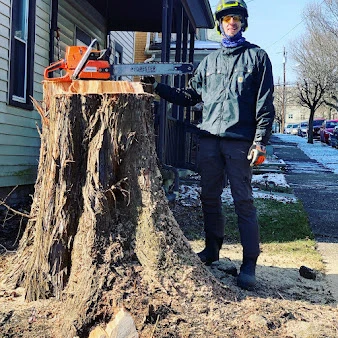
The stump is the part you still have to mow around.
A removal is not finished while a knee-high disc of hardwood is sitting in the middle of the lawn. On a postwar Ross lot there is nowhere to hide one, so most of our removals here end with the grinder on the same visit and the lawn closed back over.

How deep we take it depends on what you want the ground to do
There is no single correct grinding depth, which is why the first question is always what happens to that spot afterward. Grinding to the wrong depth for your plan means either paying for work you did not need or redoing it in the spring.
You want to stop looking at it
A few inches below grade, backfilled and leveled. The stump disappears, the mower goes over it, and nothing is growing back out of it. The cheapest version and the right one for a corner of the yard nobody is going to touch.
You are laying turf or seeding
Deeper, because grass needs actual soil, not a raft of wood chips. We take the stump and the flare roots well below grade so there is room to backfill with topsoil that roots can live in. Seed over shallow grindings comes up thin and yellow and then dies in the first dry week.
Something new is going in that hole
Deepest, and the most work. A new tree or shrub needs a real root zone, so the old stump, the flares, and as much of the major root plate as the machine can safely reach have to come out. We will also tell you plainly when the honest answer is to plant a few feet to one side instead.
Tell us the plan on the phone and the depth is in the number you get. If the tree is not down yet, the whole thing runs as one job with the removal rather than a second visit in a month.
Nobody expects how much material comes out of the ground
A grinder does not make a stump vanish. It turns it into a mound of coarse chips and soil, and the mound is bigger than the stump was, because ground wood takes up more room than solid wood does. A mature maple can leave a heap the size of a small car.
So the pile is a decision, and we make it with you before the machine starts rather than after. Most people go one of three ways: backfill the hole with it and crown it slightly to allow for settling, spread it across beds as rough mulch, or have us haul the surplus out on the truck.
Backfilling is free and it is what most Ross yards get. The catch is settling. Wood chips break down over a year or two and the spot sinks, so we leave it proud of grade and tell you to expect a dip you will want to top up with soil next season. If you are laying sod straight away, do not backfill with grindings at all. Get the chips off the site and put topsoil in the hole.
Before we arrive
Move the cars off the driveway if the stump is anywhere near it. Grinders throw debris and the wheel walks in on the drive.
Point out the sprinkler heads, the invisible fence wire, the septic lid and the buried downspout drain. Those are the four we hit most often and none of them are on a utility map.
Decide before the day whether you want the grindings. It is a two-minute conversation on site and a much longer one afterward.
Stumps wedged against a fence, a foundation or pavers
Ross lots were drawn close, and the trees that went in with the brick sixty years ago are now sitting on top of everything that got built afterward. The hard stumps here are rarely the big ones. They are the awkward ones.
Against a wooden fence
The wheel needs swing room, so a stump tight to a fence line usually means a panel comes off. That is a fifteen-minute job we do and put back, and it is far better than grinding blind at an angle and leaving half the flare in the ground.
Against a foundation or a wall
The grinder can work close, but there is a limit, and the limit is set by what is behind the wall rather than by the machine. We will not chase roots under a footer. What we can do is take everything on the open side and cut the flare clean at the wall so nothing resprouts.
Under a paver patio edge
Roots lift pavers, and by the time somebody calls, the patio is already humped. Lifting a few pavers, grinding, and resetting them is the clean version. Grinding from outside and leaving the root under the pavers just means the hump stays.
Finished grinds around the township are in the gallery, and the full service, including full stump grinding details, covers the same ground county-wide.
The machine does not know what is buried under the stump. That is why the call goes in before the wheel turns.
Chris, on locating utilities ahead of a grind
What is under there, and who finds out first
A grinding wheel takes out eight to twelve inches of soil in a pass and it does not care what is in that soil. Gas, water, cable, and electric service lines all run shallow through residential yards, and on lots this old the as-builts are often optimistic about where they went.
- The public locate happens before the machine does. Pennsylvania has a free one-call system for marking public utility lines, and it takes a few days, which is why a stump is almost never same-day work even when the tree was.
- Private lines are on the homeowner. Anything running from your meter to your garage, shed, pool, or lamp post was put in by somebody who did not file it anywhere. If you know it exists, tell us. If you suspect it exists, say that too.
- Irrigation and low-voltage are the usual casualties. Sprinkler heads, invisible fence wire, and landscape lighting sit two to six inches down, exactly where the wheel lives. Flag them and they survive.
- Old footings and buried concrete stop a grind cold. Postwar yards hide clothesline posts, patio slabs, and the odd buried step. Carbide teeth lose that argument, so if we hit one we stop, show you, and talk about the options rather than grinding through it.
Multiple stumps on one visit is the cheaper way to do this, by a wide margin. Getting the machine to your street is most of the setup, so the second and third stump cost far less than the first. Neighbors splitting a visit is a common arrangement on these blocks and we are glad to arrange it that way.
Ross Township, Allegheny County. Smaller postwar lots mean a stump you cannot mow around and cannot hide.
What people want to know before the grinder shows up
The practical questions, answered without a sales pitch attached.
Can I plant a new tree in the same spot afterward?
Sometimes, and it depends how deep we went and what is left of the old root plate. A grind done to planting depth leaves a workable hole once the grindings are out and topsoil is in. A shallow grind does not. Tell us the plan first and we will take it deep enough, or point out when moving a few feet sideways gives the new tree a far better start.
Why does the ground sink a year later?
Because wood chips decompose and lose volume. If we backfilled the hole with grindings, that mix will settle over a season or two and leave a dip. We crown it slightly on the day to allow for it, and the permanent fix is a wheelbarrow of topsoil next spring once it has finished dropping.
How long does one stump take?
Most residential stumps are well under an hour of actual grinding. The clock is really spent on access: getting the machine through a gate, matting a soft route, pulling a fence panel, or working around a patio. A wide, awkward, tight-to-a-wall stump can take an entire morning while a big open-lawn one is done before the coffee is cold.
Will the roots keep growing after the stump is ground?
No. Once the stump and the flares are gone, the remaining roots have no way to make leaves and they simply rot in place over several years. The exception is species that sucker aggressively, where shoots can come up from the root system for a season. Those get mowed or treated and they give up.
Do you have to grind, or can the stump be dug out?
Digging one out means an excavator, a crater, and a disposal problem, and on a small lot it usually wrecks more lawn than the tree was worth. Grinding leaves a contained hole and a manageable pile. We will talk about excavation when there is a real reason for it, like a foundation or a new driveway going in.
Can you grind a stump if the tree was taken down by somebody else?
Yes, and it is a decent share of the stump work we do. Send a photo with something for scale next to it, note whether a truck can reach the back yard, and you get an up-front number. It helps to know roughly how long it has been cut, because a stump that has been sitting for years is usually softer going.
One stump or five, the lawn closes back over
Call and describe what you are looking at, or send a photo with something beside it for scale and tell us what the spot needs to do afterward. You get an up-front number, the utility locate goes in, and the crew brings the machine that suits the access. Everything else we run in the township is on the Ross Township page, storm work is covered under cleanup and emergency service, and pruning on the trees you are keeping is under trimming. Reach us any day through contact.