
Where the yard ends and the woods start
Kilbuck trees don’t grow on flat ground
There is almost no such thing as a level lot in 15202 or the Kilbuck end of 15237. Houses here sit in the fold of a hillside off Camp Horne Road, tucked into ravines and hollows, with the back property line disappearing into standing woods. Most of what we take down in this township is not a yard tree at all. It is a forest tree that happens to be within reach of somebody’s roof.
That means slope work, rigging on grades where no machine can sit, and hauling brush uphill to a truck parked on a narrow drive. Insured, military discount, and a crew that finishes the job on the trip it started.
What we do in Kilbuck Township
Every service on the truck runs here weekly. The links go deep on each one.
Removal
Large tree removal · Tree removal · 24/7 emergency response · Storm damage cleanup
Care
Tree pruning · Tree trimming · Cabling · Bracing
Health
Tree health · Disease treatment · Arborist services
Groundwork
Land clearing · Lot clearing · Brush clearing · Forestry mulching · Stump grinding · Stump removal
Commercial
The wood line is the job
Kilbuck is one of the most heavily wooded townships left in the county, and that is the whole story of the tree work here. Somewhere behind almost every house there is a line where the mowed grass quits and the forest takes over. Homeowners tend to think of that line as the edge of their responsibility. In practice it is where the trouble starts, because a tree standing at the edge of the woods is in a stranger position than a tree in the middle of them.
Inside a stand, trees hold each other up. Crowns interlock, wind gets broken before it reaches any single trunk, and everything grows straight toward whatever light is left. At the edge, one side of that tree is exposed and the other is still competing, so it leans out toward the open yard, puts most of its weight on the house side, and roots into the shallow soil of a slope that was never meant to anchor a top-heavy crown. Then something dies at the wood line and stands there for two years while the owner assumes it belongs to the woods. That standing dead ash or dying oak is the single most common call we get out of this township.
The hillsides make it worse in a way that is specific to Kilbuck. These slopes move. After a wet spring, the ground along a bank shifts a few inches, and a shifting bank does not break a root plate cleanly. It loosens it. You will not see a crack or a hole. What you see is a trunk that used to look plumb and now looks slightly wrong against the door frame of the house, or a mulch ring on the uphill side that has quietly opened up. When we look at a suspicious hillside tree we get our hands on the base and check the soil on the high side, because that is where a failing root plate tells the truth first.
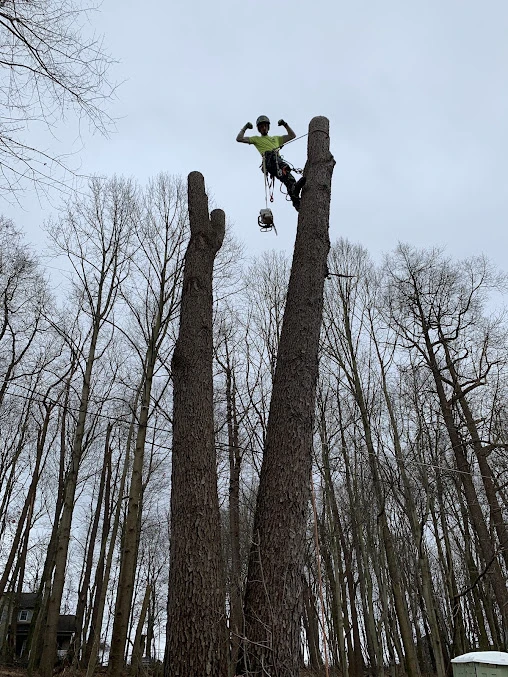
The other half of the puzzle is getting to it. Drives off Camp Horne and the roads that climb up from the boulevard thread under low canopy, run narrow, pitch downhill, and end in a turnaround that fits two cars and nothing wider. A chip truck cannot back a hundred and fifty feet down a wet ravine drive, and a lift cannot set up on a thirty degree grade. So most Kilbuck work is climbed. The climber goes up, the crown comes off in controlled pieces on rope, and every piece gets lowered instead of dropped, because on a slope anything that hits the ground loose will keep going until it finds a fence, a shed or a neighbor’s garage. Rigging on a grade is slower and it takes more line, more blocks and more planning. It is also the only honest way to do it, and we plan for it before the day of the job rather than discovering it in your driveway.
Seasons run differently against a wood line, too. In a mowed yard you notice a sick tree because it stands alone and the thin crown shows against the sky. At the edge of the woods it is camouflaged by everything behind it, so a tree can be half dead for two summers before anybody sees it. The tell is timing. A tree at the wood line that leafs out two weeks late, or goes bare in August while the stand behind it is still green, is telling you something about its roots. Late winter is the best time to walk your own edge, because with the leaves off you can read structure, dead leads, and which trunks have lost bark on the uphill side.
Brush handling is its own line item here. On a flat lot, drag distance is thirty feet. On a Kilbuck lot it is often uphill through a hundred feet of undergrowth to reach the chipper. We plan the drag path first, protect what we cross, and when it makes more sense we push the woods line back while we are already there. That is where brush clearing earns its keep in this township. Reclaiming fifteen or twenty feet of edge puts daylight and airflow back on the trees that are left, and it moves the next generation of leaners further from the house while they are still small enough to handle cheaply.
None of that means every tree at your wood line has to go. Plenty of them are simply large, and large is not the same as dangerous. What usually happens on a walk-around is that we mark two or three genuine problems, tell you the rest can stay, and put a plan on the ones that are borderline. When a removal is the right answer we say so plainly and explain what it is going to take on that grade. We work this way everywhere in Allegheny County, but on these hillsides being straight about access is worth more than anywhere else, because the access is most of the work.
“Chris was very responsive and transparent with the work scope and price. Work was executed according to the defined scope.”
Matthew Salac, Google reviewKilbuck Township questions
What people on these hillsides ask before we start. Finished jobs are in the gallery.
There’s a dead tree standing at my wood line. Is it my problem yet?
If it can reach the house, the driveway, a shed or a spot where people stand, it is worth dealing with now. A dead trunk at the forest edge holds together far longer than people expect and then lets go all at once, usually in the first heavy wet snow. Standing dead is also the easiest work we do to schedule, because there are no leaves to fight and nothing left to save. Waiting only makes the wood punkier and the rigging less predictable.
How do you take a tree down on a hillside where nothing can drive in?
It gets climbed and rigged. Chris sets the anchor points, the crown comes off in pieces sized so the rope can hold them, and every piece is lowered under control to a spot we picked in advance. On a real grade we also set a catch line downhill so nothing rolls. It takes longer than a wide open backyard drop and we tell you that when we quote it, but it is how the job gets done without leaving a scar on the slope.
My driveway is narrow, steep and goes under low branches. Can your equipment get in?
Usually, and we check before the day of the job rather than guessing. Chris walks the drive, looks at the pitch, the turnaround, the overhead service drop and where the chip truck can actually sit. Sometimes the answer is that we stage on the road and haul out by hand, which costs time but keeps your driveway and your lawn intact. If a ravine drive genuinely will not take our weight after a wet week, we say so and we come back when it will.
The dangerous tree might be past my property line. Who owns it?
Out here that question is real, because deed lines run through standing woods and almost nobody knows exactly where. We will tell you honestly if we think the trunk is off your parcel instead of quietly cutting it. In Pennsylvania you can generally trim what overhangs your side, but felling a trunk on someone else’s ground needs their say-so, whether that is a neighbor or the township. We have made those calls with homeowners plenty of times, and we would rather spend twenty minutes sorting it out than put you in the middle of a dispute.
What does a slope removal in Kilbuck cost?
The tree is only half of it. Grade, drag distance, how close the truck can park and whether the wood has to come uphill all move the number, so we do not guess over the phone. Send photos or book a walk-around and you will have an up-front number in writing before anyone starts a saw, with nothing added afterward.
Something leaning out of the woods at your house?
Call Chris or send a few photos from the deck. You get a straight read on the tree, the number up front, and a crew that carries the mess out instead of leaving it on the hill. One and done. In sawdust we trust.