
The corner you stopped walking into
Brush clearing for the back half of a Pittsburgh yard
The bramble bank behind the garage. The fence you can hear but can’t see. The honeysuckle that turned a side yard into a hedge maze. This is hand-crew work with a chipper parked at the curb, and it usually takes one day. You get a number before anybody pulls a cord.

Why the slope behind your house eats a fence in three summers
Half of Pittsburgh is built on a grade, and the borough lots show it worst. The house sits on the flat part, the driveway takes what’s left, and the last twenty or thirty feet fall away into a slope nobody has ever mowed. That slope is where brush starts. Not because anyone neglected it, but because you can’t push a mower up a forty percent bank and you were never going to.
So it fills in. Honeysuckle first, because it leafs out in March before anything else has a say. Then multiflora rose through the middle, then grape and porcelain berry pulling the whole mass together into something you could lean on. Around year three the chain-link at the bottom is inside it. People find that out when a neighbor mentions the fence, or when a post finally gives and the top rail is holding up a hedge.
Brush clearing is the fix, and it stays a hand job on ground like that. Saws and loppers working downhill, a hauling line up to the chipper at the street, and a crew that knows to cut vines at the base and again at chest height so the top dies off instead of hanging there. No machine is going on that bank, which is fine. Most of these are a morning to early afternoon, and we put the number in writing before the first cut so nothing drifts.
Cutting scrub without cutting the trees worth keeping
Every overgrown corner has a few things in it worth saving. A young oak or hickory that seeded itself and got lucky. A dogwood in the understory. A serviceberry the birds planted. They’re in there with the junk, the same height, wearing the same vines, and to anyone swinging a saw fast they all look like brush.
We walk it first and tag what stays. Chris does this himself on most jobs because it’s the part that can’t be undone. A tree of heaven or a mulberry comes out and nobody misses it. A twelve-year oak comes out and you’ve thrown away a decade you can’t buy back. Once the keepers are marked, the crew clears everything around them, strips the vines off their trunks, and leaves them standing in daylight for the first time in years. Half the time the property looks like it has trees now, because you can finally see the ones you had.
That’s also the honest line between this page and the bigger version of the work. If you’re taking a whole parcel down to open ground for a build, a fence run, or a pasture, that’s land clearing, and it comes with a grapple loader and machine time. Brush clearing is the smaller, more surgical cousin: yard scale, hand tools, selective, done in a day.
Knotweed along the creeks, and what cutting it actually does
If you back onto a run anywhere in Allegheny County you already know knotweed. Hollow jointed canes, heart-shaped leaves, eight feet tall by July, and a stand so dense nothing else grows in it. Girty’s Run, Saw Mill Run, every unnamed creek behind every borough street.
Here’s the straight version. Cutting knotweed does not kill knotweed. The rhizome network under it is the actual plant and it will push new canes. What cutting does is give you back the space above ground: your creek view, your yard line, your access to the bank. Kept on a schedule, a cut stand stays manageable instead of becoming a wall you gave up on. Anyone who tells you one visit with a saw ends it is selling you something.
What we will tell you is when to cut and how often, because timing changes how hard it comes back. And we’re careful about how the canes leave. Knotweed spreads from fragments, so we don’t drag a load of it across clean ground on the way to the truck.
The pile by the house is somebody’s living room
The other reason people call has nothing to do with looks. A brush pile within thirty feet of the house is habitat, and the tenants are groundhogs under the shed, rats in the woodpile, and deer bedding down where the bramble is thickest.
Clearing brush back from the structure breaks that. Open ground and daylight around a foundation are unattractive to almost everything that was living in the tangle. Same logic applies to the wood line at the back of a property, where pulling the brush edge back a few feet gives you a line you can actually maintain instead of a front that creeps closer every year.
What pulls up
A chipper at the curb, saws and loppers, pole saw for the vine work overhead, and a hand crew for the slope and fence-line cutting no machine can reach.
Fully insured, and a military discount for those who served.
Before-and-after corners are in the gallery. If the growth you’re pointing at is really a hedge or a canopy that needs shaping, start at tree trimming instead.
“Fantastic service! Would highly recommend! Very prompt and professional and did a great job cleaning up.”
Jamie Forrester, Google reviewSplitting up a brush day
Yours takes about ten minutes. Ours takes the rest of it.
Your part
Walk the edge with us and say where you want the new line. Point at anything that stays: a young tree, a bird feeder post, a bed you planted, the neighbor’s fence you’d rather we didn’t lean a ladder on. Say whether the chips stay or go. Approve the number.
If there’s a spigot, a drain, or a utility box somewhere under the tangle, mention it. Better than us finding it with a saw.
Our part
Read what’s actually growing there, because honeysuckle, bramble, and knotweed each get cut differently. Tag the keepers. Work top-down and downhill so the crew is never standing under what they’re cutting. Vines cut low and high. Everything to the chipper as we go instead of building a pile that has to be handled twice.
Then rake the cut ground, blow the walk and the drive, and haul what doesn’t stay. If a bad tree turns up inside the brush, we’ll price removal separately rather than sneaking it onto the bill.
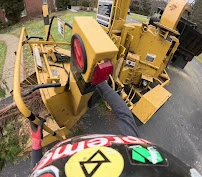
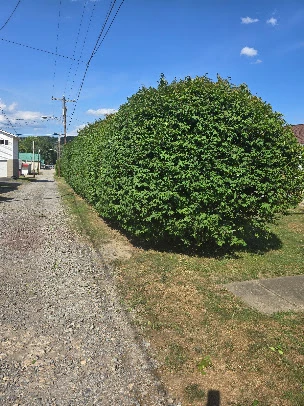
Our crew, our chipper, borough jobs a few miles from the shop.
Borough lots, and what grows on them
Brush work up here is shaped by how the boroughs were laid out. In Etna, the lots run narrow and long off the street and end in a bank, so the back third is almost always the overgrown third and the only way in is on foot through your own side yard. Millvale sits low along Girty’s Run, which means the creek-adjacent properties fight knotweed and jewelweed every season rather than the dry-bank bramble you get up top. Across the river in Swissvale, the older double lots often have a hedgerow down the middle that was somebody’s boundary in 1950 and is now twenty feet of tangle with a fence buried in it.
Access decides more than acreage. If we can get the chipper within a hose length of the work, a big corner goes fast. If everything has to be carried up a set of back steps, the same volume takes longer, and that’s the kind of thing worth seeing before anyone talks numbers. It’s also why we walk it instead of guessing over the phone.
On timing: late fall through early spring is the best brush season we get. The leaves are down so you can see the shape of what’s standing, the ground is firm enough to work a slope without tearing it, nothing is nesting in the thicket, and cut stems in the dormant season push back slower in spring. Summer clearing works fine and we do plenty of it, it’s just slower going through full leaf. If your job can wait for leaf drop, you’ll get more cleared ground for the same day of work.
Last honest note. Brush comes back. Anything you open up in western Pennsylvania wants to close again, so a cleared edge earns either an occasional mow line or a return cut every couple of seasons. We tell you which one your edge needs before we leave.
Brush questions
What people ask standing at the edge of it, before anything gets cut.
Where’s the line between brush clearing and land clearing?
Scale and method. Brush clearing is yard-sized and hand-driven: a bank, a fence run, a side yard, a corner behind the garage, cut with saws and fed to a chipper. When the job is a whole parcel, a build site, or anything needing a grapple loader and machine time, it becomes land clearing. Not sure which you’ve got? Neither are most people. We’ll tell you at the walk-around.
Can you get to a steep back slope?
Usually yes, and it’s a good part of what we do. Crews rope in and work downhill on banks where nothing on wheels belongs. What we check first is where the cut material goes, because carrying brush uphill is the slow part. If the chipper can sit at the street and we can run a path down, the day moves.
Do the chips stay or leave?
Your call, and it changes the number. Chipping on site and blowing them into a bed, a path, or the back of the woods line costs less because nothing rides away. Blowing them into the truck and hauling everything off leaves you bare ground. Plenty of people take chips on part of the property and haul the rest. Say which before the day and we’ll set up accordingly.
Will you cut down the fence you can’t see?
No. Buried fence, old posts, a wire run, a dog line, a well cap: we find those by working carefully rather than fast, and by asking you first. Tell us what you think is under there even if you’re not sure exactly where. We also stop short of a property line if the pins are fuzzy, because clearing onto a neighbor’s ground is not a conversation anybody wants.
What about poison ivy and ticks?
Both live in brush, so both come with the job. Poison ivy vines run up trunks in the tangle and we handle them, which is a real argument against doing this yourself on a warm afternoon in shorts. Ticks are worse in tall growth than short, which is one more reason clearing back from the house is worth doing. Our crew is dressed and equipped for it. You don’t have to be.
What does brush clearing cost?
It turns on density, slope, access, and whether the chips stay, so a phone number pulled out of the air would only mislead you. Chris comes out, walks the edge, and hands you an up-front number in writing. Set up a visit and you’ll usually have it inside a day or two.
Take the corner back this fall
One walk-around, one written number, one crew day, and you can see your own fence again. One and done. In sawdust we trust.