
Let it breathe
Crown thinning that lets wind and light pass through
A crown packed solid with growth acts like a sail. Wind pushes on it instead of moving through it, and the ground underneath never sees a patch of sun. Thinning is the fix: selective interior cuts, spread evenly through the canopy, that open the tree up without changing its height or its outline.

A packed crown is a mainsail with roots
Stand under a maple that has never been touched and look straight up. If you can’t find sky, neither can the wind. That solid wall of leaf and twig catches a gust the same way a mainsail catches it, and all of that push has to go somewhere. It goes into the branch unions, into the trunk, and eventually into the root plate. That is why the trees that come down in a Pittsburgh summer storm are so often the healthy-looking ones with the fullest canopies. They didn’t fail because they were weak. They failed because they refused to let the wind by.
Thinning spills the gust instead of catching it. When you take out a measured share of the interior growth, air moves through the crown rather than piling up against it, and the load on every union drops. The tree still looks like itself from the street. Same height, same spread, same shape. It just isn’t fighting the weather with a solid face anymore. Homeowners who watched a neighbor’s tree go over in a July squall usually understand this one without much explaining.
Which limbs come out is the whole craft. We work from inside the canopy, following each branch back to see where it goes and what it does. Growth that crosses another limb, growth headed back toward the center, water sprouts stacked on top of an old cut, doubled-up parallel branches feeding the same patch of sky. Those are the cuts. Anything that is carrying its own weight and holding its own space stays right where it is. Twenty five years of climbing tells you what to leave alone, which is honestly the harder half of the skill.
Grass will not grow in a basement
The other reason people call about a dense crown is what’s happening under it. A mature Norway maple in full leaf can hold a lawn at something like two percent of full sun. Turf grass needs a good deal more than that, so what you get is thin, patchy grass in June, bare packed dirt by August, and moss creeping in where the shade sits longest. People reseed that spot every spring for years and never once suspect the tree.
Thinning brings dapple back. Break up the solid canopy and light comes through in shifting patches all day instead of not at all, which is exactly the condition shade-tolerant fescue and the hostas and ferns under it were built for. It won’t turn a north-facing yard into a sun garden and we won’t tell you it will. What it does is move the ground from dead shade into working shade, and around Pittsburgh that is usually the difference between a lawn and a mud patch.
There is a bonus in it for the tree too. Air moving through a thinned crown dries the leaves faster after rain, and leaves that dry faster pick up fewer fungal problems. Tar spot, anthracnose, and the powdery mildews all like still, damp, crowded interiors. Opening the canopy is not a cure for anything, but it takes away the conditions those problems need. If a tree already has something going on, that is a conversation for tree health before it is a conversation about cuts.
What thinning is not
Thinning does not make a tree shorter or narrower. If height or spread is the problem, that is crown reduction, a different job with different rules.
It also is not general upkeep. Deadwood, structure, and timing live on the tree pruning page.
Insured, military discount for those who served. See thinned canopies in the gallery.
“Chris was very responsive and transparent with the work scope and price. Work was executed according to the defined scope.”
Matthew Salac, Google reviewEven spacing beats stripping every time
There is a fast way to make a crown look thinner and a right way to actually thin it. They are not the same, and one of them ruins the tree.
The shortcut
Lion-tailing. A crew strips the interior of every limb clean and leaves a tuft of foliage out on the end, because that reads as “thinned” from the driveway in about twenty minutes of work.
What it actually does is move all the weight and all the wind load to the branch tips, where the limb has the least leverage to hold it. The bare inner wood, never having grown in sun before, then scalds and sprouts. Those limbs whip in wind and snap.
What we do instead
Cuts get spread through the whole depth of the crown, inner wood and outer wood both, so foliage stays distributed along every limb from the trunk out. The limb keeps its taper and keeps its leverage.
We hold to 10 to 20 percent of live growth in a season, less on anything old or stressed, and we tell you before we start how much your tree can afford. Sometimes that answer is a lot less than you were hoping. Ask anyway and we will walk it with you.
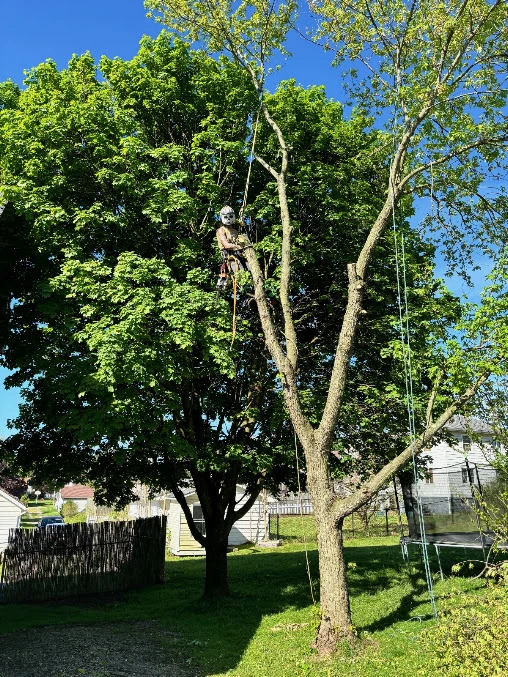
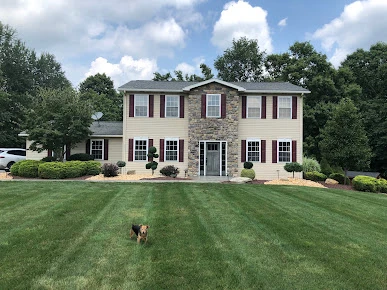
Left: sky visible through the interior, outline untouched. Right: what the ground looks like when light gets through. Our crew, our photos.
The species around here that grow too thick
Norway maple is the one we get called about most. It was planted up and down these streets for decades because it grows fast and takes city soil, and its habit is a dense, shallow, overlapping crown that shades everything under it into submission. A mature Norway is the classic no-grass-under-it tree, and it responds to careful thinning better than almost anything else we work on. Silver maple runs a close second, piling on interior growth quickly and then carrying that extra sail area on branch unions that were never all that strong to begin with.
Littleleaf linden gets thick and heavy the same way, especially the ones planted along driveways. Callery pear, still standing in a lot of yards from its planting boom, packs its branches so tightly against each other that thinning is partly about getting limbs to stop rubbing. Older sugar maples and beeches do not usually need it, and neither does a healthy oak, which is worth saying because plenty of trees get thinned that never should have been touched.
Around Wilkins Township and Forest Hills, postwar lots came with young shade trees that are now sixty and seventy years into filling in, so whole blocks hit the same density problem in the same decade. The tighter older lots in Wilkinsburg put those same crowns right up against porch roofs and neighboring properties, where a dense canopy means both a wind problem and a light problem at once. Wet clay soil and freeze-thaw winters mean the root plates here are already working hard. Taking some sail out of the crown is one of the few things you can do that helps both ends of the tree at the same time.
Thinning questions
What people ask once they’ve looked up and realized they can’t see sky.
Does thinning really help in a storm?
Yes, and the reason is simple. A solid crown behaves like a sail, so a gust pushes on the whole face of it and that force lands on the unions and the root plate. Open the interior and the same gust spills through instead of shoving. It is not a guarantee against a hundred-year wind, but it takes real load off a tree that has been catching every storm broadside for thirty years.
Will my grass grow back under the tree?
Usually it improves, and how much depends on how dark it was to start. Dense shade under a mature maple can sit around two percent of full sun, which no turf will live on. Thinning turns that into moving, dappled light through the day, which shade-tolerant grass can work with. North-facing yards and heavy clay will still fight you. We will tell you honestly if we think the tree is not the whole problem.
What is lion-tailing and why won’t you do it?
Lion-tailing is stripping the inside of every limb bare and leaving a puff of leaves out at the tip. It looks thinned from the ground and it is fast, which is why some crews sell it. It also shifts all the weight and wind load out to the branch ends where the limb has the least leverage, scalds the bare inner bark, and triggers a mess of weak sprouts. Lion-tailed limbs whip in wind and break. We spread our cuts through the full depth of the crown instead.
How much can you take out in one season?
10 to 20 percent of the live growth for a healthy mature tree, and we lean toward the lower end. Older, stressed, or recently transplanted trees get less than that or nothing at all. Leaves are how a tree eats, so pulling too many at once means it spends the next year putting out panic growth instead of building wood and roots. If your tree needs more opening than one season allows, we schedule it in stages.
Will I be able to see through the crown afterward?
You will see broken patches of sky scattered through the canopy, not a window. Done right, thinning looks like the tree from a week ago with more light in it, and most people notice the change on the ground before they notice it in the branches. If someone hands your tree back looking see-through and skeletal, too much came out.
What does crown thinning cost in Pittsburgh?
It depends on the size of the tree, how much interior work it needs, and whether we can reach it from a bucket or have to climb it. That is why nobody should give you a figure over the phone. Chris looks at the tree, tells you how much it can safely lose, and hands you an up-front number in writing. Set up a visit and you will usually have that number in a day or two.
Open it up before the next storm leans on it
One walk-around, a number in writing, and a crew that thins from the inside out and knows when to stop. In sawdust we trust.