
Lower limbs, big shade trees
Room to walk under it. Shade still overhead.
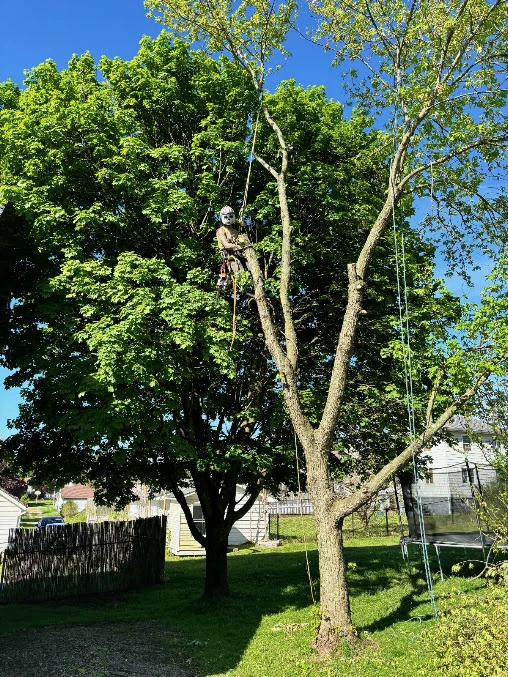
On a wooded Franklin Park lot the big trees came with the house, and nobody wants to lose one over a few low limbs. Crown raising takes off the lowest branches, the ones dragging on the roof or hanging over the driveway, and leaves the rest of the canopy right where it is. Same crew, same gear as a big removal, and every cut made where the tree can close it over.
The small-tree version: a weeping skirt lifted off the patio
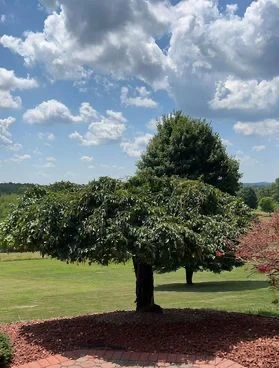
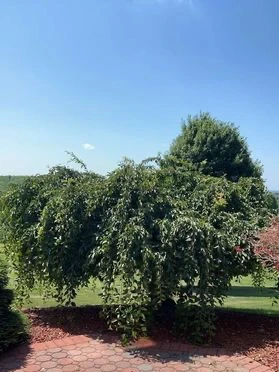
Both photos show one weeping ornamental, the finished job on the left and the starting point beside it. When we got there its hanging growth had reached the ground and spread over the bed and the brick patio in one solid mound. No trunk in sight, and nowhere to put a chair on that side of the pavers.
Raising a weeping tree is crown raising shrunk down to garden size. Nothing big gets cut. The curtain of hanging growth comes up by hand to a height that clears the pavers and the mulch ring, and the inside gets thinned so it does not drop straight back down by next summer. The trunk shows again, the bed can dry out between rains, and the tree still weeps instead of turning into a lollipop.
There are more jobs like this one in the gallery.
How much comes off, and exactly where each cut lands
The first thing people ask is how high we can go. Honest answer: as high as the job needs and no higher than the tree can afford. A tree feeds itself through its leaves. Strip too much of the lower crown in one visit and you are left with a tall bare trunk and a tuft of green on top, a tree that is short on food, catches more wind up high, and throws sprouts up and down the trunk trying to make up the loss.
So most of the height stays in living crown. On a young tree or one that is already struggling, we take a limb or two now and come back in a few years for the next ones. A big healthy oak or hickory usually has more room to give, but the rule does not change for it.
Where the cut goes matters as much as how many cuts there are. Every limb comes back to the branch collar, the slightly swollen ring where it joins the trunk or a bigger limb. Cut just outside that ring and the tree seals the wound over on its own. Cut flush into the trunk and you have opened a door for rot, and a stub left sticking out dies back and rots anyway. Heavy limbs come off in pieces with an undercut first, so the bark does not peel down the trunk when the weight lets go.
Our crown raising page covers the method in general. Up here there is one more reason to be careful: with the deer keeping anything new from coming up underneath, these canopy trees are the only ones the lot is going to get.
What you are clearing for sets the height
Before anybody climbs, we stand where you stand and look at what the limbs are actually in the way of.
- Over the roof
- Limbs resting on shingles or scraping a gutter wear the roof and drop debris straight into the downspouts. Those come back far enough that a summer of growth and a heavy snow will not bring them down onto it again.
- Over the driveway
- Enough clearance for whatever really uses the driveway, delivery trucks and plows included, so nothing scrapes a roof rack and nobody ducks on the way to the car.
- Along the road
- Franklin Park roads bend with the hills, and a low limb on the inside of a curve can hide oncoming cars from the end of a driveway. Raising those opens the sightline in both directions.
- Over the lawn and the deck
- Just high enough to mow under the canopy without a hand up over your head, and to sit on the deck without branches in the umbrella. Often the lightest lift of the bunch.
Edge trees that grew up sheltered
When part of a wooded lot gets cleared for a house or a driveway, the trees left at the edge suddenly take wind they never had to handle. They grew up tall and thin with neighbors all around them, and now there is open air on one side where the woods used to be.
Those are the trees we look at hardest on a wooded property. Raising the low side and lightening the long limbs that reach out over the clearing takes leverage off the trunk and lets wind move through the crown instead of shoving on it like a sail. We do not top them, and we do not strip them bare. When an edge tree is sound, careful work like this usually keeps it standing. When it is not, you hear that from us before you spend money pruning it.
Wind runs strangely through the plans here, funneling along the curved streets, so a look at your edge trees before a storm beats a cleanup after one.
A tree that grew up in a crowd has not learned to stand alone yet. The open side is where it shows.
When the low limbs are not the real problem
Sometimes the limb hanging over the house is the healthiest part of the tree. If the crown is dying back from the top, the trunk has a cavity, or the lean is worse than it was last year, raising it only tidies up a bigger problem. Chris will tell you that on the first visit instead of selling you a trim.
A dead canopy oak over a house comes down with crane support, never a climber, and that is large tree removal. A tree way back on the lot past the deck and the garden is difficult access removal. Once a tree is down, stump removal takes care of the root flare, and if the shrubs under the canopy need shaping while we are there, that is hedge trimming.
Franklin Park’s wooded lots, on the regular run out of 15223.
Before the low limbs come off: what people ask
Straight answers about the big trees closest to the house.
What is crown raising, exactly?
Removing the lowest limbs of a tree so there is clear space underneath for a roof, a driveway, a walk or a mower. Each cut goes back to where the limb joins the trunk or a larger branch. The upper crown stays full, so the tree keeps its shape and still shades the house.
How high can you raise the canopy?
As high as the job needs and the tree can afford. Most of the height has to stay in living crown, or the trunk becomes a long bare pole that takes wind badly and sprouts all over. Sometimes the right call is raising it partway now and finishing in a few years.
Will removing the lower limbs hurt my tree?
Done right, no. Each cut sits just outside the branch collar, the slightly swollen ring where a limb meets its parent, so the tree can seal the wound. The damage comes from flush cuts into the trunk, stubs left behind, or taking off so much at once that the tree runs short of leaves.
Can you raise a tree that hangs over the road?
Yes. On roads that curve with the hills, a low limb at the bend can block the view of oncoming cars or brush the top of a truck. We clear those over the pavement and the line of sight first, and keep someone on the ground watching the road while the limbs come down.
Is lifting a weeping tree off the patio the same job?
Same idea, smaller tree. On a weeping ornamental we bring the hanging growth up by hand to a height that clears the patio and the bed, instead of taking off whole limbs. The trunk shows again, the mulch can dry out, and the tree still looks like it is weeping.
When is the best time of year to raise a canopy?
Late fall through winter is easiest on big shade trees, because the branch structure is plain to see with the leaves down and the lawn is firm. A limb resting on the roof can come off any time, but on an oak we keep summer cuts to that and leave the rest for the dormant season because of oak wilt. A broken limb never waits for the calendar.
What are the branches hitting?
Take one photo from far enough back to get the whole tree, then one of whatever the limbs are touching: the roof, the driveway, the road at the bottom of it. Chris will look at both and tell you how much can safely come off now and whether anything should wait a few years. You get an up-front number in writing before anybody ties in. The rest of our work in the borough is on the Franklin Park page, and the contact form takes photos.