
North Hills, 15237
The oak stays. The weight over your roof comes off.
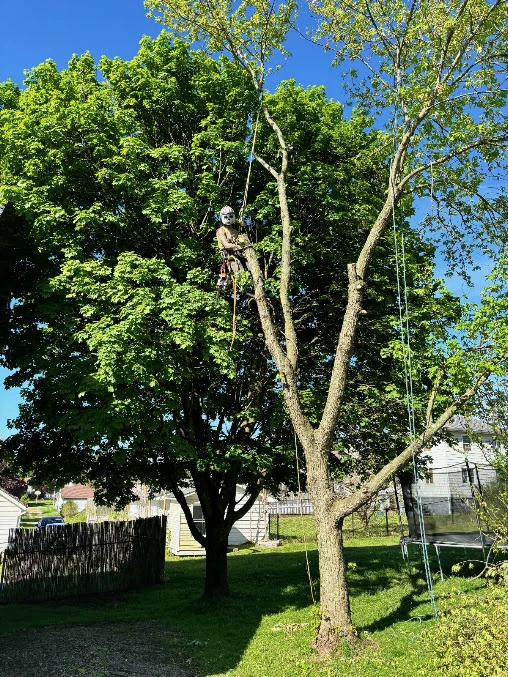
Most of the big trees in McCandless were standing before the house was, and most of them do not need to go. They need less wood hanging over the shingles, the dead limbs out, and a crown that can take a hard gust. Chris climbs it, reads it from the inside, and tells you plainly what one visit will fix.
Ten feet off the top is how a good oak gets ruined
Every so often a bucket truck rolls through the plan and somebody offers to take the top off your tree for a fast price. Say no and close the door.
What they are selling is topping: a cut straight through the stem at whatever height the boom reaches, with no thought for where the next limb is. The stub left behind cannot close over. It cracks, holds water and rots back into the trunk, and the tree answers with a thicket of quick, weakly attached sprouts that grow right back toward the height you paid to lose, only now they are hanging on by the bark.
People in this town walk North Park. They know what a mature stand of hardwood looks like when nobody has hacked at it, and a topped oak on a street off Ingomar Road stands out from a block away. A reduction gives you most of what topping promises, a shorter, lighter tree over the house, while keeping the thing that made the lot worth buying. It takes longer, because every cut is chosen from inside the crown by somebody tied in up there. Our main crown reduction page goes deeper on technique. This one is about how it plays on the big forest trees up here.
Shorter by way of the forks, never through the middle of a stem
A reduction cut always ends at a side limb big enough to take over as the new tip of that branch. That is the whole trick, and it is why a reduced crown still looks like the tree it was. Done this way, nobody driving past can tell where we were working, which is the point.
End weight first
The long limbs reaching out over the roofline carry their load at the far end, like a fishing rod with a brick tied to the tip. Shortening them back to a lateral pulls that weight in toward the trunk, where the wood is thick enough to carry it.
Deadwood out
Dead limbs in an old oak are the ones that come through a skylight in July. They get cut back to live wood and lowered on a line, a piece at a time.
Structure opened up
Crossing limbs, rubbing pairs and a crowded interior get thinned so wind can pass through. A canopy with some air in it flexes in a storm and settles back. A packed one acts like a sail and loads every union at once.
The split-level roof that lives under the oak
On plenty of McCandless splits, the lower roof off the back sits closer to a mature crown than anything else on the property, so everything the tree lets go of lands there first. In spring it is oak tassels, enough to choke a gutter run by late May. In fall it is leaves and acorns. All year the shade keeps the shingles damp, and moss moves in wherever the sun never stays long enough to dry them.
The limbs make it worse every season. Branches grow toward light, and on a split the open light is right above that low roof, so the bottom limbs drift down and out until they rest on the shingles or scrub them every time the wind moves. That rubbing wears the granules off, and a limb lying there is weight the roof was never framed to hold.
Lifting and reducing the crown over that roof is one of the most worthwhile half days we spend in this town. We shorten the limbs reaching down, raise the low edge of the canopy so there is daylight between the leaves and the roof, and take out enough interior wood that sun gets in again. The gutters will still catch some of what falls. They stop catching all of it.
Over the shingles, the deck and the beds, one rope at a time
Pruning a big tree over a house is mostly a rigging job. Nothing that comes off a crown above a roof gets dropped. Chris ties in above the work, the ground crew runs the lowering line, and each limb gets cut, caught and walked down past the gutters to somebody standing on the lawn. Over a deck or a raised bed it works the same way, because the plantings under the drip line are part of the job and a crushed hydrangea counts as damage.
Brush leaves the way we came in. Deep lots up here mean a long carry from the back of the house to the truck, so that path gets planned first and plywood goes down wherever the turf is soft. Wood gets chipped at the street, the lawn gets raked, and the gutters we just filled with sawdust get blown out before we leave. If the far end of the yard has filled in with saplings and brush under the big trees, clearing the back of the lot is its own job and pairs well with this one.
When a tree needs more than a crown can safely lose, or the lean is the problem rather than the weight, that is a different conversation, and our hazardous tree removal page is where it starts. A full takedown that needs a pick over the roof goes on the crane-assisted removal page.
One and done. We get it right the first time and I’m coming in here with professional equipment.
Chris, on how the crew works
What one careful visit buys a tree that was here first
A healthy white oak or red maple that gets its deadwood out, its end weight reduced and its structure opened up does not need us back the next spring. Done once and done properly, that kind of work tends to give a forest-grown tree twenty or thirty more years in the yard. That beats paying to take it down and waiting a generation for a replacement to cast the same shade.
How soon it wants another look depends on the tree. A quick red maple pushes new growth back toward the roof sooner than a slow white oak does, and a crown that was badly overgrown when we started may need a second pass once it has answered the first. Chris tells you what he expects for your tree before he comes down out of it, and if it still looks the way we left it when you call, you will hear that it can wait.
Pruning work across McCandless is on the regular route out of 15223, the same as everything else listed on the McCandless page. Finished crowns from around the North Hills are in the gallery.
McCandless, from Perry Highway out to the edge of North Park. Big trees on deep lots, a short drive from home base.
Before anybody climbs into that oak
What people ask when they would rather keep a big tree than lose it.
How much shorter will the tree be when you are done?
Less than the guy offering to top it would promise, and on purpose. A tree feeds itself through its leaves, so we take what it can afford to lose and stop there. On a big oak over a roof the real goal is weight off the limbs above the house, and the height change usually stays modest.
Isn’t reduction just topping with a nicer name?
No. Topping cuts straight through a stem wherever the boom happens to reach and leaves a stub that rots. A reduction cut stops at a side limb big enough to become the new tip, so the tree closes the wound and the branch keeps a natural form. The goal sounds similar. The tree comes out of it very differently.
Will it look like somebody hacked at it?
It should look like nothing happened. Every cut goes back to a fork inside the crown, so the outline stays rounded and natural, only smaller and lighter where it hangs over the house. Most people notice the extra daylight on the roof before they notice anything different about the tree.
The oak hangs over my neighbor’s yard too. Can you reduce just my side?
We can work the limbs over your house and yard. Before we start, we look at balance: taking weight off one side alone can leave a big crown lopsided and leaning on what remains. If evening it out makes sense, we say so, and a short conversation over the fence usually settles it.
My red maple has limbs lying on the roof. Can those come off first?
Yes, and on a split-level that is often where we start. Limbs resting on the shingles get shortened back to a lateral and lowered on a rope to the lawn. While Chris is up there he reads the rest of the crown, so you are not calling again next season about the limb beside it.
Can you do anything for a tree that somebody already topped?
Partly, and it takes more than one visit. We pick the strongest sprout at each old stub, take its competitors off, and slowly build something that reads as a real crown again. The rot inside those old cuts stays put, so you get a plain answer about how far that tree can be trusted.
Send a picture of the roofline with the crown above it
Stand at the street, take one shot of the house with the tree over it, and send it with a sentence about what is bothering you: the gutters, the moss, the limb on the shingles, how it moves in a storm. Chris will tell you whether this is a reduction, a lighter cleanup or something bigger, and you will have an up-front number in writing before anybody ties in. If the small trees by the front walk need attention too, ornamental pruning fits on the same visit. Reach us through the contact page or pick up the phone.