
Below the grass
Deep root feeding for trees stuck in a lawn
Your oak is living on about a third of what its ancestors got. We put liquid nutrition down under the sod, six to twelve inches into the compacted clay where the absorbing roots actually are, and we tell you honestly when your tree would do better with a bag of mulch and no bill at all.
A lawn is a terrible place to be a tree
Walk into any woodlot in Allegheny County and look down. There are two or three inches of half-rotted leaves on top, a spongy layer of older material under that, and beneath it all a network of fungal threads laced through soil you could dig with your hands. Every leaf that tree dropped for the last eighty years is still there, slowly turning back into food. Nobody fertilized it. Nobody watered it. It grew ninety feet anyway.
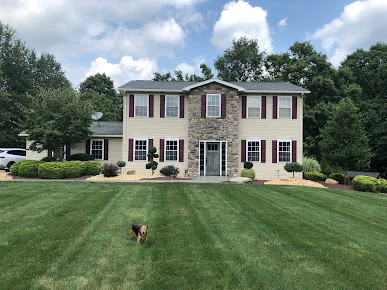
Now look at the same species of tree standing in a front yard in Shaler. Every fall the leaves get raked, bagged, and hauled to the curb, which means the nutrient cycle gets interrupted before it starts. The soil under it has been driven over by a mower once a week since the Carter administration, and clay compacts hard, going from something roots can push through to something closer to a driveway. There is turfgrass covering every inch of the root zone, and grass is very good at grabbing nitrogen and water in the top few inches before anything can get past it. Then somebody stacks mulch against the trunk in a cone, which is a whole other problem we fix for free while we are standing there.
That is the honest version of why deep root fertilization exists. Not because trees are needy. Because a yard is a stripped-down version of the environment they evolved for, and we are trying to put back a little of what got taken away.
What actually happens when we show up with the hose
Deep root feeding is liquid, and it goes in under pressure through a probe pushed down past the grass into the soil profile. Six to twelve inches is the target, because that is where the fine absorbing roots live on most mature hardwoods around here. The hair-thin roots doing the actual eating and drinking are shallower and wider than most people picture, spreading well out past the edge of the canopy.
So we work a grid, not a circle around the trunk. Injection points every two to three feet, following the drip line and pushing outward past it, because dumping everything at the base feeds the part of the tree that is not hungry. The mix carries nitrogen along with the minor elements Pittsburgh soils are frequently short on, and it goes in as a solution so it moves through the soil instead of sitting on top waiting for rain.
There is a second thing happening that nobody puts on the invoice. Every one of those injection points is a pressurized hole punched into packed clay, and the water blows out small fractures as it goes. You are getting a light aeration pass through the root zone at the same time the food goes in. On a tree whose main problem is compaction, that side effect is sometimes doing more good than the fertilizer.
When it earns the money, and when it does not
Here is where a lot of tree companies get vague and we would rather not. Feeding is worth doing when there is a specific reason the tree cannot feed itself. Construction stress is the clearest case. A new addition, a regraded yard, a driveway replacement, a trench for a gas line, anything that ran heavy equipment across the root zone or buried it under fill. Those trees usually look fine the first year and start thinning in the third. Getting nutrition and porosity back into that soil while the tree still has reserves is real work with a real payoff, and it pairs with the protective side of things on our tree preservation page.
Chlorotic pin oaks are the other classic around Pittsburgh. Leaves go pale yellow-green while the veins stay dark, usually starting in the upper crown. That is iron the tree cannot pull out of the ground, and it happens in alkaline pockets, which show up constantly next to foundations, along old lime-treated driveways, and anywhere fill dirt got brought in. The iron is often physically present in the soil. The pH has just locked it away where roots cannot reach it. Getting chelated iron into the root zone directly goes around the problem.
Newly transplanted trees make sense too, especially balled-and-burlapped stock that lost most of its root system in the nursery field.
And then the part we would rather say out loud. A healthy tree in decent soil does not need this. If your maple has a full crown, good color, and normal annual growth, feeding it is buying a solution to a problem you do not have. Worse, a tree that is failing from root rot or from soil that stays saturated needs less water and less nitrogen, not more. Pushing new growth on a root system that is already drowning is how you shorten a tree’s life while feeling good about helping it. When we get out there and find that situation, we say so, and the conversation turns into a tree health assessment instead of a sales pitch. Chris has been at this twenty five years and has talked more people out of treatments than into them.
What goes in the ground
A liquid nutrient solution injected on a grid under the drip line, six to twelve inches deep, with chelated iron and minor elements added when the tree’s symptoms call for them.
Fully insured, and a military discount for those who served.
See Pittsburgh trees we have worked on in the gallery, or read up on tree health checks and tree preservation when the trouble is bigger than nutrition.
“Absolutely a great worker! Professional and knowledgeable about our trees. Quick response time. 10/10 would recommend!!”
Erin Auvil, Google reviewMulch first, needle second
Almost every conversation about feeding a tree should start with the free version. Here is the order we actually recommend it in.
Start with a ring
Wood chips spread three inches deep, out as wide as you can stand to look at, and pulled back a few inches so nothing touches the bark. That single move suppresses the grass stealing the nitrogen, holds August moisture, moderates soil temperature, and rots down into exactly the layer the forest floor has and your lawn does not.
It costs a Saturday, and we will drop chips off if we are working nearby. Volcano-shaped mulch piled on the trunk does the opposite, so if yours looks like that, pull it back today.
Then the injection
When the ring is not enough, or when the tree is stressed from construction, transplant shock, or iron lockout, that is when the probe comes out. We read the soil and the symptoms first, set the grid under the drip line, and inject at pressure, working outward from the trunk.
Fall after leaf drop is the best window, when the tree is moving resources down instead of up. Early spring before bud break is the second-best. Mid-summer feeding during a drought is the one we will tell you to skip, and if a tree needs structural work too we will fold that into a pruning visit so you are not paying for two trips.

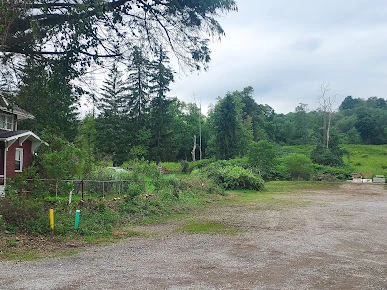
Left: fall canopy work, the season we prefer for feeding. Right: the kind of compacted, stripped ground that leaves nearby trees hungry for years.
Clay, coal fill, and old lime
Soil here is not one thing. Older streets in Shaler Township sit on heavy clay that seals up under decades of mowing, so compaction is the first suspect whenever a mature tree starts thinning. Down in Glenshaw we run into properties where fill was brought in during construction and the trees have been living in somebody else’s dirt ever since. Around Ross Township, plenty of yards were cut into hillsides, which means the topsoil that took ten thousand years to build got pushed somewhere else, and what is left drains fast and holds almost nothing.
Pin oak chlorosis follows the same map. Wherever concrete, mortar, or limestone base has been leaching into the soil for fifty years, the pH creeps up and iron goes out of reach. You will see it worst on the side of the tree facing the driveway or the foundation. That is not a coincidence, and it is one of the few problems a needle in the ground genuinely solves.
If a tree has been slowly getting thinner and you cannot point at a reason, walking the soil beats guessing at a treatment. Chris will do that walk and hand you an up-front number for whatever the tree actually needs, which is sometimes nothing.
Feeding questions
The ones homeowners ask once they realize the tree has a reason for looking like that.
Can I just spread lawn fertilizer around the tree instead?
You can, and it will mostly feed your grass. Granular product broadcast on turf gets intercepted in the top couple of inches, which is exactly the zone the lawn owns. It also tends to be heavy on nitrogen in ratios built for making grass green, not for a hardwood. Getting the solution down past the sod is the whole reason the probe exists.
How deep does the probe actually go?
Six to twelve inches on most Pittsburgh soils. Deeper sounds better and is not, because past about a foot you are below the absorbing roots on the majority of hardwoods and the material just leaches away. If somebody tells you they are feeding at three feet, ask what they expect to find down there.
When is the best time of year for it?
Fall, after the leaves come down and before the ground freezes. The tree is pulling reserves into the roots then and the soil is still workable. Early spring before bud break is the solid second option. We avoid feeding in the middle of a summer drought, because you are asking a tree to grow without the water to support it.
My oak has yellow leaves with green veins. Is that a feeding problem?
Very likely, and it is one of the few cases where injection is close to a direct fix. That pattern is iron chlorosis, common in pin oaks near foundations and driveways where the soil pH has drifted alkaline and locked the iron up. Chelated iron delivered into the root zone bypasses the pH problem. Expect improvement over a season or two, not a week.
How many treatments before I see something?
Trees run on a slower clock than lawns. On a construction-stressed or transplanted tree, the honest answer is one to two growing seasons before the crown reads noticeably fuller, and the first sign is usually better leaf color and longer shoot growth rather than dramatic new canopy. Anyone promising a turnaround by next month is selling.
What does deep root fertilization run in Pittsburgh?
It comes down to trunk diameter, how much root zone we are covering, and whether the mix needs iron or other correctives added. We do not guess at that over the phone. Chris walks the property, looks at the soil and the crown together, and gives you an up-front number in writing before anything happens. Set up a visit and you will have it in a day or two.
Find out if your tree is hungry or just sick
Those are two different problems with two different answers, and one walk around the property sorts out which one you have. If the answer is mulch and patience, we will say that. If it is feeding, you get a written number and one visit that handles it. In sawdust we trust.