
Bolted back together
Tree bracing that holds a split fork over Pittsburgh
A crack opened up in the crotch of your maple after the last storm and the tree is still standing. That is the window. Bracing puts threaded steel rods straight through the failing union so the two halves stop working against each other, and it only works if somebody drills it before the wood tears the rest of the way apart.

The crack you only notice once the wind stops
Most bracing calls start the same way. A storm rolls through Allegheny County overnight, you walk the yard in the morning expecting to find a limb on the driveway, and instead everything looks fine. Then a week later somebody notices a dark seam running down the middle of the trunk where the tree splits into two big leaders. It has probably been opening for years. The storm just moved it far enough to see.
That seam is a failing union. When a tree grows two trunks out of the same spot instead of one trunk with branches, the bark between them gets pinched inward rather than knitting together. Arborists call it included bark. It looks like a normal fork from the ground and it is actually two pieces of wood pressed against each other with no real connection, holding on by geometry and habit. Load them with wet snow, a full canopy of summer leaves, or one hard gust off the river valley, and the two halves lever apart at the base.
Bracing is the fix for that specific problem. We drill through the union and run threaded steel rods across the split, seated with washers on the outside, so the halves are physically bolted through each other instead of just leaning on each other. The rod carries the load the wood stopped carrying. Done at the right moment, it turns a tree that was going to peel open into a tree that stands for another twenty years, and it costs a fraction of what a mature hardwood removal and replacement runs.
Old apples, old maples, and the forks that give out first
Around here the usual patients are the trees that got planted for shade or fruit two or three owners ago and never had a pruning cycle. Backyard apples are the classic case. They fork low, carry heavy fruit loads out at the ends, and the crotch has been quietly widening every August since the Clinton administration. Silver and Norway maples do the same thing on a bigger scale, with unions six feet off the ground and thirty feet of leader above them. Bradford pears fail so predictably that we can usually tell you which side is going before we walk to the truck.
What all of them share is a low union under real weight. That is what puts a tree in bracing territory rather than something else. Rods go low, through the split, where the pulling apart actually happens. If the concern is movement up in the crown, two leaders swaying out of sync forty feet in the air, that is a different install and it belongs on the tree cabling page. Plenty of trees get both: rods bolting the union at the bottom, a cable higher up taking the sway out before it reaches the rods. That combination is more common than either one alone.
Timing is most of the outcome. A fork that has opened a quarter inch and is still holding sound wood on both sides is a straightforward install and a tree you keep. The same fork two seasons later, after the seam has run another foot down the trunk and started collecting water, is a removal with a bill attached and a hole in the yard where the shade used to be. Nothing about the tree looks dramatically different between those two visits, which is exactly why people wait. The crack does not get worse in a way you can watch. It gets worse on the days nobody is outside.
The honest part of this job is knowing when the hardware will not save anything. A union that has already torn through, sits over rot, or holds a leader that is dying anyway is not a bracing candidate. Steel through soft wood tears out, usually on the worst possible night. When Chris looks at a tree and tells you the rods would be throwing money at a removal you are going to pay for eventually, that is not a sales move. We would rather be honest once than come back for the cleanup twice. Have him take a look and you will hear whichever answer is true.
What goes in the tree
Threaded steel rod sized to the union, drilled through and seated with washers and nuts countersunk so the tree can grow over the hardware. Crown cable added above when the union needs the load taken off it.
Fully insured, PA HIC #163598, and a military discount for those who served.
See real climbing and hardware work in the gallery, or read up on tree health care if what worries you is the whole tree, not one fork.
“Chris was wonderful to deal with, beginning to end. He was excellent at communicating what he was going to do.”
Kellie Walker, Google reviewRods in a tree, start to finish
Two columns because there are two jobs here. Yours takes about ten minutes.
Your part
Call, or send a photo of the fork from twenty feet back so the whole union is in frame. Walk the tree with Chris and tell him when you first noticed the crack and what the tree has been through since. Say yes to the up-front number. Keep the area under the fork clear on install day.
After that, watch it. You are the person who sees this tree every day, so you are the one who will notice if the seam starts moving again.
Our part
Read the union before anything else: how far the split runs, whether there is decay behind it, whether the wood on either side is sound enough to hold a rod. Size the hardware to that specific fork. Climb, set position, drill straight through, run the rod, seat the washers, and countersink so the tree can close over the ends.
Where the crown is throwing extra leverage at the union, we take weight off with reduction cuts or run a cable above the rods so the steel is not fighting the whole canopy alone. If the tree took storm damage on top of the split, emergency response handles the urgent half first.
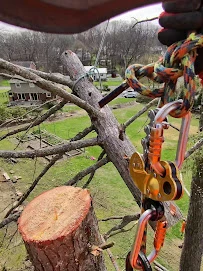

Our hardware, our cuts, our jobs around Allegheny County. Nothing borrowed from a stock library.
Why North Hills trees split where they do
The suburbs north of the city were built out fast, and the shade trees went in at the same time as the driveways. Fifty and sixty years later those trees are at the size where a weak fork finally matters. In McCandless we see it most in the big yard maples that were planted as saplings in new developments and never got a structural prune while they were young. Up in Hampton Township the lots run bigger and older, so the calls tend to be oaks and beeches with unions higher off the ground and a lot more canopy hanging on them. Along the river in Oakmont, the wind funnels differently and the trees behind the older homes take a harder sideways push than anything up on the ridge.
Yard layout matters as much as the tree does. A split maple standing in the open middle of a lawn is a very different conversation from the same maple with a garage under one leader and the neighbor’s fence under the other. The tree does not care which way it comes apart. We do, and so does your insurance company, so the trees sitting over something expensive move to the front of the line whether or not their unions look the worst.
Weather does the rest. Pittsburgh freeze and thaw works water into an open seam, ice expands it, and the wet spring clay lets the root plate move just enough to add flex where you least want it. Then July puts a full leaf canopy on top like a sail. A union that survived twenty winters can go in a single afternoon once that pattern gets far enough along, and it almost never goes at a convenient time or in a convenient direction.
Bracing, asked plainly
The questions people actually ask standing under the tree, answered the same way.
What is the difference between bracing and cabling?
Bracing is steel rods drilled through a union low in the tree, usually a split trunk fork, to bolt two halves together that have already started to separate. Cabling is flexible line installed high in the crown to limit how far leaders can sway. Rods stop separation, cable limits movement. Many trees are best served by both, and we will tell you which your tree needs.
Does drilling holes in my tree hurt it?
Less than the split does. A tree seals around a properly placed rod the same way it seals a pruning cut, and the wound is small relative to a union that is opening. The real damage comes from the tearing, not the drilling. What matters is that the holes are placed correctly the first time, which is why this is not a job for a cordless drill and a trip to the hardware store.
How long does the hardware last?
The steel outlasts most of us. What changes is the tree around it. Wood grows over the washers, decay can develop behind an old split, and load patterns shift as the canopy fills out. Assume the install is permanent and the tree is not, which is why a braced union gets looked at on a schedule instead of forgotten.
How often should a braced tree be checked?
Once a year is a reasonable rhythm, plus a look after any storm that does damage in your neighborhood. We are checking whether the seam has moved, whether the wood around the washers is sound, and whether the crown has put on enough weight to need reducing. Most years it is a five minute walk-around and nothing else.
Can you brace a tree that has already split badly?
Sometimes, and sometimes the answer is no. If the union has torn well down the trunk, if there is soft rot behind the split, or if a leader is dying independently, the rods have nothing solid to grab. Hardware in bad wood is worse than no hardware because it convinces you the problem is handled. We will say so directly when removal is the cheaper and safer road.
What does tree bracing cost around Pittsburgh?
It comes down to the size of the union, how many rods it takes, the climb, and whether the crown needs work on top of the install. That is not something to guess at over the phone. Chris walks out, reads the fork, and hands you an up-front number in writing before anything gets drilled. Set up a visit and you will have it in a day or two.
Catch the fork before it finishes opening
A split union is one of the few tree problems where waiting is the whole risk. Get eyes on it, get a number in writing, get the steel in while the wood is still sound. One and done, in sawdust we trust.