
The piece flies, it never falls
Crane picks that lift the tree off your house
A rope job lowers weight through the tree. A crane pick takes the weight out of the tree entirely, hooks it, and carries it over the roof to the street. Same saw, same climber, completely different physics. Chris runs crane days across Pittsburgh when the ground under a limb is something you’d rather not gamble on.
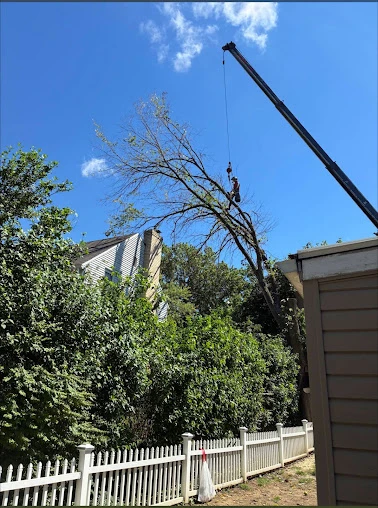
What the crew is doing before the boom ever comes up
The crane work starts on a day when there is no crane. Chris walks the property with a tape and a lot of looking up. Where does the machine sit so its outriggers land on something that will hold: a driveway apron, a compacted berm, a street lane with cribbing and pads under the feet. What is directly overhead of that spot, because a boom cannot come up through a service drop or a neighbor’s silver maple. And then the math nobody sees: pick radius. A crane can hold far more weight close to itself than it can way out at the end of the boom, so the real question is what a given section of your tree weighs at the exact distance it has to travel. Green red oak is heavy. Wet green red oak thirty feet past the machine is a different conversation.
Every one of those answers has to line up before we book the day. If the outriggers can only sit in one place and that place puts the tree at the far end of the chart, the picks get smaller and the day gets longer. If the machine can tuck close, we take bigger bites and the whole tree is gone by lunch. Either way you get the plan and the up-front number in writing before anybody commits, and we tell you plainly if the rope-and-rigging approach on our large tree removal page is honestly the better call for your property.
The climber and the operator are having a conversation
Here is the part most homeowners picture wrong. The climber does not ride the crane. He climbs the tree the ordinary way, on his own rope and saddle, and he works alongside the hook. The operator swings the ball in, the climber sets a choker around the section, signals for the operator to take up just enough tension that the piece is being held rather than hanging, and only then makes the cut. The moment the fibers part, the section is already in the crane’s hands. It lifts a foot straight up, swings clear of the roof line, and goes down to the guys on the ground by the chipper.
Nothing about that sequence is loud or dramatic, which is exactly the point. There is no crack, no swing, no fifteen-foot drop into a rigging line that shocks the whole trunk. That transfer of load happens by hand signal and radio, over and over, twenty or thirty times on a big removal, and each repetition looks identical to the last. Twenty five years in the trade is what makes a crane day boring to watch. Boring is the product you are buying.
The ground crew has its own choreography. Nobody stands under a suspended piece, ever. The landing zone is roped off, the sections come down in the same spot each time, and the loader and chipper eat them while the climber is already setting the next choker. The rhythm is what makes crane jobs move.
Why the crane day is often the shorter, gentler day
People assume the crane means a bigger, messier, more invasive production. It usually means the opposite. On a rope removal, the climber dismantles the canopy into pieces small enough to lower safely, which means dozens of cuts, dozens of lowers, and a lot of wood landing in your yard to be dragged out. On a crane removal the same canopy might leave in eight pieces, each one flown straight to the curb where the loader is waiting.
That matters to your lawn more than anything else. Wood that never touches the turf leaves no ruts, no drag scars, no plated path across the grass for a machine to crawl on. The crane sits on pads in one spot the entire day. On the wet clay soil that most of Allegheny County is built on, especially in a spring thaw, that single-footprint approach is the difference between a clean job and a month of reseeding. See what a finished yard looks like in the gallery.
The picks ropes simply cannot make
Two situations put the crane on the schedule no matter what. The first is a dead spar with no safe anchor left in it. When a red oak has been standing dead for four or five years, the wood is punky and there is nothing up there a climber should trust with his life. The crane holds the top while it is cut, so the tree is being supported from above rather than being climbed from below. The second is anything hanging over a structure that is too heavy to rope. Roping a section over a house means controlling a falling weight with friction. Flying it means the weight never falls at all. Over a slate roof, a sunroom, a pool, or the neighbor’s new fence, that distinction is the entire job. The same logic drives our difficult access tree removal work, where the constraint is the ground instead of the weight.
Before the crane day
We handle the street permit and the lane closure paperwork with the municipality when the setup needs the road. That is our errand, not yours.
We knock on the doors that will be affected, because a neighbor who knows the plan at 7am is a neighbor who moves the car instead of calling the borough.
Insured, military discount for those who served. One and done, in sawdust we trust.
Questions before the day? Send them over and Chris answers them himself.
“Christopher and his crew arrived on time, worked safely and efficiently, and handled the entire process with real professionalism.”
Felicia Provenzano, Google reviewThe setup nobody warns you about
A crane arriving on a residential street is a small event. Here is who handles which part of it.
Yours
Move the cars out of the driveway the night before, not the morning of. Unlock the gate. Tell us about the septic lid, the French drain, or the buried invisible fence line, because outriggers put real pressure on a small patch of ground and we would rather know.
If you rent, loop in the property owner early. Crane setups need permission we cannot get from a tenant.
Ours
Permit the lane and set the cones. Site the machine, crib and pad the outriggers, and confirm overhead clearance with the utility before the boom leaves its cradle. Run the picks with a climber on signal. Chip, load, sweep the street, and roll the cones back up.
If a storm put the tree on the house last night, that becomes an emergency tree service call and the crane goes out the same day when we can get one.


Our crew, our machines, on real North Hills properties.
Narrow streets, steep driveways, hundred-year canopies
Crane siting around here is a local skill. In Allison Park the lots are deep and the driveways are long, so the machine often sets up well onto the property and reaches the back yard without ever touching the road. Cranberry Township runs the other way: newer streets, wider aprons, easy setups, and mature landscaping the homeowner spent real money on that we plan every swing around. Down in Penn Hills the hillside streets and the old canopy give us the tightest picks we do, where the boom has to thread between a power drop and a neighbor’s roof.
Freeze-thaw winters and saturated clay are what kill Pittsburgh’s biggest trees, and they tend to kill them where the trees are closest to houses. If yours has gone gray at the top, dropped a leader, or started leaning since the last big storm, the crane conversation is worth having now rather than in February. Get Chris on the property and you will know within a day what the plan and the number are.
Crane day questions
The things people ask once they realize a crane is coming to their street.
Does the crane have to sit in the street?
Only when the yard cannot take it. A long driveway or a firm level pad on the property is usually our first choice, because it keeps the road open and the reach short. When the street is the only option, we pull the permit, set the cones, and let the neighbors know ahead of time so the lane closure is a nuisance for a few hours instead of a surprise.
Does the climber ride up on the crane?
No. He climbs the tree on his own rope and saddle exactly like any other removal. The crane holds the wood, never the person. The climber sets the choker, signals for tension, and cuts once the piece is already supported from above.
Will the outriggers crack my driveway?
We put timber cribbing and steel pads under every foot to spread the load across a wide area instead of four points. Concrete in good shape handles it fine. If your apron is already spidered or the driveway is old asphalt in July heat, we will tell you before the day and pick a different setup spot.
How much of my yard gets torn up?
Less than a rope job, in most cases. The machine parks once and stays there, and the wood flies to the curb instead of being dragged across the lawn. You should expect pad marks where the outriggers sat and some traffic where the chipper worked. We rake and grade before we leave.
Can you fly a tree over the house if the only clear landing is the front street?
That is the standard crane pick and it is why the machine exists. The section leaves the canopy, clears the ridgeline with room to spare, and lands where the loader is waiting. The whole travel path gets planned during the walk-around, including where every person on the ground stands while a piece is in the air.
How long does a crane removal take?
Most single-tree crane jobs are a half day to a full day, including setup and teardown, which is often faster than roping the same tree down piece by piece. Multiple trees or a tight street setup can push into a second day. You get the honest timeline and the up-front number after Chris walks the property, never a guess over the phone. Book the walk-around or call (412) 526-2028.
If it has to come off the house in one piece, we bring the machine
One walk-around, one written number, one crane day, and the tree that has been worrying you since the last storm is gone. One and done. In sawdust we trust.