
Loaded, strapped, gone
Brush removal when the pile has to leave the property
Some brush should become mulch. Some brush should become somebody else’s problem, meaning ours. This is the truck that pulls up to the pile you have been walking around since March, loads every stick of it, and drives away with the whole thing on the back. Nothing chipped into your beds, nothing stacked neater than you found it. Empty ground.
Four good reasons a chipper is the wrong tool today
Most of the time we would rather run brush through the machine and leave you a pile of mulch, because it is faster and you get something out of it. Then there are the days it makes no sense at all, and those days are common enough around here that they earned their own service.
The first is room. A chipper needs a place to sit and a place to throw, and a lot of the streets we work on do not offer either. A narrow one-way in Millvale with cars on both curbs, an alley behind a Bellevue rowhouse barely wide enough for a pickup mirror, a shared driveway where staging a machine blocks a neighbor who has to be at work at six. When there is nowhere to park the chipper without shutting the block down, the answer is a truck that loads and leaves.
The second is that nobody wants the chips. On a small city lot with forty feet of yard, a cubic yard of fresh mulch is not a gift, it is a mound you now have to deal with. Plenty of homeowners tell us straight out: I do not want it here in any form. Fair enough. That is the whole ask, and the truck answers it.
The third is thorns. Multiflora rose, greenbrier, blackberry canes, hawthorn. Run that through a chipper and you have made a mulch nobody can kneel in, weed, or let a dog walk across for two seasons. Thorny material earns a ride out of here rather than a second life in your planting bed.
The fourth is the one people rarely know about, and it matters most. Japanese knotweed regrows from a fragment of cane the size of a pen cap. Japanese barberry throws roots from cut stems that touch soil. Spread that as chips across your own yard and you have planted it, thoroughly, in every bed you spread it in. Knotweed in particular travels down the creeks around here, and half the reason it is in your yard is that somebody upstream moved it without meaning to. Material like that gets bagged, contained, loaded, and taken somewhere it will not start over. We do not chip it, and we tell you that before we touch it.
Grapple truck on the street, or two guys with gloves
How brush gets to the truck depends entirely on what is between the pile and the curb, and that difference is most of what separates one job from another.
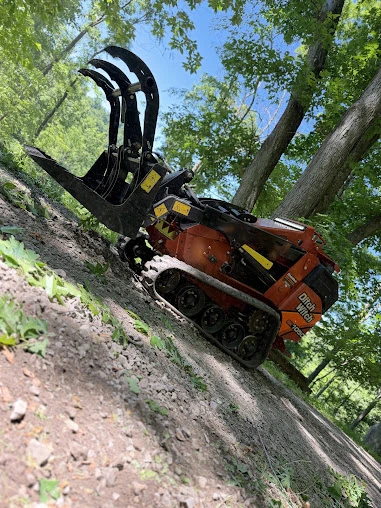
The grapple is the easy version. If the pile is within reach of a machine parked on the street or driveway, the arm swings over, closes on a few hundred pounds at once, and drops it in the bed. A pile that would take two people the whole morning is loaded in twenty minutes, nobody handles a thorn, and the lawn never gets crossed. Out in Wexford or on the wider Hampton and Franklin Park properties, where there is acreage and room to swing, most of a haul is machine work.
Then there is the Lawrenceville version, which we do just as often. Backyard behind a fence, gate three feet wide, a set of stairs down from the deck, and a hundred and twenty feet of walk to the street. No machine gets back there and none ever will. So it is bundled, carried by hand out the gate, and stacked in the truck by arm. It takes longer and we tell you that when we look at it, because you deserve to hear which version of this job you have before the number shows up rather than after.
Steep is its own third case. Half the North Hills is a hillside, and a lot of brush ends up at the bottom of a slope where gravity helped it get there and will not help it leave. We rope-and-haul, run bundles up in loads, and stage them at the top where the truck can reach. Slow, but it works, and it is a good deal better than the alternative of that pile living there permanently.
The pile has three or four different lives in it
Almost nobody has a clean brush pile. What you actually have is a pile that started as brush and then collected everything else nobody knew where to put. Cut limbs from the tree work last fall. The deck boards from when the railing got replaced. Last year’s Christmas tree, still on its side behind the shed with tinsel in it. Some cardboard. A bag of leaves that split open. Half a fence panel.
Here is the plain version of what we take and what we do not, so nobody is surprised at the truck. Anything that grew gets loaded: limbs, brush, trunk wood, root balls, hedge trimmings, vines, that Christmas tree, leaves and yard waste sitting alongside it. Clean lumber and old fence sections mixed into a brush pile we will generally take right along with it, because pulling them out and leaving them behind helps nobody.
What we are not is a junk hauler. Appliances, furniture, tires, drums, paint, tar shingles, treated railroad ties, anything with a motor in it: that is a different truck and a different license, and we will say so plainly instead of loading half and leaving you a rump pile. If your heap is more garage cleanout than yard cleanout, we will tell you that on the walk-around, and you can get a proper junk service for the other half. If it is mostly organic with a few boards in it, that is a normal day for us.
Larger mixed loads with a lot of construction material in them belong on the debris hauling page. If your material is clean wood and you would rather keep the mulch, look at brush chipping instead, since that is the same crew making the opposite choice.
What shows up
Grapple loader for street-reachable piles, a dump body sized for brush volume rather than weight, hand tools and cordage for the carry-out jobs, and tarps so nothing blows down your block on the way out.
Insured, twenty five years in the trade, and a military discount for those who served.
See loaded trucks and cleared ground in the gallery, or ask us for an up-front number on your pile before anybody starts.
“Triple T came and fell a broken pine tree in my front yard. They were in and out in about an hour and left my yard looking better than ever.”
A Google reviewerA look, a load, and an empty spot on the lawn
Most brush hauls are one visit start to finish. Some are one visit that starts ten minutes after we look at it.
Your part
Send a photo with something in frame for scale, a trash can or a person. Tell us whether the pile is street-side or behind a gate. Tell us if there is anything in there that is not wood.
Then move the cars off the driveway apron on the day and open whatever gate we need open. That is all of it.
Our part
Walk the route from the pile to the truck first, because the route is the job. Give you the up-front number before anybody lifts a stick. Load it, thorny stuff and all, in the order that keeps the truck legal and tight. Rake out what pressed into the grass under it. Strap and tarp before we roll.
If we are already on the street and you point at a pile, we will often look, price it, and load it the same visit. Storm work gets moved to the front of the line.
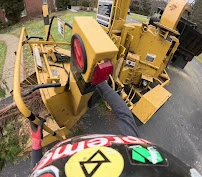
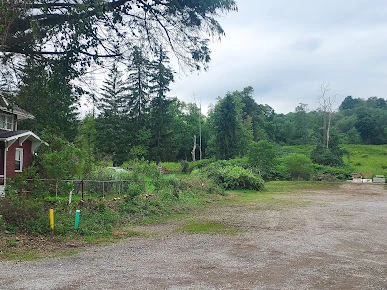
Left: the chipping option, for the days it makes sense. Right: what the ground looks like after the truck pulls out. Both our crew, both local jobs.
Where it goes once the tailgate closes
People ask this more than anything else, and it is a fair question given what gets dumped down ravines around here. Clean organic material goes to licensed composting and yard-waste yards in the region, where it gets ground and windrowed and eventually comes back as compost and mulch somebody else buys. Contaminated or invasive material gets handled separately so it does not get spread as product. Nothing goes over a hillside, into a creek bottom, or onto the back of somebody’s vacant lot. If you want to know specifically where your load went, ask and we will tell you.
The river boroughs are where we do the most of this. In Bellevue the lots are deep and skinny with alleys behind them, so a haul is usually a carry-out to the front curb and a truck that cannot linger long. Avalon runs uphill off Ohio River Boulevard, which means brush collects at the bottom of grades and gets staged upward. Ben Avon has old, established plantings behind the houses, so a lot of what leaves there is overgrown yew, privet, and hedge material rather than storm wood.
And then there is spring, which is its own annual ritual. Something gets cut in November, the pile goes by the fence line where nobody has to look at it from the kitchen window, and then winter happens. By April it has settled, gone gray, grown a few weeds through it, and become the thing you notice every time you go outside. Half our brush hauling season is exactly that pile, on a Saturday, from people who finally decided this is the year it goes.
About hauling brush off
Answers you would get standing next to the pile with us.
Do I have to be home when you take it?
Not if the pile is out front or in an unlocked side yard and we have agreed on the number beforehand. Plenty of these happen while people are at work, and you come home to bare grass. If we need a gate opened or there is any question about what stays and what goes, we would rather you were there for the five minutes it takes to point.
The pile has been sitting all winter. Is that a problem?
No, that is most of what we haul. An overwintered pile is heavier, settled, and usually has grown into the grass a little, so it loads slower than fresh brush. It also tends to be home to something by spring, so we work from the outside in and give whatever is living in there a chance to leave first.
Can you get to a pile in a fenced backyard?
Yes, it just becomes a hand-carry instead of a machine load. We bundle it, walk it out the gate, and stack it in the truck. It takes longer than a street-side pile of the same size, which is why we always want to know about the gate before we quote the number rather than discover it on the day.
Will you take the knotweed I cut down?
Yes, and please do not put it in your own chipper or your compost. Knotweed regrows from cane fragments, so chipping it spreads it across everywhere the chips land. Same story with barberry. We contain that material, load it separately, and route it so it does not come back as mulch in somebody’s yard.
There is old lumber and a Christmas tree mixed in. Still fine?
The Christmas tree is fine, it is a tree. Clean boards and old fence panels mixed into a brush pile we will usually take right along with it. Where we stop is the junk-hauler side of things: appliances, furniture, tires, paint, shingles, treated ties. We will look at your pile and tell you honestly which service it needs before you book anything.
What does it cost to have a brush pile hauled off?
Volume drives it, and access drives it just as hard, since a hand-carry from a back gate is a different day than a grapple load off the curb. We look at the pile and the walk, then hand you an up-front number in writing. Send a photo and we can usually get close over the phone before we ever pull up.
Have the pile gone, not rearranged
One look, one load, one truck pulling away with all of it. You get your yard back and never think about that corner again. One and done. In sawdust we trust.