
Cut for the crop
Fruit tree pruning that fills the basket, not the canopy
A shade tree gets pruned so it lives long and drops nothing on your roof. A fruit tree gets pruned so sunlight reaches the wood that actually sets apples. Those are two different goals and two different sets of cuts, and the backyard apples and peaches around Pittsburgh mostly get the wrong one.

Light is the crop. Everything else is bookkeeping.
Fruit sets where sunlight lands. That is the entire principle, and once you know it, a neglected apple tree stops being mysterious. The outside of the canopy is a solid green shell, so all the light stops there, and that is exactly where the fruit is: forty feet up, out on the tips, out of reach, small because too many of them are competing. The inside of the tree is shaded dead wood that has not made an apple in a decade.
Our job is to cut holes in that shell so light gets to the middle and lower limbs again. Water sprouts, those pencil-straight shoots pointing at the sky, come out because they never fruit and they shade everything under them. Limbs growing back toward the trunk come out. Two branches occupying the same layer of the tree, one comes out, and it is the one with the worse angle. What is left should be open enough that you could toss a hat through it, which is an old orchard saying and still the fastest way to check your own work.
Peaches want a bowl. Apples tolerate a spine.
Stone fruit and pome fruit are built differently and get pruned into different shapes, and that is not a stylistic preference. Peaches, nectarines, and most plums get an open-center form: the central leader is removed early and three or four scaffold limbs are trained outward into a vase, so the middle of the tree is empty air. Stone fruit is a sun hog and rots fast in humidity, and an open bowl lets light and Pennsylvania’s wet air both move straight through.
Apples and pears are fine with a central-leader form, a single trunk running up the middle with tiers of scaffold branches spiraling around it like a Christmas tree. They tolerate more shade, they carry heavier fruit on stronger wood, and the pyramid shape keeps the upper tiers from smothering the lower ones. When somebody prunes an apple like a peach, or a peach like a shade tree, the tree survives and just quietly stops producing much. That is the single most common thing we find on a first visit.
Old wood, new wood, and why peaches need a harder cut
Where a tree carries its fruiting wood decides how aggressive the annual pruning has to be. Apples and pears fruit on spurs, stubby little side shoots that keep producing for several years running. Cut those off casually and you have removed next season’s crop, which is why apple pruning is careful and mostly about thinning whole branches instead of shortening every twig.
Peaches are the opposite. A peach fruits on wood that grew last summer and that wood will not fruit again. If nobody removes a good share of the old growth each year, the fruiting zone marches farther out toward the branch tips every season until the tree is tall, leggy, and producing at the ends of limbs that cannot hold the weight. A peach needs a real haircut annually, sometimes 40 percent of last year’s growth, and homeowners almost always find that number alarming until the following August.
Cherries sit in between, sweet cherries fruiting on longer-lived spurs and sour cherries leaning more on newer wood. Twenty five years in the trade is mostly what tells us which of those rules is in front of us in your yard, because the tag came off the tree in 1998 and nobody remembers what variety it was.
What we prune
Apple, pear, peach, plum, sweet and sour cherry, and the backyard oddballs: quince, persimmon, pawpaw, mulberry, and old semi-dwarf stock nobody has touched in years.
Insured, military discount for those who served. See our cuts in the gallery.
For shade trees and yard specimens, see tree pruning. For dogwoods, redbuds, Japanese maples and other landscape ornamentals, see ornamental tree pruning.
“Christopher and his crew arrived on time, worked safely and efficiently, and handled the entire process with real professionalism.”
Felicia Provenzano, Google reviewRescuing a backyard apple takes three winters
The tree that came with the house and has not been touched since. Here is how that goes.
Your part
Tell us what the tree is doing now. Tiny apples, fruit only at the top, half the limbs bare, a wasp problem in September. If you know what it is, say so. If you do not, that is normal and we will figure it out from the bark and the buds.
Then be patient with it. A restoration is a three-year plan, and the first winter is the least dramatic-looking of the three.
Our part
Year one, the obvious wrongs go: dead limbs, broken limbs, crossing limbs, the tallest runaway leaders brought back to a manageable height, and the worst of the water sprout thickets. Year two, we choose the permanent scaffolds and open the interior properly now that we can see what the tree wants to do. Year three, we shape and settle it into a normal annual cycle.
Cutting all of that in one winter would push the tree into a panic response and it would answer with a hundred new sprouts and no fruit at all. Slow is the only way that works. Storm-broken limbs jump the schedule and go to emergency service.

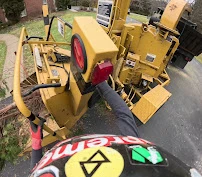
Interior opened up, and every stick of brush fed through the chipper before we pull out. Our crew, our photos.
Timing, disease, and the Western Pennsylvania calendar
Apples and pears get pruned in late winter, roughly mid-February through the front half of March around here, while the tree is dormant and the buds have not swelled. You can read the structure with the leaves off, the cuts are clean, and the tree seals them as it wakes up. It also lets you count fruit buds, which are fatter and rounder than leaf buds, so we can tell how hard to thin before the tree spends any energy.
Cherries break that rule on purpose. A cherry cut in late winter is an open invitation to bacterial canker and black knot in a wet Pennsylvania spring, so sweet and sour cherries get pruned in summer instead, right after harvest, when the wood is dry and the cuts close fast. Peaches sit in the middle and do best just as the buds start to move, late enough that we can see which wood survived the winter and skip whatever the cold already killed.
Disease housekeeping is half of fruit tree work in this climate. Black knot shows up on cherries and plums as black swollen galls on the twigs, and the only real treatment is cutting well below each one and getting that wood off the property. Fire blight scorches apple and pear shoots so they look torched and curl into a shepherd’s crook, and it moves on tools, so we sanitize between cuts and between trees when it is anywhere in the yard. None of that brush goes in your compost pile.
We prune fruit trees across the near western suburbs, and the old homestead trees are the fun ones. Plenty of properties in Kennedy Township and Coraopolis still carry apples and pears planted when the lot was a farm, half-buried in later landscaping and thoroughly overdue. Newer yards out in Moon Township tend toward planted dwarf and semi-dwarf stock that never got trained in its first five years and needs the shape built now. Clay soil and freeze-thaw winters make Pittsburgh trees slow to recover, which is another reason we spread big corrections over seasons instead of doing them all at once.
Fruit tree questions
What homeowners ask Chris while standing under an apple tree that has not produced in years.
My apple tree only fruits at the very top. Why?
Because that is the only place getting sun. The outer canopy has closed into a shell and the shaded interior wood has gone dormant or died. Opening the middle back up lets the lower limbs start setting fruit again, though they take a season or two to respond. It is worth doing for the reach alone, since fruit forty feet up mostly feeds the birds.
Why does my peach tree need such a hard cut every year?
A peach only fruits on wood that grew the previous summer, and that wood is finished after one crop. If the old growth is not removed annually, the fruiting zone keeps moving outward until you have a tall tree with peaches only at the tips of limbs too weak to carry them. A yearly cut of roughly a third to 40 percent of last season’s growth keeps production close to the trunk where the wood is strong.
Can you save a neglected apple tree, or should it come out?
Usually it can be saved if the trunk is sound and there is still living scaffold structure under the mess. It takes three winters of staged cuts, not one heavy hack. If the trunk is hollow, the roots are failing, or the graft union is dead, we will tell you straight and talk about removal instead of taking money for a rescue that will not hold.
When do you prune cherry trees?
Summer, right after the harvest comes off. Cutting a cherry in the wet late-winter window invites bacterial canker and black knot straight into the fresh wounds. Pruning in dry summer weather lets the cuts close quickly, and it is the right time to take out any black knot galls we find on cherries or plums.
What do you do about fire blight on my apples and pears?
Cut well below every infected shoot, into clean wood, and sanitize the blades between cuts and between trees so we are not carrying the bacteria around your yard. The infected wood leaves with us, it does not go on your brush pile or in your compost. If the blight has reached the main scaffolds, we will say so honestly, because at that point the cutting gets severe and the outcome is uncertain.
What does fruit tree pruning cost in Pittsburgh?
It depends on how many trees you have, how far gone they are, and whether it is one visit or a staged restoration. That is why Chris looks at them before anybody talks money. You get a written price up front for the visit, and if the tree needs three winters, we will tell you what each of those looks like too. Set up a visit and you will usually have the numbers within a day or two.
Get more fruit off the trees you already own
One walk through the yard with Chris, one up-front number in writing, and a crew that knows why the peach gets cut harder than the apple. In sawdust we trust.