
Roots and all
Stump removal that takes the whole root ball, Pittsburgh
Sometimes below grade isn’t far enough. When a driveway, a pool, a garage slab, or a sewer line is going where that tree stood, the stump and everything under it has to physically leave the property. We dig it out, chase the roots, fill the hole back in, and hand you ground that’s ready to build on.
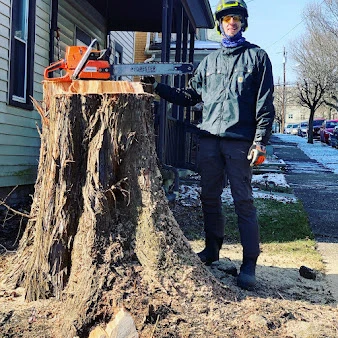
Pulling it out versus chewing it down
These are two different jobs and people mix them up constantly, so here’s the blunt version. Grinding chews the stump into chips from the top and stops maybe a foot under the surface. The root system stays right where it is, slowly rotting for the next decade. Removal means the stump and the root ball come out of the ground as a mass, get loaded onto a truck, and leave. What’s behind is an open hole that we fill and pack.
For nine out of ten backyards, grinding is the smarter call and we’ll tell you so. It’s faster, cheaper, gentler on the lawn, and grass grows over it fine. If all you want is to stop hitting the thing with the mower, go read the stump grinding page and call it a day. Nobody at Triple T is going to sell you an excavation you don’t need.
The tenth job is where this page lives. Anything structural going into that ground changes the answer completely. Footers, slabs, foundations, retaining walls, pool shells, new driveway base, a paver patio you want dead flat in five years. Buried wood rots, and rotting wood shrinks. Whatever sits on top of it settles, cracks, and moves. An inspector won’t sign off on a footing poured over a root plate either, and we’ve had contractors call us specifically because a job got flagged.
Excavation also wins when something has to run through the ground rather than sit on it. Sewer laterals and water services in the older parts of Allegheny County are already fighting roots, and cutting a trench through a live root mass is miserable, slow work that tends to find clay tile you didn’t know was there. Take the whole root system out first and the trench becomes a normal afternoon.
Trees that come back if you leave the roots
The other reason to dig is biology. Some species do not accept being ground down. Tree of heaven is the headline offender around here, and Pittsburgh has an enormous amount of it growing along alleys, hillsides, and every neglected fence line in the city. Cut it or grind it and the root system panics and throws suckers, sometimes dozens of them, sometimes fifty feet from where the trunk was. People fight the same tree for six or seven years without ever winning. Black locust, mulberry, and princess tree behave the same way to a lesser degree.
Tree of heaven also carries a second problem, which is that spotted lanternflies love it, and a stand of resprouting suckers is a nursery. If you’re clearing invasive growth off a property line or a slope, taking the root mass out is the difference between finishing and starting an annual chore. This overlaps with land clearing work, and when a lot has several of them we usually handle everything on one mobilization instead of coming back.
Chris walks every one of these before quoting, because the honest answer changes with the species, the diameter, the access, and what’s going on that ground afterward. You get an up-front number in writing, and if grinding does the job we say that out loud. Book the walk-around and we’ll sort out which one you actually need.
Removal, plainly
Root ball dug out whole, roots chased past the drip line, debris hauled off, hole backfilled and compacted in lifts, grade left ready for whatever comes next.
PA One Call filed on every dig. Insured, military discount, 25 years in the trade.
Excavated stumps and cleared ground are in the gallery. Lighter option: stump grinding. Bigger job: land clearing.
“Best tree cutting around! And the clean up was amazing! Thank you Triple T Tree!!!”
Juli, Google reviewWho handles what on a dig
Excavation has more moving parts than a grind. Almost none of them are yours.
Your part
Tell us what’s going in that spot and roughly when, because a pool shell going in next month and a lawn going in next spring get different backfill. Flag anything private and buried: irrigation, dog fence, downspout drains, an old oil tank line, a run out to the garage. PA One Call marks the public utilities and nothing else.
Clear us a path wide enough for a machine to reach the stump, or tell us the gate width and let us solve it.
Our part
File the 811 ticket, wait out the locates, and lay out a dig plan around the marks. Open the ground around the root plate, cut the anchor roots, and work the mass loose. The grapple lifts it out and onto the truck in one piece when it’ll cooperate, in sections when it won’t. Lateral roots running toward walks and lines get chased and cut.
Then backfill in lifts, compact as we go, top with soil, and put the machine tracks back to level. Anything we can’t reach on foot gets talked through first. Standing tree still up? Both happen on one visit.
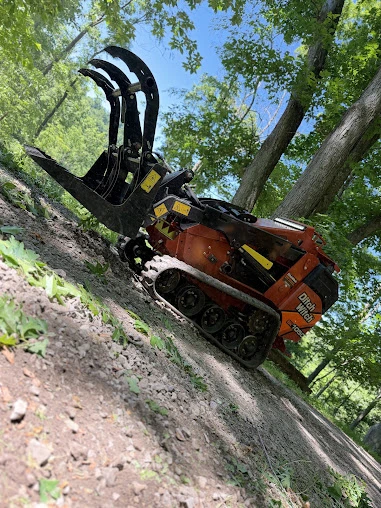
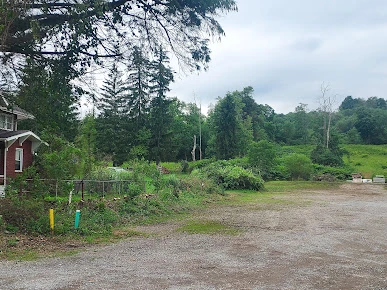
Our machines, our jobs. The lot on the right went from stumps and brush to buildable ground.
What goes back in the hole
A pulled root ball leaves a bigger void than people picture, and how it gets filled decides whether the spot stays level. Loose dirt shoveled in settles for years and gives you a saucer in the lawn. We fill in lifts, compacting each one, so the ground behaves. For plain yard restoration that’s clean fill capped with topsoil and crowned an inch or so for settlement. If a slab, a driveway base, or footings are coming, the fill spec changes to something that compacts hard, usually crushed stone brought in and packed, and we coordinate with whoever is pouring so the base is what they need rather than what we guessed.
Older neighborhoods make this more interesting. Digs in Penn Hills and Monroeville hit heavy clay that holds water and moves with the freeze-thaw, so compaction and drainage matter more than they would in sandy ground. Out toward Robinson Township the newer commercial and residential development means we’re often digging on a schedule ahead of a contractor, with the ground handed over graded and ready. Hillside lots anywhere in this county get one extra look before the machine moves, because pulling a mature root mass out of a slope removes something that was holding soil in place, and we’re not leaving you with a washout instead of a stump.
Digging questions
What people ask once they hear the word excavator.
How do I know if I need removal instead of grinding?
Ask what’s happening on that ground. Grass, mulch bed, or nothing at all means grinding is enough and it costs you less. Concrete, footings, a pool, a driveway, a trench, or a species that resprouts means the roots have to come out. Tell Chris the plan for the spot during the walk-around and he’ll tell you which one it is.
Do you call PA One Call before you dig?
Always, and it’s not optional on an excavation. The 811 ticket goes in ahead of the work and we wait the required time for gas, water, electric, and telecom to be marked. Private lines are on you to point out, since 811 does not locate irrigation, invisible fence, drain tile, or anything a previous owner buried themselves.
What do you put back in the hole?
Depends on what’s going on top. Lawn restoration gets clean fill compacted in layers and capped with topsoil, mounded slightly for settling. Anything structural gets a compactable base, typically crushed stone, packed to the spec your builder needs. We’d rather talk to your concrete guy for two minutes than guess.
Can I build over the spot once the stump is gone?
That’s the reason to do it this way. Once the root ball and major laterals are out and the hole is properly compacted, the ground under your slab or footing behaves like the rest of the lot. Leave wood down there and it rots, shrinks, and takes your concrete with it. Give us the construction timeline and we’ll leave the pad the way the next trade needs it.
Will it grow back if you dig it out?
Not once the root crown and the main laterals are gone, which is exactly why we dig for tree of heaven, black locust, mulberry, and the other aggressive resprouters. Grind one of those and you’ll be mowing suckers for years. If you’ve already been fighting suckers from an old stump, that’s your sign the roots are still alive down there.
What does stump removal run in Pittsburgh?
Diameter, species, how deep the roots run, machine access, whether we can get a truck close, and what fill the hole needs all move the number. No honest answer exists over the phone. Chris looks at it in person and puts an up-front number in writing before anything gets dug. Set up a visit and you’ll have it quickly.
Get the roots out and get building
One crew digs it, hauls it, fills it, and packs it, and the next trade shows up to ground that’s ready. No craters, no suckers next spring, no second contractor. In sawdust we trust.