
Somebody has to finish it
Tree debris hauling for the mess that got left behind
Logs in one corner, brush in another, a heap of chips by the driveway and a ring of grindings where a stump used to be. You did not make that mess in a single afternoon and you are not going to move it in one either. We back in, lift all of it, and leave you looking at grass.
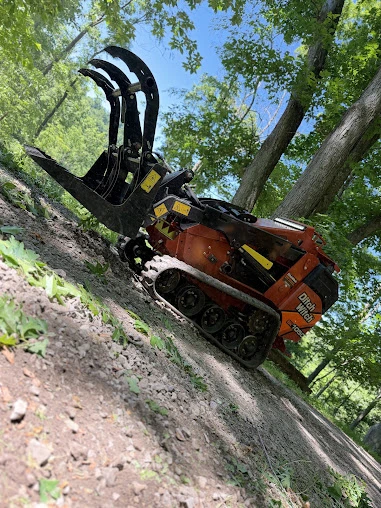
The guy took the money and never came back for the wood
We see this every month, and it is the single most common reason somebody calls this number about hauling. A crew shows up, drops the tree, cuts it into rounds, takes payment for the removal, and tells you they will swing back Tuesday with a truck for the wood. Tuesday comes. Tuesday goes. Three weeks later the rounds are still sitting where they landed, the grass under them is yellow, and the phone number you have goes to voicemail that never fills up because nobody empties it.
It happens because hauling is the unglamorous, expensive half of the job. Felling a tree is one skilled morning. Moving eight thousand pounds of green wood off a lot takes a machine, a truck with real capacity, dump fees, and a place to legally take it. An outfit working out of a pickup can do the first part and simply cannot do the second, so they quote the whole job, collect on the fun part, and vanish from the part that costs them money.
You are not stuck with it. We take over finished work all the time and we do not need to know who left it or why. Point at the wood, we lift the wood. There is no lecture and no upsell into a removal you already paid for once. If you have got paperwork or a name and you want to tell us, fine. If you would rather just have it gone and never think about that contractor again, that is completely reasonable too.
Your buddy’s F-150 was never going to do it
The other half of our hauling calls come from people who did the cutting themselves and did it well. The saw work went fine. The tree came down where it was supposed to. Then the job hit the pile stage, which is where nearly every do-it-yourself takedown quietly ends.
Here is the arithmetic nobody runs beforehand. Fresh-cut green maple weighs somewhere north of fifty pounds per cubic foot, and green oak is heavier still. Wood that has been down two weeks has barely started to dry. So a modest stack of rounds, the sort of pile you could throw a bedsheet over, is comfortably a ton or better. A half-ton pickup with a payload sticker in the door frame reading around seventeen hundred pounds is done after four or five decent rounds, and the tailgate is not even up.
Then there is the second problem, which is that most transfer stations and yard-waste yards around here will not take a random open pickup load of mixed tree material from a resident, and the ones that will charge in a way that makes two or three trips a genuinely bad deal. Add the fuel, add the Saturday, add the back you have to live in on Sunday, and the numbers stop working long before the pile does. There is no shame in that. Green wood is dense in a way that does not read from the kitchen window.
One load, four kinds of material, no sorting required from you
What makes this its own service rather than a version of brush removal is that most of these piles are mixed. Somebody cut a tree down, and everything that came off it is now sitting in four different states across your yard.
Rounds and trunk sections are the heavy freight, and they set how many trips the truck makes. Limb wood and brush is the bulk, taking up far more room than it weighs. Chips are their own headache, because a mound of chips that has sat through a couple of rains is wet, packed, and shovel work rather than fork work. And grindings, the sawdust-and-soil mix a stump grinder leaves, are the heaviest thing per square foot on the whole property, a cubic yard of it running eight or nine hundred pounds of dirty, sandy material.
All four go on the same truck in the same visit. You do not need to separate anything, stage anything, or figure out what belongs in which category. We load it in the order that keeps the truck legal and the weight over the axles, which sometimes means the ugly heavy stuff goes on first while the pretty brush waits, and that is just how loading works.
If your material is all clean trunk wood and you want it split or sold rather than hauled off, ask about wood hauling instead, since that is the same crew handling logs as logs. If a storm made the mess this week, storm debris cleanup is the version with the sorting and chipping built in.
Grapple on the street, or gloves and a wheelbarrow
The machine is what makes this affordable, and whether the machine can reach your pile is the biggest single factor in what the work costs. A grapple arm closes on several hundred pounds at once and swings it into the bed. Wood we can grapple gets moved in minutes and nobody’s spine is involved. Wood behind a locked gate, down a set of stairs, or on the far side of a wet lawn we cannot cross has to come out by hand and wheelbarrow, one load at a time, and that is a different day entirely.
Neither one is a problem. We do both weekly. What matters is that we look at the walk before anybody gives you a figure, because a contractor who prices a mixed pile off a photo without asking about the route is going to show up, discover the stairs, and start renegotiating on your driveway. Chris walks it, counts the trips honestly, and the up-front number he hands you is the one you pay.
What backs into the driveway
Grapple loader for anything within reach of pavement, a dump body built for weight rather than just volume, forks and shovels for chips and grindings, wheelbarrows for the carry-out jobs, and tarps so nothing leaves a trail down your street.
Insured, 25 years in the trade, military discount for those who served.
Loaded trucks and swept-clean ground both live in the gallery. Ask for an up-front number and we will come look at the pile.
“Christopher and his crew arrived on time, worked safely and efficiently, and handled the entire process with real professionalism.”
Felicia Provenzano, Google reviewStaging a load without annoying the whole block
A loaded truck on a narrow Pittsburgh street is a temporary imposition on everybody. How long it stays there is the part we control.
Where the truck sits
Driveway apron first if there is one, because that keeps the street open and the weight off your lawn. If the only option is curbside, we take the narrowest footprint that still lets the arm swing, put out cones, and keep at least one lane moving. On the tighter borough streets we schedule mid-morning, after people leave for work and before the school buses come back through.
We do not leave a loaded truck parked on your street overnight, and we do not stage material at the curb for a pickup that happens some other day. What comes off the property leaves with us the same visit.
Raked after, every time
Lifting a pile is half the work. What is underneath it after two months is flattened yellow grass, a mat of bark and rotted twigs, a wet layer of leaf mold, and usually a good deal of sawdust from wherever the cutting happened.
We rake that out, fork up the mat, sweep the drive and walk, and grade back any rut the machine put in soft ground. Bare ground gets left bare and honest rather than covered over with scattered chips to hide it. If a spot is going to need seed to come back, you hear that from us before we pull out. Tell Chris what you are looking at and he will tell you what the ground will look like after.

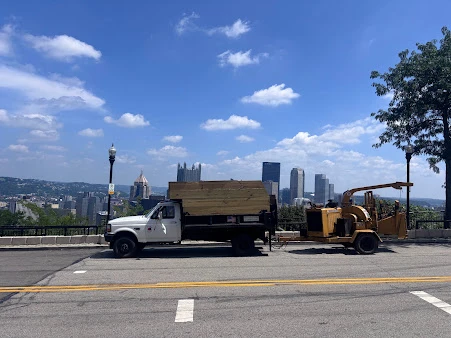
Left: a mixed load going on. Right: the same wood on its way out of the city. Our truck, our crew, no stock library.
What rides out, and what needs a different truck
Anything that grew goes on our truck without a second thought: rounds, trunk sections, limb wood, brush, root balls, hedge material, chips, stump grindings, bagged leaves sitting alongside it. That is our whole world and there is no piece of a tree we will refuse.
Where we stop is worth saying plainly, because being vague about it wastes your morning. We are not a junk service, so household goods, furniture, appliances, and anything with a motor in it stay put. We do not take roofing shingles or construction demolition, which need a licensed C and D hauler and a different landfill entirely. And we leave pressure-treated lumber, railroad ties, and painted or creosote-soaked wood alone, because treated material cannot go to a composting yard and has to be disposed of through a route we do not run. If your pile is half tree and half garage cleanout, we will take our half and tell you straight who handles the rest so you are not making six phone calls to find out.
Geography changes the job more than people expect. Down in Wilkins Township the properties open up and most piles sit somewhere a grapple can reach, so a haul that would take a crew all day elsewhere is a morning. Chalfant is small, tight, and built on a grade, which means a loaded truck has to be parked thoughtfully and the neighbors notice, so we work fast and leave. East Pittsburgh has the old narrow lots with alleys behind them, and half the debris we pull out of there comes down the alley by barrow rather than off the front curb.
One more thing about timing. The pile is at its lightest and easiest the week it is made. Every month it sits, it settles into the turf, collects rain, grows weeds through it, and becomes home to something that would rather we did not disturb it. A pile from last October loads slower than the same pile would have in October, and it takes the lawn under it with it. If it has been sitting, it is not too late, it is just heavier than it needed to be.
About getting it hauled
The questions people ask standing in the driveway next to a pile that has been there since spring.
Another company cut the tree and left the wood. Will you still take it?
Yes, and we do it constantly. You do not owe us an explanation about who left it or what you already paid. We look at what is on the ground now, hand you a number for moving it, and load it. No lecture, and no attempt to sell you a removal you already bought once.
Can you take logs, brush, chips and stump grindings in one load?
That is exactly what this service is. Mixed material goes on the same truck in the same visit, and you do not have to sort or stage anything first. We load in whatever order keeps the weight distributed properly, which sometimes means the heavy grindings go on before the brush.
Do you have to be able to drive onto my property?
No, though it is faster and cheaper when we can. If the truck can park where the grapple reaches the pile, it goes quickly. If the material is behind a gate, down stairs, or across ground too soft to cross, it comes out by barrow and by hand. Both are normal. We just want to see the route before quoting so nothing changes on the day.
I have a truck. Why can I not just do this myself?
Some people can, for a small pile. The catch is weight: green wood runs well over fifty pounds per cubic foot, so a half-ton pickup is at its payload limit after a handful of rounds. Then most local transfer yards will not take mixed tree material off a resident’s open truck. Between the trips, the fees, and the lifting, it usually stops being worth the Saturday.
What will the yard look like where the pile was?
Raked and swept, not merely emptied. We fork up the mat of bark and rot underneath, rake the flattened grass, blow off the drive and walk, and grade back any rut the machine made. If the ground under a long-standing pile is dead and will need seed, we tell you that before we leave rather than covering it with chips.
What does it cost to have tree debris hauled off?
Volume and weight set the floor, and access moves it as much as anything, since a barrow carry from a back yard is a longer day than a grapple lift off the curb. Chris comes out, walks the route, counts the trips, and puts an up-front number in writing. Send us a photo to start and we can usually get close before we ever pull up.
Stop mowing around it
One walk-around, one written price, one truck that takes every piece of it with us. You get the corner of your yard back and the pile stops being your problem. One and done. In sawdust we trust.