
Cuts that heal
Tree pruning that buys a Pittsburgh tree 30 more years
Pruning is the surgery, and the tree either heals from it or it doesn’t. Deadwood out, crowded limbs thinned, bad structure corrected while the wood is still small enough to correct. Every cut lands at the branch collar, in the season that tree can handle it, so the wound closes instead of sitting open through a Pittsburgh winter.
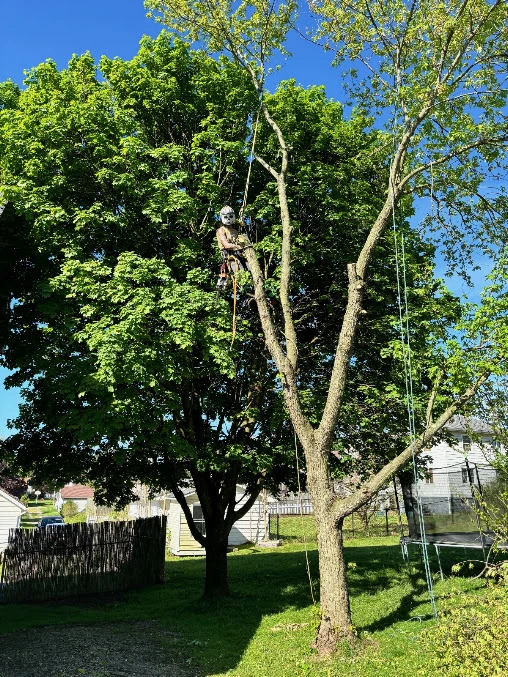
Every cut is a wound. Make it a small one.
A tree has no way to heal a cut the way skin does. It walls the injury off and grows around it. That is the whole reason pruning has rules. Cut in the right spot and the tree seals it in a season or two. Cut in the wrong spot, leave a stub, or tear the bark on the way down, and you have opened a door that decay walks through for the next decade. Twenty five years in the trade teaches you to respect that fast, usually by looking at somebody else’s mistake fifteen years later.
The right spot is the branch collar, that slightly swollen ring where the limb meets the trunk. The tree keeps its healing tissue there. Cut just outside the collar and leave it intact and the tree closes the wound on its own schedule. Cut flush to the trunk and you have removed the tissue that does the closing. On anything bigger than your wrist we three-cut it, undercut first, then the relief cut, then the finish cut at the collar, so the limb can’t peel a strip of bark down the trunk on its way to the ground.
We take out what is dead, what is dying, what is rubbing, and what is growing back into the middle of the tree. Then we stop. A crown that has had a quarter of its live growth removed in one season is at its limit, and most healthy trees need a lot less than that. If somebody tells you your tree needs to be opened way up in a single visit, get a second opinion. Ask us for one, even if the work ends up going to the other guy.
Nobody tops a tree on our watch
Topping is cutting the leaders off at some arbitrary height because the tree got taller than the homeowner expected. It is the single most damaging thing you can do to a mature tree and it is still done all over Allegheny County, usually by whoever knocked on the door after a storm. The tree responds by pushing out a mess of fast, weak sprouts from below the cuts. Those sprouts are attached to nothing but the outer wood, they grow back to the old height in about five years, and they break in storms. Meanwhile the big open cuts are rotting from the inside out. A topped tree is a hazard tree on a delay.
When a tree is genuinely too big for the spot, the honest answers are reduction pruning back to a lateral limb that can take over as the new leader, or a straight removal and a replant with something that fits. Not topping. If a tree on your property was topped years ago, we can usually clean up the sprout clusters and restore some structure over two or three visits, but nobody can undo it.
Pruning vs trimming
Pruning is health and structure work: deadwood, crossing limbs, weak unions, decay. The target is the tree.
Trimming is clearance and looks: limbs off the roof, off the wires, off the driveway, hedges and ornamentals shaped. The target is you and your property.
Most visits end up being a bit of both, and we bill it as one job. Insured, military discount for those who served. See the cuts in the gallery.
“Absolutely a great worker! Professional and knowledgeable about our trees. Quick response time. 10/10 would recommend!!”
Erin Auvil, Google reviewTiming is half the job in Pennsylvania
The calendar decides as much as the saw does. Here is how we split the work.
Your part
Tell us what the tree is doing that bothers you. Dropping limbs, leaning toward the porch, dead on one side, too dark under it. Walk the yard with Chris and point. Get an up-front number in writing before anybody climbs.
Then let the season be what it is. If your oak needs work in June and it can wait until January, we will tell you to wait.
Our part
Read the whole tree first: species, live crown ratio, decay pockets, union angles, which limbs are actually feeding it. Set a plan for how much comes out and what stays. Climb it, or run the bucket where the bucket fits, and make clean collar cuts on every limb. Rope out anything that would bruise the lawn or the roof on the way down.
Chip, rake, blow the beds clean, and walk it with you before the truck moves. Storm damage that can’t wait for a season goes to emergency service instead.


Same weeping ornamental, same afternoon. Deadwood out, interior opened, shape left alone. Our crew, our photos.
What the calendar means for your species
Most Pennsylvania hardwoods prune best in late winter and very early spring, while they are still dormant. The leaves are off so we can actually see the structure, the wood is firm, insects and fungal spores are not moving yet, and the tree pushes healing growth over the cut as soon as it wakes up. That window across the Pittsburgh region usually runs from roughly February into the front half of April, depending on how the winter behaves.
Oaks are stricter than that. Oak wilt is a fungal disease that moves through beetles drawn to fresh cuts, and it kills red oaks fast. That means oaks get cut in dormancy only, never in the growing season, and never in the spring stretch when the beetles are most active. If an oak needs emergency work in July because a limb came down on the driveway, we do it and we treat the cut, but nobody prunes a healthy oak in summer for cosmetic reasons.
Elms follow a similar rule for Dutch elm disease. Spring-flowering ornamentals like dogwood and cherry get pruned right after they finish blooming so you do not throw away next year’s flowers. Storm-broken and clearly dead wood is the exception to all of it and can come out any month of the year, because a dead limb is not going to get healthier while it waits.
We prune all over the North Hills, and the pattern changes street to street. The older properties in Fox Chapel carry big specimen oaks and beeches that were planted as landscape features and get one careful visit every few years. Newer subdivisions in McCandless and Wexford are full of maples and pears planted twenty five years ago at the same time, which means whole streets hit the same structural problems in the same season. Clay soil and freeze-thaw winters hold the roots back, so what the crown does above ground matters more here than it would somewhere with better dirt.
Pruning questions
The ones people actually ask, answered the way Chris would answer them in the driveway.
When is the best time to prune trees around Pittsburgh?
Late winter into very early spring for most hardwoods, while the tree is dormant. Structure is visible with the leaves off, the cuts stay clean, and the tree seals them as it breaks bud. Dead and storm-broken wood is fair game any time of year.
Why do you refuse to prune my oak in the summer?
Oak wilt. The fungus rides in on beetles that are drawn to the smell of a fresh cut, and it can kill a red oak in one season. Healthy oaks get pruned in dormancy only. If an oak needs emergency work during the growing season we will do it and seal the cut, but we are not going to make a cosmetic cut in July.
Can you just top my tree so it stops getting taller?
No. Topping puts big open wounds in the leaders and forces out weak sprouts that regrow to the old height in about five years and then break. It shortens the tree’s life and makes it more dangerous, not less. If height is the problem we either reduce the crown back to sound lateral limbs or we talk about taking the tree out and planting something that belongs in that spot.
How much can come off in one visit?
A quarter of the live crown is the ceiling for a healthy mature tree, and most jobs are well under that. Older or stressed trees get less. A tree that loses too much leaf area at once responds with a flush of panic growth and a weaker root system, which is the opposite of what you paid for.
What is the difference between pruning and trimming?
Pruning works on the tree’s health and structure: deadwood, rubbing limbs, weak unions, decay. Trimming works on your property: limbs off the roof and the wires, clearance over the driveway, ornamentals and hedges shaped. Same crew, same truck, different goal, and plenty of visits include both.
What does tree pruning cost in Pittsburgh?
It rides on the size of the tree, how much has to come out, and whether we can reach it from a bucket or have to climb. That is why we look before we talk numbers. Chris walks the property, tells you what the tree needs and what it does not, and hands you an up-front number in writing. Set up a visit and you will usually have it within a day or two.
Prune it right once, not badly every year
One walk-around, one written number, one visit from a crew that knows where the collar is and when to leave the saw in the truck. In sawdust we trust.