
You cut it. Now what.
Brush chipping for the pile you already made
Three weekends of yard work are sitting behind your garage in a mound taller than the fence. Nobody’s coming for it and it isn’t shrinking. We bring the chipper to the pile, feed it down to a wheelbarrow of chips, and either spread that back on your beds or take it with us. One visit, and the corner of the yard you’ve been avoiding since April is just yard again.
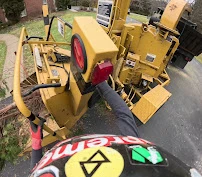
How a mound gets behind the garage in the first place
Almost nobody plans a brush pile. It happens in pieces. You take the low limbs off the maple in April so the mower fits underneath. In May you finally rip out the yew hedge your grandmother planted, roots and all. June you cut back the honeysuckle that had eaten six feet of fence, and by August there is a mound behind the garage that has its own weather. Every homeowner who calls us about it says a version of the same sentence: I thought it would settle.
It does settle, a little, and then it stops. Brush is mostly air, so a pile that looks like a small car is often only two or three loads once it goes through the machine. That gap between how it looks and what it actually is runs both directions, though. We have also pulled up to piles that photographed like nothing and turned out to have an entire dismantled deck railing buried in the middle. That is why we ask questions before we quote instead of after.
The other version of this call comes from three houses at once. Somebody on the street had a limb come down, a neighbor added their hedge trimmings, a third person contributed a Christmas tree from two years back, and now there is a collective pile at the end of a shared drive that nobody wants to claim. We chip those all the time. One visit, one machine, one number, and the neighbors can sort out the split among themselves.
Limbs to about twelve inches, fed butt-first, in that order
The chipper on our truck takes wood up to roughly twelve inches through. That covers essentially everything a homeowner generates with a chainsaw and a bad Saturday: limb wood, hedge material, saplings, storm-broken tops, whole scrub trees. Long pieces do not need cutting down to length first. In fact we would rather you left them long, because a twenty-foot limb fed butt-first pulls itself through and the small end vanishes as fast as the crew can walk it up. Short chunks are slower work than long ones, which surprises most people.
Butt-first matters more than length. Feeding the cut end in first means the rollers grab solid wood immediately and the branching stays behind, folding in on itself as it goes. Feed the same limb the other way around and the crew is wrestling a bushy tangle into a hole that is trying to spit it back out. Pittsburgh sees a lot of piles built by well-meaning people who stacked everything tips-out toward the driveway, which looks tidier and takes noticeably longer to run.
What jams a chipper is almost never the wood
A twelve-inch oak limb is easy. What stops the machine is the stuff that came with it. Vines are the biggest one around here, because a rope of grapevine or bittersweet will not break, it will wrap the rollers and bind them up like fishing line on a reel, and clearing that is somebody lying under the feed table with a knife for twenty minutes. Root balls are the second, and they are worse than they look. Dirt and gravel packed in the roots of a yanked-out shrub hit the knives at speed and dull a whole set in one pull, which is why we shake them out or set them aside for hauling instead of chipping.
Then there is the mystery hardware. Old piles collect things. Fence wire that was strung through a hedge before anybody remembers, a T-post the vines pulled over, tomato cages, a length of chain-link, the metal bracket off a swing set, half a bag of concrete mix. Steel in the feed is how knives break, and a broken knife is a bad day for everybody standing near the machine. So when Chris walks the pile he is not admiring your brush. He is asking what came out of the ground with it, whether there was ever a fence on that line, and how old the bottom of the pile is. Answer honestly, including the part you forgot about, and the visit goes smoothly.
What shows up
A chipper rated for twelve-inch wood, a truck to take chips away when you want them gone, and the crew to walk the pile in instead of dragging it across your grass.
Insured, military discount, and a real number in writing before anybody pulls a starter cord.
See the machines working in the gallery. If you would rather the brush left whole, that is brush removal. For trunk wood and log-sized material, read wood chipping.
“Triple T came and fell a broken pine tree in my front yard. They were in and out in about an hour and left my yard looking better than ever.”
A Google reviewerDrag distance is the whole price, and we say so out loud
The chipper does not move. Your brush does. Everything about what a chipping visit runs comes down to how far the crew walks each armload.
Piles that go fast
Staged within throwing distance of where the truck can park. Flat ground between pile and driveway. Butts pointed the same direction. Nothing under it and nothing buried in it. A pile like that gets fed almost as fast as two people can lift, and a mound the size of a minivan can be gone before lunch.
If you have not built the pile yet, this is worth knowing before you start cutting.
Piles that cost carry time
Down a bank behind the house. Across a soft back lawn in March. Through a gate the chipper cannot follow. Three separate small piles instead of one. Every one of those is workable, and every one of them means the crew is carrying wood uphill for an hour instead of feeding it.
We tell you which one you have during the walk-around and it shows up in the number, not as a surprise after. That is the same straight-talk we bring to storm debris cleanup, where the volume is bigger and the honesty matters more.
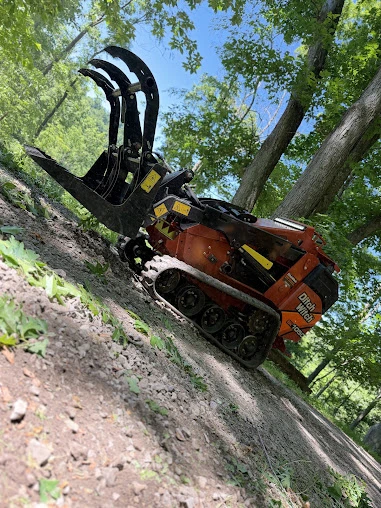

Left, the grapple saves the lawn on a big pile. Right, the same corner of the yard once the mound is gone.
Chips stay or chips ride along
Whatever goes through the machine comes out as mulch, and you get first claim on it. Blown into a corner of the yard it makes a free ground cover for beds, paths through the trees, or the muddy strip where the dogs run. Fresh chips are coarse and they will fade to gray over a season, which most people find perfectly fine for a back border and a little rough for a front bed. Say the word and we aim the chute where you want the pile. Say nothing and the chips go in the truck and leave with us, and the yard is bare grass again the same afternoon.
One local wrinkle: the pile that sat through a Pittsburgh spring. Rain gets into a mound of green brush and the bottom eighteen inches turn to a black composted mat, half soil and half leaf, threaded with dirt. That layer does not chip. It fouls the knives and gums the chute. So on an old pile we work top-down, chipping everything above the wet line, then fork the muck out separately and haul it. It is honest extra work and we would rather explain it standing in your yard than pretend the whole mound is going through the machine.
Home base is 15223, so most of this work happens close. Piles in Reserve Township tend to be down the bank behind the house, which is exactly the carry-time conversation. Yards in Millvale and Sharpsburg sit tighter together, where the pile is usually squeezed along a shared drive and access decides everything. Wherever it is, Chris has been reading Pittsburgh brush piles for twenty five years and knows what is at the bottom of yours before he moves the first limb.
Pile questions
What people ask standing next to the mound, pointing at it.
Do I have to cut the brush shorter before you come?
No, and please do not. Long limbs feed better than short ones because the machine pulls them through on its own once the butt end is in. Cutting a twenty-foot limb into four-foot lengths just means four times the handling for the crew and a longer visit for you. Leave it long and leave the branching on.
What if I do not know what is buried in the bottom of the pile?
Tell us that, exactly that. An old pile with an unknown bottom gets treated as suspect, which means we work down carefully and pull out anything that is not wood rather than feeding blind. The worst outcome is the homeowner who says it is all clean because they forgot about the fence wire from six years ago. Nobody is annoyed at a pile with junk in it. We are annoyed at a surprise.
Can you chip up the shrubs I dug out with the roots on?
The tops, yes. The root balls, no. Soil and stone caught up in roots destroy a set of knives in one feed, so we cut the root mass off, chip everything above it, and haul the balls away whole. Same rule for anything that came out of the ground rather than off a tree.
Where do the chips end up?
Your call, made before we start. We can blow them into a spot you pick and you have free mulch for the beds or a path. Or they go straight into the truck and off your property. Most people take some and send the rest with us, and that works fine as long as we know before the chute is aimed.
My pile is at the bottom of the hill. Is that a problem?
Not a problem, just carry time, and we will tell you exactly how much before you agree to anything. The chipper needs firm ground and truck access, so it sits up top and the crew works the brush uphill. Sometimes the grapple can reach it and sometimes it is arms and legs. Either way it goes in the number up front, not on the bill after.
What does chipping a brush pile come to?
It comes down to how much is there, how far it has to travel to the machine, and what is mixed into it. That is three things we cannot read off a phone call, so Chris comes out, walks the pile, and hands you a straight price in writing. Set up a visit and you will usually have it within a day or two.
Get the back corner of the yard back
One call, one walk-around, one morning with the chipper, and the mound behind the garage is mulch or gone. Insured, up-front number in writing, and we sweep the drive before we pull out. In sawdust we trust.