
For the road foreman
Municipal tree work for boroughs and townships
Allegheny County has around 130 municipalities and almost none of them have a forester on staff. Tree calls land on the road foreman’s desk between the pothole list and the leaf pickup schedule. Triple T is the crew that takes those calls off the desk: street trees, park deadwood, sight triangles, and the storm work public works shouldn’t be climbing.
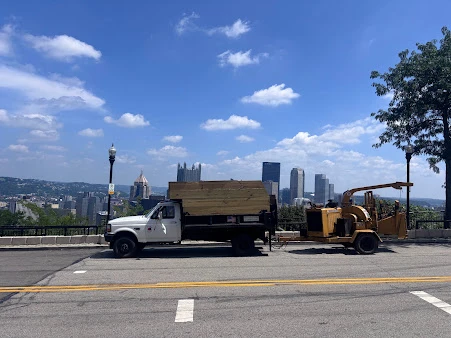
The strip between the sidewalk and the curb
Most of the tree work a borough actually owns lives in that four-foot planting strip in the right-of-way. Norway maples and pin oaks planted in the sixties, now sixty feet tall with roots under the sidewalk slabs and crowns growing into the utility drop. Nobody planted them expecting the borough to still be responsible for them in 2026, but here we are, and the resident who calls about a limb over the sidewalk is calling the municipal building, not a landscaper.
Right-of-way trees carry a different kind of exposure than backyard trees. A dead limb over a public sidewalk is a claim with the municipality’s name on it. So the work has to be defensible: what we found, what we did, what we recommended, and what date any of that happened. We write it down as a matter of course, because that record is the thing your solicitor asks for eighteen months later when a resident’s attorney sends a letter.
Sight lines are the other half of right-of-way work. Overgrown corner plantings that swallow a sight triangle, a low branch hiding a stop sign, a canopy grown down over the signal head at a five-point intersection nobody has trimmed since the last reconstruction. Those are cheap fixes when the truck is already in the borough, and expensive problems when a crash report cites obstructed visibility.
Parks, ball fields, and everything with people underneath
Community parks concentrate the risk. The mature oaks along the third-base line at the borough field are shading the bleachers, which means their deadwood is directly over the people sitting in them. Playground equipment gets sited under shade for good reason and then the shade tree ages out. Pavilion roofs, walking-trail edges, the pool fence, the memorial trees somebody’s family planted twenty years ago that are now half hollow at the base.
Drop zones in a park are the real planning problem. You can’t rope a limb over a playground during rec hours, and the summer schedule usually means there is no such thing as a quiet weekday afternoon. So we build the schedule backward from your rec calendar: early mornings before the fields open, weekdays during the school year, the window between the end of the fall season and the first hard freeze. Coned-off drop zones with a groundman watching the perimeter, not just tape and hope.
The good news is that park work batches well. Once we’re on site with the bucket and the chipper, walking the whole property and clearing every piece of deadwood over a bleacher, a bench, or a path costs the borough far less than three separate mobilizations across three separate complaints. If you’ve got a park inventory, send it. If you don’t, we’ll walk the grounds and build you one.
Storm nights: you have the road, we have the tangle
When a line of storms comes through Allegheny County, every public works department in the county is doing the same thing at once: getting roads open. Your guys are good at that. What they usually shouldn’t be doing at two in the morning is running a saw on a forty-footer that’s wrapped through a service drop and loaded with tension, in the rain, with a pickup and a homeowner chainsaw.
That’s where an overflow crew earns its keep. Public works clears what a loader and a truck can clear. We take the ones that need a climber, a bucket, or real rigging, and we take them in whatever order your foreman says. It’s the borough’s storm, not ours. We plug into the priority list you already have, and we’re on the phone with your foreman rather than freelancing around your operation. Our storm response page covers how we triage a county-wide blow when the calls stack up.
The paperwork side, done so it survives an audit
Small municipalities get burned by contractors who do fine tree work and terrible administration. We handle the administrative side like it matters, because for a borough secretary it matters as much as the sawdust. Certificate of insurance naming the municipality as a certificate holder, with any additional insured language your policy requires, in hand before the crew rolls. Invoices that itemize by location and date so they reconcile against the meeting minutes that authorized the work.
We respond on your forms, not ours. If a job goes out for solicitation or quotes, send the packet and we’ll fill out what you sent, in the format you sent it, by the date on the cover page. Where prevailing wage applies to a project, we’ll say so up front and price it that way rather than discovering the requirement halfway through. And if a proposed job crosses a threshold that forces you into a formal process, we’d rather tell you that than let a council member find out at the next meeting.
What your secretary needs
COI naming the municipality, issued from our carrier before mobilization. W-9 on request. Itemized invoicing by site and date.
Twenty five years in the trade, fully insured, and a crew used to working in the public eye with residents watching from the sidewalk.
See the equipment on real jobs in the gallery, or read the commercial side if you also manage authority or association property.
“Came through did an excellent job removing a huge pine tree that was damaged in the recent storm.”
Allyson W., Google reviewSplitting the work with public works
Nobody’s trying to replace your road crew. The line just needs to be drawn before the storm, not during it.
Your side
Tell us who’s authorized to call a crew out, and what dollar threshold that person can approve without a vote. Give us the priority list on a storm night. Point at the park and the intersections you already know are problems.
Send the COI requirements and the invoicing format once, and we’ll match them every time after that. If a job needs to go out for quotes, hand us the packet.
Our side
Walk the right-of-way and the park grounds, note species, condition, deadwood over public space, sight-line obstructions, and clearance over signs and signals. Flag what’s urgent versus what fits next year’s budget line.
Set traffic control on street jobs: flaggers, cones, a lane closure done properly rather than a truck with its hazards on. Then the tree work, the haul-off, and a street swept clean before we leave. Get the borough on our call list and storm nights get shorter.

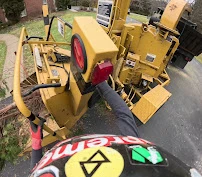
Our own crew on Allegheny County jobs. The chipper stays curbside on street work so the lane closure covers it.
Small boroughs, old streets, big trees
The river boroughs north of the city are where this work gets interesting. Etna is a mile and a half of borough with street trees crowded against narrow rowhouse frontages, where a lane closure has to be planned because there is no second lane to divert into. Millvale has the flood history, the riverfront park, and a street grid that runs uphill fast, so a takedown on the upper streets means gravity is working on the crew the whole time. Sharpsburg packs a lot of public frontage into a small footprint, with mature canopy over sidewalks that see real foot traffic all day.
What all three have in common is a public works department of a handful of people who already do six jobs each. The tree calls are real, the liability is real, and there is nobody on the payroll whose title includes the word arborist. That’s the whole reason this service exists. Call the number, describe the tree, and you’ll get a straight answer about whether it’s a today problem or a next-budget-cycle problem, along with a price you can bring to council.
What boroughs ask us
Usually from the municipal building, usually before a meeting. Straight answers so you can repeat them to council.
Is prevailing wage going to apply to our tree job?
Sometimes, and it depends on the project and the funding behind it. Routine maintenance tree work usually falls outside it, but tree work bundled into a larger public construction project frequently does not. We’d rather raise the question during the walk-through than find out after the invoice goes to the auditor, so tell us how the job is funded and we’ll flag it and price accordingly.
Can you name the borough on your certificate of insurance?
Yes, and we’ll do it before the crew mobilizes rather than after. Send us the exact entity name as it appears in your ordinances plus any additional insured wording your policy requires, and the COI comes to your inbox straight from our carrier.
Who is responsible for the tree in the strip between the sidewalk and the curb?
That depends on your ordinance, and it varies borough to borough around here. Some municipalities own right-of-way trees outright, some assign maintenance to the adjacent property owner, and plenty have language nobody has read since it was written. We’ll do the work either way, but it’s worth having your solicitor confirm which it is before a resident dispute starts, because the answer decides who gets billed.
Will you respond to our solicitation or quote request?
Send the packet. We fill out the forms you sent, in your format, and get it back by the date on the cover page. If the scope in the packet doesn’t match what’s actually in the field, we’ll say so in writing instead of quietly pricing a job that can’t be done as written.
How do you handle traffic control on a street job?
Properly, which means flaggers where the work needs them, cones and signage set before the bucket goes up, and a real lane closure rather than a truck parked with the four-ways flashing. On a narrow borough street we’ll talk to your foreman ahead of time about detours and whether the police department needs a heads-up. Residents get less annoyed when the closure looks planned.
Can we call you on a storm night without a contract in place?
Yes. Plenty of municipalities call us the first time at midnight with a tree across a road. It works better if we’ve already got your priority contact and your COI requirements on file, but nobody gets turned away for paperwork during a storm. Send us the contact list now and the two in the morning call gets a lot faster.
Take the tree calls off the foreman’s desk
One walk of the right-of-way, one written price you can hand to council, one crew that shows up with the insurance certificate already in your file. Twenty five years in the trade, and paperwork that survives an audit. In sawdust we trust.