
All 19 square miles of it
Penn Hills is big. We cover the whole thing.
Allegheny County’s second-largest municipality is not one neighborhood, it’s about forty of them stitched together with ravines. A crew that only knows Rodi Road is going to be lost by the time it gets out toward the Plum line, and a crew that only works flat ground is going to look at the hollows and quote you a fairy tale. Triple T Tree Care runs the whole township: the postwar plans, the wooded lots, the streets that just end in trees, and the odd corners where nobody has touched a canopy since the last century.
Chris has been in the trade 25 years and takes every Penn Hills call himself. Removals, pruning, stumps, storm work, the whole truck. Insured, military discount, and one visit start to finish.
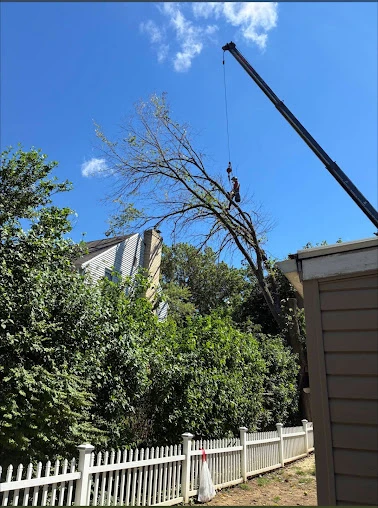
What we do in Penn Hills
Every service on the truck runs here weekly. The links go deep on each one.
Removal
Large tree removal · Tree removal · 24/7 emergency response · Storm damage cleanup
Care
Tree pruning · Tree trimming · Cabling · Bracing
Health
Tree health · Disease treatment · Arborist services
Groundwork
Land clearing · Lot clearing · Brush clearing · Forestry mulching · Stump grinding · Stump removal
Commercial
Four townships’ worth of tree problems in one
The plans off Rodi Road and Frankstown Road are where the volume is. Those streets filled in through the fifties and sixties, and the builders put a shade tree in every front yard the same year they poured the walks. Those maples are now sixty-plus years old, forty feet wider than anyone pictured, and sitting on lots that never grew with them. They are due, all at once, up and down the same block. We take a lot of them out, and we prune a lot more of them back into something a homeowner can live with for another decade. It is genuinely common for us to do three houses in a row on one street because the neighbors watched the first job and wanted the same thing before winter.
Then the ground drops. Hollows and ravines thread through the whole township, and every plan eventually backs onto one. Those edge trees grew up sheltered on three sides, so they put almost nothing into low anchor roots, and when a wet spring finally gives a gusty front something to push on they go over whole with the root plate lifting a slab of hillside. That is the call we get after every real storm: a tree lying downhill, its rootball standing up like a wall, and a fence or a shed under it. It is a different job from a street removal, it needs rigging off standing trees and a plan for getting wood back uphill, and it is a big part of why we know this township the way we do.
Out toward the Plum line the lots get bigger and the woods get closer, and the work shifts again. Half an acre of unmanaged edge growth, ash that died standing years ago, wild grape pulling crowns apart. Some of that ends up being removal work tree by tree and some of it is clearing a property line back to where somebody can mow. Standing dead ash deserves its own warning on those lots. Once the borer has been through, the wood goes brittle fast, and a tree that looked climbable two summers ago is now something nobody should be tied into. We take those from the ground or from a lift, and we take them before they decide to come down on their own schedule.
The streets that dead-end into woods are their own category. Half the plans in this township stop at a treeline instead of a cul-de-sac, so the last three or four houses on the street have a forest edge for a back yard. Those edge trees lean toward the light, which means they lean toward the houses, and nobody planted them so nobody has ever pruned them. When one of those calls comes in we look at the whole edge, not the single tree the homeowner pointed at, because the one leaning at your roof is usually holding up two more behind it.
The one that comes up most in Penn Hills, though, is the tree that isn’t yours. There are a real number of vacant and aging properties here where nobody has touched a canopy in ten or fifteen years, and the tree that grew up unmanaged on that lot is now leaning over an occupied house next door. We get that call constantly. The honest answer is that ownership follows the trunk, but you have the right to cut what crosses your line, and there is usually more we can legally do from your side than people expect. Chris will walk it with you, tell you plainly what can come off without touching the neighbor’s property, and if the only real fix is on their ground he’ll tell you that too instead of selling you half a job.
Storms hit a township this size three different ways at once. A front that just rains on Verona Road can be dropping limbs up on the ridge, and the hollows will be doing something else entirely. So we triage. Anything on a house, a car, or a wire gets stabilized first, wherever in the township it is, and the yard trees wait their turn. We keep people posted on where they sit in the line rather than promising everyone an hour that we cannot hold. Same standard we hold everywhere in Allegheny County, it just gets tested harder here.
Whatever comes down goes out the same day, and most removals finish with the stump ground below grade before the truck leaves. One and done. That is the whole idea.
“Absolutely fantastic work, carefully executed, highly recommend.”
John Seifert, Google reviewPenn Hills questions
The five things this township asks us most. More of the work is in the gallery.
My neighbor’s tree hasn’t been touched in years and it’s over my house. What can I actually do?
More than most people think. The trunk decides who owns the tree, but anything growing across your property line is yours to cut back to that line, and on a badly overgrown tree that is often enough to get real weight off your roof. Come out and we’ll walk the line together and mark exactly what comes off from your side. If the dangerous part is squarely on their ground, we’ll say so plainly and put it in writing so you have something to hand the owner or the township. We work vacant-property situations here constantly and we’re used to dealing with owners who are not around.
A tree behind my house went over into the hollow. Is that harder than a normal removal?
Different, not necessarily worse. Hollow-edge trees usually come over whole with the root plate standing up, which means there’s tension in the trunk and no safe place to just start cutting. We rig off standing trees above it, relieve the load in order, and cut the plate back down flat so you’re not left with a wall of dirt. Getting wood back uphill is the slow part, and we price that honestly instead of discovering it on the day. Call (412) 526-2028 and send a photo from your back door if you can, that tells us most of what we need.
How long after a big storm before you can reach me?
Depends where you are in the triage line, and we’ll tell you straight where that is. Penn Hills is big enough that one front hits the ridge, the flats and the hollows completely differently, so we work anything on a structure, a vehicle or a wire first across the whole township, then everything else. Most yard-tree calls land within a few days of a storm. We answer the phone at any hour, and we’d rather give you a real day than a comfortable one we can’t hold.
Every maple on my street is the same age. Should mine come down or can it be saved?
Often it can be saved, and we say so. A sixty-year-old plan maple that’s never had real work usually needs deadwood out, end weight reduced over the roof, and any bad co-dominant union addressed. Do that and you buy years. What sends a tree the other way is decay in the trunk, a split at the union, or roots that got cut for a walk or a driveway a while back. Chris looks at the tree in front of him and tells you which one you have. Plenty of Penn Hills trees we’ve been asked to remove got pruned instead.
What is this going to cost?
Nobody can answer that over the phone without seeing the tree, and anyone who does is guessing. Access is the variable here more than size, because a fifty-foot maple with a driveway beside it and the same tree down a hollow with no access are two different days of work. Send photos or book a walk-around and you’ll have an up-front number in writing, usually inside a day or two, and that number covers cleanup and hauling.
Got a Penn Hills tree that’s overdue?
Call or send photos. Chris sizes it up himself, you get the number up front, and the crew clears it in one visit. In sawdust we trust.