
Flat grid, river town, working crew
Braddock’s saw crew, block by block
Braddock is one of the easier boroughs in the valley to work and one of the most interesting. The street grid runs flat and square between the Mon and the mill, so a truck and chipper can usually park where the tree is instead of three houses down and uphill. That flat ground is the whole difference between here and the hillside boroughs above the tracks, and it shows up in the schedule: a removal that takes a full day on a slope off Bell Avenue is frequently a morning down on Braddock Avenue.
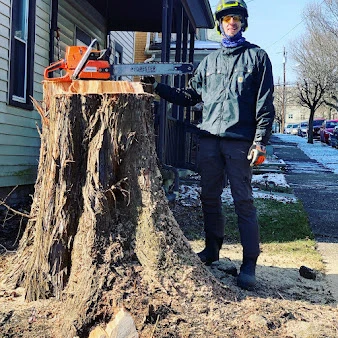
Chris runs the crew and he has been sawing for 25 years. Insured, military discount, and the same one-and-done standard whether the job is a dead silver maple behind a rowhouse or a full lot of volunteer growth going back into use as a garden.
What we do in Braddock
Every service on the truck runs here weekly. The links go deep on each one.
Removal
Large tree removal · Tree removal · 24/7 emergency response · Storm damage cleanup
Care
Tree pruning · Tree trimming · Cabling · Bracing
Health
Tree health · Disease treatment · Arborist services
Groundwork
Land clearing · Lot clearing · Brush clearing · Forestry mulching · Stump grinding · Stump removal
Commercial
What the work looks like down here
Two kinds of trees dominate our Braddock phone calls, and they need opposite answers. The first kind is the volunteer: ailanthus, mulberry, and box elder that seeded into an open parcel or against a foundation wall and got fifteen years of nobody’s attention. Those come out. The second kind is the old street sycamore, and those stay. There are sycamores on these blocks with trunks wide enough that they were mature when the library was already old, and they are the best shade in the borough. Anybody who tells you to drop one because it sheds bark every summer is selling you a saw. Those trees get a proper reduction, deadwood out, clearance over the sidewalk and the parked cars, and another forty years.
The lot work is its own category. Side-lot buyers, garden groups, and folks putting a parcel back to use call us with a deadline attached to something real: a growing season, a grant window, a build date. That changes how we plan it. We walk the parcel with whoever holds the deadline, mark what comes out and what is worth keeping, and put the clearing on the calendar so the ground is open and rough graded before you need it, not two weeks after. Old fill and buried foundation edges are normal on these parcels, so we probe before pulling anything instead of hooking a machine to something nobody can see.
The foundation trees are the ones that need a straight conversation. A tree of heaven that started in the gap between a porch and a wall does not stay small, and by the time the trunk is wrist thick it is already working on the mortar. Cutting the stem alone buys you one season, because the root system sends up a dozen more. When the stem is that close to a wall, the honest fix is the cut plus real stump work, done in one visit, so the thing is finished rather than paused.
Working next to occupied homes is the constant here. These blocks have people in them, cars on them, and porches close enough to the property line that a dropped limb is somebody’s afternoon ruined. So we rig rather than fell whenever the drop zone is short, keep the chipper feed off the sidewalk, and sweep the street, not only the yard, before we roll out. If the neighbor’s fence gets touched, we tell you before you find it.
The pace of the block matters too. A lot of what happens down here happens because somebody decided a parcel was worth something again, and that person is usually standing right there while we work. We keep the same courtesies on every job: the crew tells the house next door what time the saws start, we do not block a driveway somebody needs at three o’clock, and the parked cars in the fall zone get moved before a rope goes up. Half our Braddock calls come from a neighbor who watched the last one and asked for a card.
Wood is worth a conversation before we cut. Some owners here want the trunk sections left in rounds because they burn or because a woodworker two streets over will take them, and a straight sycamore or oak butt is genuinely useful to somebody. Say so at the walk-through and we stack it where you want it instead of loading it out. Otherwise it all leaves on the truck and the yard goes back to bare ground and rake marks. Either way it gets settled at the walk, while everybody can still hear each other.
The mill next door shapes the trees more than people realize. Decades of heat, soot, and road salt off the truck routes left a lot of these street trees with rough bark and thin upper canopies, and that history is why some of them look worse than they actually are. A tree with a scarred trunk and a few dead tips is often fine structurally. A clean-looking tree with a split at the main union is the one that scares us. That is the difference we are reading when Chris walks a property, and it is why we would rather come look than answer by text.
Storm calls are quick here and we take them seriously. Wind coming up the river funnel hits the flat grid all at once instead of hillside by hillside, so a bad night in Braddock tends to leave several trees down in a few blocks. Call any hour, we stabilize whatever is dangerous first, get photos for insurance, and clean up the rest on a schedule that works for you. Same crew, same standard we bring anywhere in Allegheny County, and the truck is about twenty minutes out.
“I had a tree damaged by wind and close to falling. Triple T came out within an hour and cut it down.”
Peter Cardone, Google reviewBraddock questions
What owners, side-lot buyers, and garden crews ask before we start. More of the work sits in the gallery.
Can you clear a lot on a community project timeline?
Yes, and we would rather plan around your date than guess at it. Tell us what the ground has to be ready for and when, whether that is a planting season, a fence going in, or an inspection. We walk it with you, mark what comes out, and book the crew so the parcel is open and raked ahead of your deadline. Everything we quote is one visit, cleanup included. If a permit or a utility locate has to clear first, tell us that at the walk and we will build the schedule around it instead of showing up to a lot we cannot legally touch yet.
There is a tree growing right against my foundation. What do you do about it?
Cut it and take the root out, in that order, same trip. Around here those are almost always tree of heaven or mulberry, and they resprout hard if you leave the stump. We work in tight against the wall with hand saws where a machine cannot go, then grind or dig the remainder depending on how close the footer sits. Then it is done rather than back next spring.
I like the big sycamore out front. Do I have to lose it?
Usually not. Those old street trees are worth keeping and most of them just need weight taken off, deadwood cleared, and clearance restored over the sidewalk and the parking lane. Chris will walk it with you and say plainly whether it is structurally sound. If pruning does the job, that is what we recommend and the tree stays where it is.
Can your equipment get to a back lot on these blocks?
The flat grid helps us more than almost anywhere in the valley. Alleys, curb cuts, and level ground mean the chipper usually parks close and the wood comes out the short way. When a mid-block parcel has no rear access, everything moves out the front through the gap between houses, which is slower but still one visit. We tell you which situation you have at the walk-through, not after. Where a machine genuinely cannot fit, we climb it and rope it down in pieces, which is the same work done by hand and costs you time rather than a second appointment.
How fast can you get here after a storm?
Braddock is roughly twenty minutes from home base, so storm calls here get same-day attention and the dangerous ones get moved to the front of the line. Call (412) 526-2028 at any hour. We make the site safe first, photograph the damage for your insurer, and then set the cleanup for a time that suits you.
Got a Braddock tree or a lot that needs opening up?
Call or send photos. Chris sizes it up, you get the number up front, and the crew handles the whole thing in one visit. In sawdust we trust.