
The campus landscape
Office park tree maintenance, planned by the campus
Most Pittsburgh office parks were planted once, in the eighties, and then mowed around for forty years. The trees kept going. Now the Bradford pears are splitting, the honey locusts are shaking hands over the drive, and the monument sign is behind a wall of yew. Triple T works the whole campus on a schedule instead of one emergency at a time.
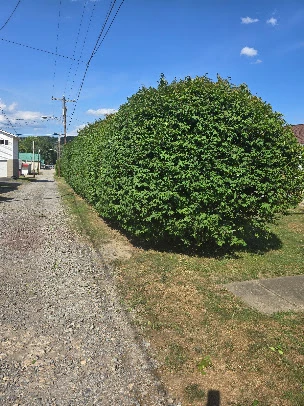
Everything on the campus was planted the same week
That single fact explains almost every tree problem an office park has. A developer finished the buildings, a landscape plan went in during one season, and forty years later every specimen on the property is the same age, the same size, and arriving at the same failure point at the same time. Residential streets get their trees in waves. A campus gets them all at once, which means the maintenance bill arrives all at once too, unless somebody spreads it out on purpose.
The eighties plant list around Pittsburgh is easy to read from the parking lot. Bradford pears along the drives, because they flowered fast and grew faster. Honey locusts in rows, spaced on thirty-foot centers that looked generous on paper and now have crowns fully interlocked. Pin oaks in the parking islands, dropped into soil pits about the size of a dishwasher. Yews and junipers packed tight around the entrance sign and the building foundation. Every one of those choices made sense in 1984 and every one of them is a work order now.
Bradford pears are the loudest. They grow with a dozen branches erupting from nearly the same point on the trunk, and once the tree passes about twenty-five years the included bark in those unions gives up. They do not fail gradually. They come apart in a single wet snow or one thunderstorm gust, usually into a parking stall, usually with somebody’s car in it. If a campus has a row of them, the whole row is on the same clock. That row is the first thing Chris looks at.
The parking island is the hardest place a tree can live
Nothing on the property is fighting harder than the tree in the middle of the lot. Its roots are inside a cut in the asphalt, and everything under that asphalt was compacted with a roller before the paving crew showed up, which means the soil has almost no pore space left for air or water. A mature shade tree wants somewhere around a thousand cubic feet of rootable soil. A standard island gives it maybe a tenth of that. The tree does not know it is supposed to stay small, so it grows to the size its genetics call for and then starves.
Then add heat. Asphalt at ninety degrees of air temperature runs well past a hundred and thirty at the surface, and the island bakes from all sides. Add salt: every winter the plow pushes brine-soaked slush directly into the only soil that tree owns, and sodium wrecks soil structure while chloride burns roots outright. Add the fact that rain lands on pavement and runs to a drain instead of soaking in, so the island is somehow both drowning in February and bone dry in August.
What actually keeps island trees alive is unglamorous. Mulch out to the full curb line instead of a volcano around the trunk, so the soil holds moisture and stops getting compacted by foot traffic. Vertical mulching or air-tool decompaction where the soil has gone to concrete. Watering in the first three summers after any planting, and during real drought stretches after that. Pruning for structure while the wood is small, because you cannot fix a bad union at eighteen inches of diameter. And honesty about the ones already lost, because a declining island tree replaced now with something suited to the site beats a stump grind and an apology in four years.
Selection matters more here than anywhere else on the property. Pin oaks hate the alkaline soil that leaches out of concrete curbs and go chlorotic and yellow within a decade. Species that shrug off salt, heat, and confinement belong in islands. We will tell you which of yours are worth investing in and which ones are a maintenance annuity you should stop paying.
Rows planted on thirty-foot centers, now touching
The other campus signature is the row. Honey locusts, lindens, or maples set in a straight line down a drive or a walkway, evenly spaced, and spaced for the tree the designer pictured rather than the tree that showed up. Thirty feet between trunks is comfortable for two decades. Past that, crowns interlock, the branches on the inside of each canopy shade out and die, and the whole row starts growing lopsided as each tree reaches for the only open light it has left, which is over the pavement.
That reach is why row trees end up hanging low over drive lanes and walkways rather than growing straight up. The fix is not a hard shearing every couple of years. It is selective thinning that opens the interlocked sections, plus raising the canopy on the pavement side to a consistent height so delivery trucks and lawn equipment stop tearing limbs off and leaving wounds that rot. Done once properly, a row like that holds its shape for four or five years. Sheared back hard every season, it fights you forever and looks worse each time.
Deadwood is the quiet item on the same list. The shaded-out interior branches die but do not fall right away, so they sit in the canopy over a walkway or a stall until wind or ice brings them down. Nobody budgets for deadwooding until the first one lands. Pulling it out on a schedule is one of the least expensive things a campus can do and it removes most of the limb-drop calls entirely.
What a campus visit covers
Every tree on the property gets looked at, including the ninety that did not drop a limb this year. Structure, decline, clearance over drives and walks, sightlines at the entrance, and what the parking islands are actually doing.
Insured, certificate of insurance on request, and twenty five years of reading trees behind the recommendations.
See campus work in the gallery. Related: commercial tree maintenance and crown raising for clearance over drive lanes.
“Christopher and his crew arrived on time, worked safely and efficiently, and handled the entire process with real professionalism.”
Felicia Provenzano, Google reviewWorking a campus between the morning rush and lunch
Tenants notice tree crews. The goal is that they notice for about an hour.
What you handle
Tell us which entrances feed the heaviest traffic and when. Let tenants know the day before so nobody comes out to a coned stall and a surprise. Point out any lot section that has to stay fully open, and give us a spot to stage chips and wood.
Then go back to work. Questions during the day go to Chris directly.
What we handle
Early starts, usually on site before seven so the noisy part happens while the lot is still half empty. Cones and a spotter on any lane we narrow, one section at a time so traffic always has a path. Islands done in blocks rather than scattered, so the same driver is not dodging us in four places.
Drive lanes and fire lanes get cleared to real truck height. Lot is blown clean and reopened before the lunch rush, and any stall we took comes back the way we found it.
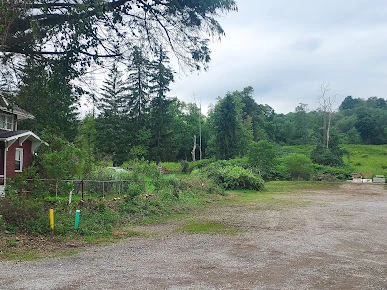

Our crew and our equipment on Allegheny County jobs. No stock photography anywhere on this site.
What the entrance drive says before anybody parks
A tenant’s first impression of a building happens at about twenty miles an hour, coming off the main road onto the drive. If the canopy over that drive is low and ragged, if the monument sign is half swallowed by overgrown yew, if the row of pears looks like it lost an argument with winter, the property reads as neglected before anyone has seen the lobby. This is the cheapest appearance work on any campus and the most visible. Raise the canopy over the drive to a clean, even line. Cut the shrubs back off the sign so the whole face reads from the road. Take out the volunteer trees that seeded themselves into the bed and now block the address numbers. It changes how the property looks in an afternoon.
Leases make this less optional than it sounds. Plenty of office and flex leases around here carry appearance and common-area standards, and tenants renewing at market rates notice when the grounds have slid. A campus that looks maintained holds tenants. One with a split pear taped off in the visitor row for three months does not.
We work office parks and flex campuses across the region, including Robinson Township, Moon Township, and Findlay Township out along the airport corridor, where the mid-eighties development boom put the same plant list on property after property. If your campus went in during that stretch, we have almost certainly worked its twin down the road, and we know what your trees are about to do.
Campus questions
What building owners and facility managers ask on the walk-through.
Our whole campus needs work. Does it all have to happen at once?
No, and it usually should not. The walk-through sorts every tree into three buckets: safety work that happens now, appearance work that can wait for a quieter budget season, and long-term structural pruning that pays off over years. Most campuses end up on a three-year plan where year one clears the hazards, year two catches up the drives and entrances, and year three is maintenance instead of triage. You see the whole plan and the whole cost up front, then decide how fast to move through it.
We have a row of Bradford pears. Do they all have to come out?
Usually not in one season. Some are far enough gone that removal is the only honest answer, some can be reduced and thinned to buy several more years, and a few are structurally fine. We tag them individually rather than treating the row as one decision. Where a row does come out, staggering it over two or three seasons and interplanting replacements keeps the drive from looking stripped bare.
Can the tree in our parking island be saved?
Depends on how much soil it has and how much canopy it has already lost. If the tree is thinning from the top and the island is a small cut in the asphalt, it is telling you it ran out of root room years ago. If it is stressed but still holding a full crown, decompaction, proper mulching to the curb, and a few seasons of watering often turn it around. We will tell you which one yours is instead of selling you care for a tree that is finished.
How early can your crew start so we are not in the way?
Most campus days start around six thirty or seven. That gets the loudest cutting done while the lot is mostly empty and leaves the afternoon for chipping and cleanup at a lower volume. If your tenants include a call center or anything noise-sensitive, tell us on the walk-through and we will build the day around it.
Will you have to close part of the parking lot?
We cone off one working section at a time, never the whole lot. Typically that is a handful of stalls plus a lane for the chipper. Fire lanes stay passable the entire time. We move through in blocks so drivers are not dodging equipment in several places at once, and everything reopens as we finish each section.
How do you price maintenance for a whole campus?
Chris walks the property, counts what is actually there, and hands you an up-front number in writing broken out by phase so you can budget it across fiscal years rather than swallowing it whole. No guessing over the phone off a site plan. Set up a campus walk-through and you will have the numbers, usually within a few days.
Your campus trees are all the same age. Plan like it.
One walk-through gets every tree on the property looked at, a three-year plan you can budget, and a written price for each phase. Then we show up early, work clean, and get out before lunch. In sawdust we trust.