
Borough work, 15235
Churchill’s evergreens were planted as architecture
Somebody drew these yards on purpose. Churchill went up as a planned borough in the fifties and sixties, and the landscape plans came with the house plans: a blue spruce set to anchor one corner of the lot, a row of hemlocks along a side line to hold privacy, a stand of pines placed to frame the low horizontal roof instead of hide it. Sixty-some years later those trees are sixty feet tall and a good number of them are finished. That is most of what we do here.
Removals, pruning, screen-row work, stump grinding, storm calls. Insured, military discount, and Chris on the walk-around before anything gets quoted. One and done, and the up-front number you approve is the number on the invoice.
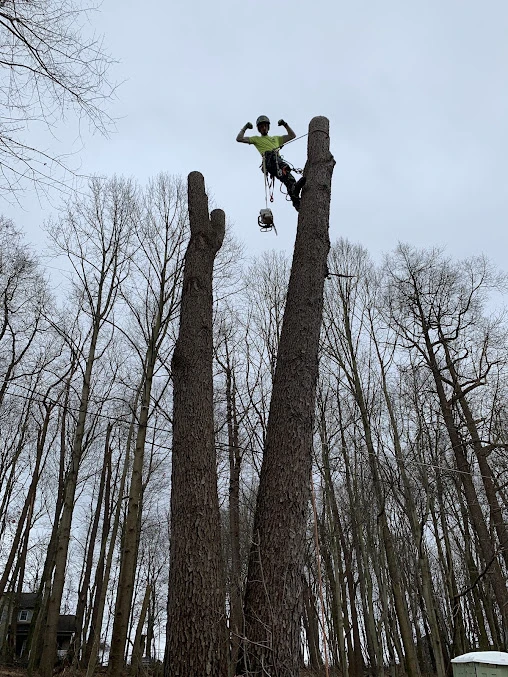
What we do in Churchill
Every service on the truck runs here weekly. The links go deep on each one.
Removal
Large tree removal · Tree removal · 24/7 emergency response · Storm damage cleanup
Care
Tree pruning · Tree trimming · Cabling · Bracing
Health
Tree health · Disease treatment · Arborist services
Groundwork
Land clearing · Lot clearing · Brush clearing · Forestry mulching · Stump grinding · Stump removal
Commercial
Working inside somebody’s design
Churchill is small and quiet, a couple thousand people on wide landscaped lots just off the Parkway East, and it has a look you notice within one block. Low rooflines, long window walls, deep front setbacks, and evergreens used the way a designer would use a wall. That is the part a lot of tree crews miss. On a typical postwar street a spruce is a spruce. Here it was placed, and it has a job, and taking it out without thinking about the job leaves a house looking naked from the road. Chris starts a Churchill walk-around by asking what the tree was doing for you, because the answer usually changes the plan.
What brings us out most is the blue spruce. They were the signature planting of the era and they are in trouble across the whole borough. Needlecast is the common story: the interior needles brown and drop, then the lower third of the tree goes bare and stays bare, and the top keeps growing so you end up with a green tuft on a stick. Spruce will not refill the bottom once it is gone, and there is no spray that undoes it. Cytospora canker shows up on the same trees, killing branches one whole limb at a time with a chalky white resin bleed at the trunk. Sometimes we catch a tree early enough that a real health plan is worth running. Often we are looking at something that has been declining for eight years and the honest call is taking it out before it drops the top on the driveway.
Screen rows: take the dead ones, keep the line
The hemlock and arborvitae rows along side property lines are the other constant. Those were planted close together to make a hedge that would read as solid, and after six decades they are anything but uniform. Two are dead, one is leaning into the neighbor’s yard, four are fine, and the whole run has gone woody and open at the bottom. Ripping out the entire row is the fast answer and almost always the wrong one, because you paid for privacy and now you have a fence line and a view of somebody’s patio.
So we do surgery on it instead. Take the dead and dying stems out one at a time, low, without wrecking the roots of the good ones on either side. Clean up the survivors so they can put growth where the gaps are. Grind the stumps deep enough that the same holes can be replanted with something that will actually thrive under mature shade rather than another hemlock that will inherit the same adelgid problem. Two years of patience and the line closes back up. That is a slower conversation than most companies want to have, and it is why people here call us back for the second half of the row.
Where the yards meet the greenway
Then there are the backyards that end at the Churchill Valley greenway. When the old country club land went quiet and came back as a conservancy corridor, the woods stopped being mowed and started behaving like woods: unmanaged ash, black locust, wild cherry, and volunteer maple all leaning toward whatever light they can find, which is usually the light over your lawn. Ash mortality has left a lot of standing dead timber back there, and dead ash is the least predictable wood a climber deals with, brittle and unwilling to hold a rope the way a live tree does.
Our work along that edge is mostly deadwooding and hazard reduction on the trees whose failure would land on your property. We are careful about the line. What is rooted on conservancy ground is not ours to cut, and we will tell you where that boundary sits rather than let a crew guess. What overhangs your yard from your side of the line, and anything rooted on your ground, is fair game and it is worth handling before a wet March wind sorts it out for you. Same crew, same standard we run everywhere in Allegheny County, just a slower and more deliberate day because of what is under the drop zone.
Timing matters more here than people expect. The borough sits high enough that wet snow and ice loads hit the old evergreens hard, and a spruce that has been thinning for years carries what weight it has left way out at the tips, which is where it does the most damage when it finally lets go. Late fall is our busiest Churchill stretch for that reason. People look up in October, see how little green is actually left on the thing, and would rather deal with it on a dry Tuesday than during a February storm with a limb across the driveway and the power company already three days behind. If a tree has been nagging at you since spring, the walk-around costs nothing and it settles the question either way.
Access here is easier than most of our territory, which is worth saying out loud. Wide lots, real driveways, no alley gymnastics. The chipper gets close to the work, the wood leaves with us, the stump goes below grade the same visit, and the lawn gets raked before the truck pulls out. On a street where the yards were designed, leaving ruts and a pile of brush is not an option.
“Absolutely a great worker! Professional and knowledgeable about our trees. Quick response time. 10/10 would recommend!!”
Erin Auvil, Google reviewChurchill questions
What people here ask before the ropes go up. More of the work is in the gallery.
My blue spruce is bare on the bottom third. Can it be saved?
The bare part, no. Spruce does not push new growth from old bare wood, so those lower branches are not coming back no matter what gets sprayed. The real question is whether the top half is still healthy and holding. If it is, we can treat what is causing the loss and buy you years. If the canker has moved into the leader and the crown is thinning too, you are looking at a tree that will get uglier and heavier every season, and taking it down on your schedule beats waiting for a wet snow to decide.
Two hemlocks in my privacy row are dead. Do I have to take the whole row out?
No, and we would talk you out of it. We pull the dead stems individually, protect the roots of the neighbors on both sides, prune the survivors so they fill toward the gaps, and grind the stumps deep enough to replant right there. You keep the screen you paid for while it recovers. Full row removal is a last resort for us, usually when adelgid has hit every plant in the run and nothing left is worth saving.
There are dead trees in the greenway woods behind my house. Will you cut those?
Only what we are allowed to. If the trunk is rooted on conservancy ground, it is not ours or yours to cut, and we will show you exactly where that line falls instead of guessing. Anything rooted on your side, plus limbs reaching over your yard, we handle. In practice most of the risk back there is standing dead ash, and dealing with the ones aimed at your house takes care of the problem that actually matters.
Will removing this tree ruin how the yard looks from the street?
That is a fair worry here and we take it seriously. These lots were composed, and pulling one big evergreen out of the composition can leave the house looking exposed. Before anything comes down we stand at the curb with you and look at what the tree is holding up visually. Sometimes the answer is a heavy reduction instead of a removal. Sometimes it is removal plus a replacement set a little farther off the foundation than the original was. Either way you know what the yard will look like before we start.
What does tree work cost in Churchill?
It rides on the tree, the access, and what sits under it, so nobody should be quoting you a figure over the phone. Send photos or book a walk-around and Chris gives you an up-front number in writing, usually within a day or two, and it covers the cleanup too.
Got a Churchill evergreen on its way out?
Call or send photos. Chris walks the lot, tells you straight whether it is worth keeping, and the crew handles the rest in one visit. In sawdust we trust.