
Damage from the inside out
Insect treatment for trees being eaten alive
Some bugs annoy a tree. Borers and defoliators kill it. Emerald ash borer erased most of the ash canopy in Allegheny County, birch borer works through white birches street by street, and bagworms strip an arborvitae hedge in a single July. We treat what can be saved, and we say so plainly when a tree is already past it.

Emerald ash borer and the math nobody wants to hear
If you owned an ash tree in Western Pennsylvania in 2010, you probably don’t own it anymore. The emerald ash borer arrived, worked through the region in under a decade, and left standing gray skeletons along every creek bottom and back property line from Etna to Wexford. The beetle itself is a half-inch of metallic green. The damage is done by the larvae, which tunnel S-shaped galleries under the bark and cut the tree’s plumbing until nothing reaches the crown.
The signs are readable from your driveway once you know them. Look for D-shaped exit holes about an eighth of an inch across, which no other local pest leaves behind. Look for blonding: pale patches where woodpeckers have flaked off the outer bark chasing larvae, and one of the earliest honest signals a tree is infested. Look for sprouts pushing straight out of the trunk, which is an ash trying to grow around a crown it can no longer feed. Then look at the top third of the canopy, because ash dies from the top down.
Here is the part that separates a real conversation from a sales pitch. A healthy ash with most of its canopy intact can be protected essentially indefinitely with trunk injections on a two-year cycle. The treatment goes into the vascular tissue and it works, and there are ash trees standing in this county today only because somebody started injecting them and kept it up. But an ash that has already lost half its crown has lost the plumbing that would carry the treatment, and injecting it is money set on fire. At that point the conversation changes from treatment to removal, because dead ash goes brittle faster and more dangerously than almost any other tree we handle. Climbers hate it. That is not a scare tactic, it is scheduling advice.
The borers that hunt trees already having a bad year
Ash borer will take a perfectly healthy tree. The other borers we deal with around Pittsburgh are opportunists, and that changes the whole approach. Bronze birch borer goes after white and paper birches, the ornamental ones people plant in clumps of three because they look beautiful against snow, and which are living well south of the climate they actually want. The birch dies back from the top, thins out branch by branch, and shows raised ridges on the bark where larvae have tunneled underneath. By the time the upper branches are bare, the injection window has usually closed.
Two-lined chestnut borer works oaks, despite the name, and it almost never attacks a comfortable one. It shows up after a drought summer, after construction has compacted the root zone, after a lawn crew nicked the trunk with a mower for the fifth year running. The oak flags: leaves brown and hang on rather than dropping, usually starting high and working down. Treating that oak without addressing why it was stressed in the first place is treating a symptom. Sometimes the honest answer is water, mulch, and clearing the deadwood rather than a chemical.
That stress connection is the most useful thing on this page. Borers are attracted to trees that are already struggling, and a good soak during a dry August is genuinely one of the strongest insect defenses a homeowner has. Twenty gallons at the drip line, slowly, once a week through a drought, does more for a mature oak than most sprays. Chris will tell you that on the walk-around before he’ll sell you anything.
Defoliators: loud, ugly, and usually survivable
The bugs that eat leaves scare people far more than the ones that kill trees. Bagworms are the exception worth acting on. Those little cone-shaped bags hanging on arborvitae, spruce, and juniper are caterpillars wearing armor made of the plant they’re eating, and an evergreen that gets stripped does not push new needles the way a maple pushes new leaves. A heavy bagworm year can kill a privacy hedge outright. Timing is everything: treatment lands in June while the larvae are small and feeding, and once the bags seal up in late summer, spraying is theater. Picking them off by hand over the winter genuinely works on a small hedge.
Fall webworm builds those messy gray tents out at the ends of branches in August, usually on cherry and walnut. Eastern tent caterpillar builds a tighter, tidier tent in the branch crotches in April, usually on cherry and crabapple. People mix them up constantly. Neither one typically kills a mature tree, because both hit at times of year when the tree has already banked most of its energy, and both look far worse than they are. Cutting out a webworm nest with a pole pruner is fine. Burning it out with a torch, which somebody suggests every single year, is how you kill the tree the bugs weren’t going to.
Spongy moth runs in cycles and is the one defoliator that can actually finish a tree, though usually only after repeated years of full stripping on an oak that was already weak. When a bad cycle rolls through, the trees that die are almost always the ones that were carrying borers or root damage first. Everything on this page connects back to the same idea.
What we treat, honestly
Trunk injections for ash worth saving. Targeted timing for bagworm and borer flights. Deadwood and hazard work when treatment is no longer the answer.
Fully insured, PA HIC #163598, 25 years in the trade, and a military discount for those who served.
Chewing damage is this page. Sticky leaves, sooty mold, and sap-feeding pests live on the pest treatment page, and fungal problems are covered under tree disease treatment. Work photos are in the gallery.
“Christopher and his crew arrived on time, worked safely and efficiently, and handled the entire process with real professionalism.”
Felicia Provenzano, Google reviewRight chemical, right season, right pest, or nothing
Most bad insect work is a product applied on the wrong week. Here is how the job is split.
Your part
Call when you notice something: bare branch tips, bark flaking off in pale patches, bags on the evergreens, webs at the branch ends. Photos of the trunk and the canopy help. Then tell us what changed recently, because new construction, a regraded yard, or a dry summer usually explains the whole thing.
Keep watering during drought. It is unglamorous and it is the single best thing you can do between visits.
Our part
Identify the actual insect instead of guessing from a photo on the internet. Judge whether the tree has enough live canopy to make treatment worth it. Set the application to the pest’s calendar rather than ours, since a June bagworm window and a spring ash injection window are not interchangeable. Then give you an up-front number and tell you what happens if you do nothing.
If the tree is past saving, we say so and quote the takedown instead. Nobody gets sold an injection for a dead ash.

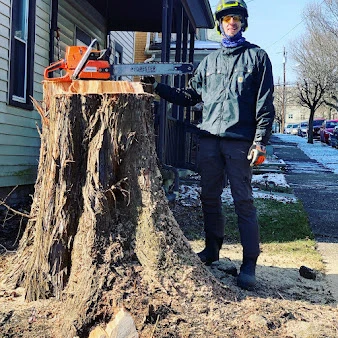
A cut face tells the truth about what was living inside a trunk. Both photos are our own crew, on our own jobs.
Where the bugs are worst around here
Insect pressure follows the trees people planted, so it changes by neighborhood. The developments in McCandless and Franklin Park went up during the decades when ash was the standard street and yard tree, which means those are the properties still carrying the last mature ash on the block, and the ones where a two-year injection cycle is either already running or already too late. Newer construction in Cranberry Township brings the other pattern: arborvitae privacy rows along every property line, which is exactly what bagworms want, plus young oaks stressed by compacted fill soil and prime for two-lined chestnut borer.
Our clay soil makes it worse. It holds water in spring, then bakes hard and sheds water in August, so a tree can be waterlogged and drought-stressed in the same year. That swing is what softens up an oak or a birch enough for borers to move in. Watch your trees in the second half of summer, because that is when a struggling one starts telling on itself.
Borer and caterpillar questions
The ones we answer standing under the tree, before anybody signs anything.
Is my ash tree worth treating or is it too late?
The rough rule is canopy. An ash that still has most of its crown responds well to trunk injections and can be held indefinitely on a two-year cycle. Once it has lost about a third to half of the canopy, the vascular system that carries the treatment is already compromised and injecting it wastes your money. We look at the top of the tree first, because ash dies downward.
What are the little D-shaped holes in my bark?
Those are emerald ash borer exit holes, and they are diagnostic. No other pest around Pittsburgh leaves that shape. If you’re also seeing pale blonded patches where woodpeckers have stripped the outer bark, the infestation has been running long enough for the birds to find it, which usually means longer than the homeowner thinks.
Do the bags on my arborvitae go away on their own?
No, and evergreens do not recover from being stripped the way leafy trees do. Bagworms need treatment in June while the larvae are small and actively feeding. By late summer the bags are sealed and spraying accomplishes nothing. On a short hedge you can pick the bags off through the winter and cut the next generation off before it starts.
There’s a big web in my tree. Should I be worried?
Almost certainly not. Webs at the branch tips in August are fall webworm, and tents in the branch crotches in spring are eastern tent caterpillar. Neither one usually kills an established tree, since both arrive when the tree has already stored its energy for the year. Clip the nest out if it bothers you. Never burn it, which does more damage than the caterpillars ever would.
Why did borers pick my tree and not my neighbor’s?
Except for ash borer, most borers target trees that are already stressed by drought, root damage, soil compaction from construction, or repeated mower wounds at the base. Your tree probably had a hard year that your neighbor’s tree didn’t. That is also why watering deeply during a dry stretch counts as real insect defense.
How much does insect treatment cost?
It depends on the pest, the size of the tree, and whether treatment even makes sense, which is why we won’t throw a figure at you over the phone. Chris looks at the tree, identifies what’s actually in it, and hands you an up-front number in writing. Book a walk-around and you’ll usually have it inside a day or two.
Find out what’s in the tree before it finishes the job
One look tells us whether you’re holding a tree that can be saved or scheduling a takedown before it gets dangerous. Either way you get a straight answer and a written number, not a subscription. In sawdust we trust.