
We do not top trees. Here is what we do instead.
Somebody offers to take the top out of your maple every spring in this township. It is cheap, it is fast, and it is the single worst thing anyone can do to a mature tree.
Ross Township, Allegheny County. Pruning on a weekly rotation, (412) 526-2028.
Topping cuts a big stem back to a stub with no branch left to take over. The tree responds with a burst of weak shoots off the wound, all attached to nothing but bark, and in six or eight years you have a heavier, uglier, less stable tree than the one you started with, plus decay working down the cut. Everything below is what a proper prune actually looks like on the trees Ross Township grows.

Four cuts, and what each one is for
Trimming is not one job. When Chris walks a Ross yard he is deciding which of these the tree needs, and often it is two of them on the same visit.
The canopy lift off a roofline
The most common prune in this township by a distance. A postwar ranch with a shade tree planted eight feet off the wall, and sixty years later the low limbs are dragging on the shingles, filling the gutters every fall, and holding moss on the north slope of the roof because nothing dries. Lifting the canopy means taking the lowest tier of limbs back to the trunk or to a good lateral, so there is daylight and air between the branches and the house. Done right you get the roof back and the tree keeps its shape, because the limbs that come off are the ones nobody was looking at anyway.
Deadwood out of a mature maple or oak
Old trees shed. A pin oak drops its dead third from the top down and a silver maple carries dead interior limbs for years before they let go. None of it is a sign the tree is finished, but every one of those limbs is going to come out eventually and it will pick the moment. A deadwood pass takes the dead and the hanging pieces out of the crown with a climber, which is the whole job on a lot of Ross trees. The tree looks the same afterward and stops raining branches on the driveway.
Thinning for wind
A crown that has gone solid catches wind like a sail, and on a tall silver maple with a tight fork that load goes somewhere you do not want it. Thinning removes a measured share of the smaller branches spread evenly through the crown so air moves through, without changing the outline. Take too much and you shock the tree and start it growing back twice as dense. The restraint is the skill.
Reducing weight on one side
Trees that grew next to a house or under a bigger neighbor reach for light and end up lopsided, all their weight extended out over the one place it should not be. A reduction shortens those long limbs back to a lateral branch big enough to become the new end, which keeps the taper and keeps the tree looking like a tree. It is the honest alternative to topping and it is what somebody should have offered you in the first place.
When to cut, and when to wait
Timing matters less than people think and more than nothing. The dormant season is the default for structural work, roughly once the leaves are down through late winter. The wood is visible, the crown structure reads clearly from a rope, the ground is firm, and the tree has months to seal the cuts before it pushes new growth.
Summer is fine for deadwood and for lifting limbs off a roof. Dead is dead in any month, and a canopy lift is not a structural cut. What we avoid in summer is heavy live reduction on a tree already under heat and drought stress, because it is asking a lot at the wrong moment.
Two exceptions override the calendar. A broken or hanging limb over anything that matters comes out the day you call, in any season, and if a front did it the work may run into cleanup rather than pruning. And we do not make fresh cuts on oaks in the warm months when beetles are moving, because the sap draws them to open wounds. Oak work here waits for the cold.
Worth mentioning when you call: which limbs are touching the house, the gutters or the service line, whether anything has dropped out of the tree this year, the species if you know it, whether the limbs cross into a neighbor’s yard, and how wide the back gate is.
A good prune is the one nobody notices. You look up a week later and just think the tree seems healthy.Chris, on what a canopy lift should look like
Trimming and hedges are different visits
People book the two together and that is sensible, but they are separate kinds of work and it helps to say which one you want when you call.
Tree pruning is climbing work. Somebody goes up on rope, makes decisions limb by limb, and the cuts are permanent choices about how that tree grows for the next decade. Hedge and ornamental shearing is ground work on a shape you maintain on a cycle, and the rules are almost the reverse: frequent light cuts, all of it done from a ladder or the ground.
Where they meet is the walk-around. Chris looks at the whole property once, tells you what genuinely needs doing this year and what can sit, and you get an up-front number in writing covering the lot of it. Nobody gets sold a prune on a tree that is fine. Send photos through the contact form if it is easier, and include one wide enough to show the tree against the house.
Now and then the answer is that pruning will not save it. A tree that has lost most of its crown or has a split running into the trunk is a removal, and we would rather tell you that than take money for a trim that buys a season.
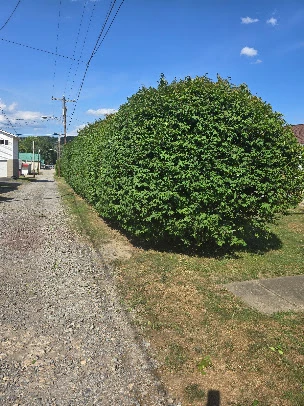
Pruning the block, not just the tree
Streets here were planted in one season, so the trees come due in one season too. It is common for us to lift three canopies in a row on a Ross street because the first neighbor liked how the roof looked afterward. If a couple of houses on your block have the same overgrown maple, mention it when you book and the whole street goes on one visit at one setup.
The rest of the work runs alongside. Pruning that turns up a dead or split tree becomes a takedown, which usually finishes with the stump ground out the same day, and anything hanging after a storm is an emergency call rather than a scheduled prune. We cover Ross Township weekly and the wider Allegheny County map on the same rotation. The general tree trimming page has more on the method, and before-and-after work is in the gallery.
Ross Township, Allegheny County. Postwar plans with sixty-year-old shade trees planted too close to the brick.
Pruning questions from around the township
The ones we answer standing in the front yard, most weeks.
How often does a mature tree actually need pruning?
Less often than people are told. A healthy mature maple or oak in a Ross yard is usually on a five to seven year cycle for deadwood, and a canopy lift lasts longer than that because the limbs you removed do not grow back where they were. Young trees benefit from more frequent light work while their structure is still being set.
Why will you not just take the top out to make it shorter?
Because it does the opposite of what you want. Cutting a stem back to a stub leaves nothing to take over growth, so the tree throws dozens of weak shoots off the wound that are attached to bark rather than wood. In a decade it is taller, heavier and far more likely to fail, with decay running down from the cut. A reduction to a proper lateral gets you the same height with none of that.
My limbs are over the neighbor’s yard. Can I have those cut?
Generally you can trim what crosses your line, and your neighbor can trim what crosses theirs. The trunk decides who owns the tree. What works better than either side cutting alone is one visit where both of you agree on the plan first, so the tree comes out balanced rather than flat on one face.
Will pruning fix a tree that keeps dropping branches?
Usually, if what it is dropping is dead. Mature trees shed interior deadwood for years and a climbing pass takes all of it out at once. If the limbs coming down are live and green, that is a different signal, and we want to look at the crown and the root zone before telling you anything.
Do you clean up, or do I get a yard full of brush?
It all leaves with us. Brush goes through the chipper, larger wood goes on the trailer, and the lawn and beds get raked and blown before the truck pulls out. You should not be able to tell we were there except by looking up.
Can you prune around the wires coming into my house?
Tell us that on the phone first. Anything touching a Duquesne Light line is their call before it is ours. The service drop running from the pole to your own house is a different matter and we do work near those, with the right training and the right gear, but we will never guess about what a line is.
Have Chris look at the tree before anyone cuts it
Call and describe what the tree is doing, or book a walk-around through the contact page. You get an honest read on what needs doing this year, an up-front number in writing, and a crew that leaves your yard cleaner than it found it. In sawdust we trust.