
The pile is the job
Storm debris cleanup: getting the wood off your lot
Everything the wind knocked down is now sitting on your grass, and it is heavier and bulkier than it looks from the kitchen window. This page is about the material itself. What gets chipped, what gets loaded whole, what the truck can carry in one run, and how a yard that looks like a logging landing on Sunday morning is bare grass by Monday night.
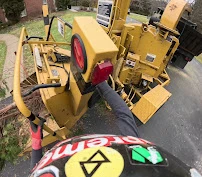
Everybody guesses low, and everybody guesses low by a lot
Here is the number that surprises people every single time. One mature silver maple crown, laid out flat on a suburban lawn, is usually somewhere between four and seven truckloads of chip and log once it is broken down. Not one. Not two. A crown that occupied a sphere seventy feet across in the air does not politely compress when it hits the ground.
The reason the guess goes wrong is that you are looking at a pile from one side. Standing at the patio door you see the top layer of brush and you think about a half hour with the loppers. Underneath that brush are the limbs the brush was attached to, and somewhere in the middle is a trunk section that weighs more than your car and is not going anywhere without a machine. A homeowner who starts Saturday morning with good intentions usually gets through the outer twenty percent, hits the first piece of real wood, and stops.
Green wood makes it worse. Storm debris is freshly broken, still full of water, and fresh maple runs a good bit over fifty pounds per cubic foot. What looks like an afternoon is a truck, a chipper, and a crew.
Three piles, not one, and the sorting is what makes it fast
The first thing our crew does is not cut anything. It is sort. Storm debris divides into three categories, and every piece leaves your property by a different route, so putting the right piece in the right place at the start is what keeps a job from taking two days instead of one.
Saw logs go first. Anything above roughly ten or twelve inches through gets bucked into rounds we can lift or roll, and those go on the truck whole. If you burn wood, this is the moment to say so, because we will cut those rounds to whatever length your stove wants and stack them wherever you point.
Chippable brush is the middle category and the biggest by volume. Anything under about twelve inches, limbs and leaves and all, goes in the chipper and comes out as chip in the box.
The third pile is the one nobody plans for: the rakings. Twigs, bark slabs, the shredded material that comes off any limb dragged across a lawn. It will not feed a chipper cleanly, so it gets raked, forked, and tarped off to the truck at the end. That last pile is the difference between a yard that is clear and a yard that is clean.
What the chipper eats and what it flatly refuses
A drum chipper is happy with green limbs, leaves, vines, and anything fibrous that will pull through a feed roller. It does not want dirt, and this is the thing people get wrong when they help. A limb dragged butt-first across bare soil comes to the machine with grit on the cut end, and grit takes the edge off chipper knives faster than any amount of wood. So we cut a fresh face on anything that has been dragged.
It also does not want your uprooted root ball, which comes out of a lawn half soil and half rock. Those get cut off the trunk and loaded separately, or ground where they sit. And it does not want fence wire, tree stakes, or the hundred feet of Christmas lights that were still up in that spruce. Metal in a chipper is a bad day.
The trunk is the honest limit. Our chipper eats twelve-inch wood, and a lot of what a storm brings down is bigger than that at the base. That wood rides out whole on the truck, which is why the truck matters as much as the chipper. Anybody advertising a full storm cleanup with a trailer and no way to move trunk wood is planning to leave your logs in a corner of the yard.
Why the borough truck is not the answer this time
People try municipal channels first, and it is reasonable, and it almost never works after a real blow. Yard-waste programs across Allegheny County are built for what a normal household produces: a hedge trimming, a few bags of leaves, brush bundled in something one person can carry. The rules are usually a diameter cap around four inches, a length cap around four feet, a bundle count per week, and no logs at all, ever.
Your storm pile violates every one of those on the first limb. Even when a municipality runs a special post-storm collection, you are looking at weeks rather than days, and the pile sits at the curb the whole time while the grass under it dies. If the debris is all that is left and the trees are fine, debris hauling is the narrow version of this same work.
What shows up to move it
Chipper rated for twelve-inch wood, a grapple loader so nobody drags trunk sections across your lawn, dump capacity for logs, and rakes and tarps for the fine material at the end.
Insured, military discount for those who served. Chris has 25 years of reading how much wood is actually in a pile.
Tree still standing and wrecked? That is storm-damaged tree removal. Whole-property recovery with hangers and hazards is storm damage cleanup. Finished yards live in the gallery.
“Triple T came and fell a broken pine tree in my front yard. They were in and out in about an hour and left my yard looking better than ever.”
A Google reviewerMoving tonnage without wrecking the lawn under it
The debris weighs what it weighs. Where the weight travels is a choice somebody makes before the machines move.
Ground protection
Wet spring clay is the worst surface in Pittsburgh for a loaded machine, and a rut cut into saturated turf does not heal on its own. Where equipment has to cross grass, mats or plywood go down first and the machine travels one path instead of finding a new one every trip. The grapple stays on the driveway whenever the reach allows it, and trunk sections get carried rather than dragged, because dragging is what tears sod and shears irrigation heads.
Rake clean, not contractor clean
Contractor clean means the big stuff is gone and there is a scatter of twigs, sawdust, and tire marks left behind. It is the industry standard and it is not what you are paying for.
Rake clean means the lawn gets raked in passes, the driveway and walk get blown off, ruts get graded back level, and the sawdust cone from every cut gets swept up. When we pull out, the story your yard tells is that a tree used to be there, not that a crew was. Anything we could not fully protect, you hear about before we leave. Reach Chris here if something turns up after.
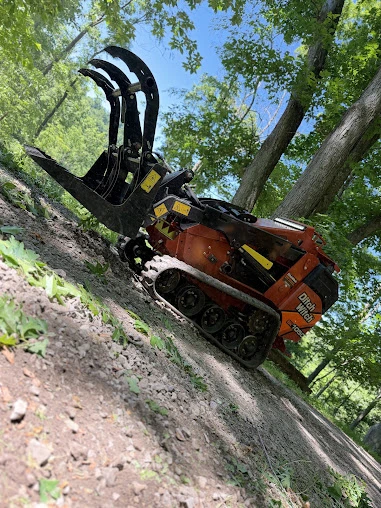

Left is why we carry trunk wood instead of dragging it. Right is the pile leaving, which is the only part that counts.
Three yards’ worth of brush on one curb
In the older river boroughs the lots are narrow, and after a storm the pile from your maple, your neighbor’s box elder, and the tree behind the alley all end up shoulder to shoulder on thirty feet of curb. Nobody can tell whose is whose, the borough truck will not take a mixed heap that includes logs, and each household is waiting on the other two to move first. The fix is usually one crew doing the whole run of curb in a single visit.
The geography sets the terms. In Braddock the streets are tight and parking is street-side, so a chipper needs a real plan for where it sits before anybody starts feeding it. North Braddock runs uphill off the flats, and a loaded truck on a wet grade is its own set of problems, so we stage low and work up. Turtle Creek has the steep back yards where the debris is downhill of the house and forty feet from any pavement, which is exactly the situation where a grapple earns its keep and a wheelbarrow does not.
One more thing worth putting on your calendar. Two or three weeks after a big blow, on the first properly windy afternoon, wood that got cracked but stayed hooked in a canopy finally lets go. If that happens on a property we cleaned, call us and we come look at it.
Debris questions
Mostly asked while somebody is staring at a pile trying to do the math.
How many truckloads is one big downed tree, really?
A mature maple or oak crown is commonly four to seven loads of chip and log, and people usually guess one or two. The spread depends on species, whether the leaves are still on, and how much trunk came down with the crown. We will tell you the honest count during the walk-around rather than after we run out of truck.
Can I stack the brush at the curb and have the borough take it?
Not after a real storm. Yard-waste rules across the county cap diameter around four inches, cap length around four feet, limit bundles per week, and exclude logs entirely. Your pile breaks all of that on the first limb, and the heavy piece will still be sitting there after the truck leaves.
Does everything go in the chipper?
No. Brush and limbs up to about twelve inches chip. Bigger wood gets bucked into rounds and loaded whole, because there is no shredding a trunk. Root balls come out full of soil and rock, so those get cut free and hauled separately or ground where they sit.
Can I keep the wood for my stove?
Absolutely, and plenty of people do. Tell us at the walk-around and we will buck the trunk to your stove length and stack the rounds where you want them instead of loading them. It changes what we haul, so it is worth mentioning before the price is written, not after.
Will the truck and chipper tear up my yard?
We keep the grapple on the driveway whenever the reach lets us, mat or plank the crossings where it has to go on grass, and carry trunk wood rather than drag it. Wet spring ground marks more easily than anything else. We grade and rake what we mark, and we flag any spot we cannot fully protect before we start.
What does hauling a yard full of storm debris come to?
It comes down to volume, how far the debris sits from a place a truck can park, and how much of it is trunk wood versus brush. That is why we look at it in person instead of guessing on the phone. Chris walks the property and writes down an up-front number that includes the hauling. Set up the visit and you will have that figure in hand quickly.
Have the pile gone by the weekend
Chris walks the debris, counts the loads honestly, and hands you a written price before anything runs. Then one crew, one visit, and a lawn you can walk barefoot on again. In sawdust we trust.