
Under the trees you’re keeping
Underbrush clearing that leaves your woods standing
The back acre used to be woods you could walk into. Now it’s a wall of thorn and vine at eye level with your good trees somewhere behind it. This is the careful version of clearing: everything at knee-to-shoulder height comes out, the canopy stays untouched, and you get your woods back instead of a bare lot.

How woods turn into a wall without anybody noticing
Almost nobody calls about this the first year. It happens on a schedule slow enough that you adjust to it. One spring you notice you’re walking around the back section instead of through it. A few springs later you’re mowing up to a green wall and calling everything past it “the woods,” which by then is a polite word for a thicket you have not set foot in since your kids were small.
The cast is the same on nearly every property we walk in Allegheny County. Multiflora rose comes in first and arches over into a bramble the height of a person, with thorns that will take a sleeve off. Barberry fills the low gaps and hides everything at ankle height. Bush honeysuckle grows into the middle layer and leafs out in March before the natives get a vote, which is how it wins. Grapevine and bittersweet climb whatever is standing. And poison ivy runs up the trunks as a hairy rope, sometimes as thick around as your wrist.
Every one of those is a different cut. Rose gets taken low and dragged out with a rake. Barberry has to come up at the crown or it just resprouts. Honeysuckle takes a clean cut at ground level. Vines get their own treatment entirely, which is the part people get wrong most often when they try it themselves on a Saturday.
Cutting at eye level while a canopy stands over your head
Here’s what makes understory work its own thing. The whole job happens inside a stand of trees you want to keep. A skid steer swinging through will scar trunks and, worse, compact and gouge the root flare where a tree’s roots run out shallow through the top foot of soil. Damage there doesn’t show up for a season or three, and then a big oak starts thinning at the top and nobody connects it back to the day the woods got cleaned up.
So we split the ground. Machine work only in the open lanes where there’s nothing to hurt. Everything within the drip line of a keeper gets cut by hand, working around the surface roots rather than over them. It’s slower. It’s also the only way to hand you an open understory and the same trees you had.
That’s also the honest boundary between this page and its neighbors. If your ground is open and overgrown and there is no canopy to protect, that’s brush clearing, and it moves faster because it can. If you want everything ground into mulch where it stands across acreage, look at forestry mulching. This page is the one where trees are staying and the work has to be careful about it.
Picking what stays before anything gets cut
Understory clearing that gets done fast comes back looking sterile, and the reason is always the same: the crew cut everything at that height because everything at that height looked like the same problem. It isn’t. A wooded back acre around here has real natives mixed into the junk, at the same height, wearing the same vines.
Dogwood in the shade layer, which flowers in May and is the reason your woods look like something in spring. Spicebush, which holds the bank together on a slope. Young oaks and hickories that seeded themselves and are waiting on a gap in the canopy. Witch hazel. A serviceberry the birds planted. Cut those out with the barberry and you’ve handed yourself a park lawn under trees.
So we walk it with you first and tag keepers. Chris does that part himself on most jobs, because it’s the piece that can’t be undone after the fact. Twenty five years in the trade mostly means knowing what a young red oak looks like in July with a grapevine over it.
Vines get cut at the base and left in the tree
The vines are their own operation. Grapevine, bittersweet, and poison ivy all climb into the crown and spread across the top, and once a vine is thick enough to shade a canopy it’s taking sunlight the tree needed and adding a sail’s worth of weight in an ice storm. Liberating a tree means severing the vine at the base and again a few feet up so the top section is cut off from its roots for good.
Then we leave it up there. Pulling a live vine down out of a crown tears bark, snaps small limbs, and often brings a dead branch down on whoever is doing the pulling. A severed vine dies in place, dries out, and comes down in pieces on its own through the following year. Your woods look untidy up top for a season. That’s the trade, and we say so up front.
What you actually get when the understory opens
The first thing people mention is depth. A property line that stopped visually at a green wall thirty feet out now runs back a hundred and fifty feet through trunks, and the yard reads as twice the size it did. Nothing was added. You just got to see what you owned. Then you can walk it: kids use it, dogs use it, and you can finally reach the back of your own fence line. Ticks drop off too, because dense understory holds the humid ground layer they need. Open it to airflow and sun and the habitat gets worse for them. It isn’t a treatment and we won’t oversell it, but people notice by the second summer.
What comes with the crew
Hand saws, loppers, and a brush cutter for the close work around keepers, a pole saw for vines overhead, and a chipper set up in an open lane rather than in among the trunks.
Fully insured, and a military discount for those who served.
Opened-up woods lines are in the gallery. If the same growth keeps coming back every year, vegetation management puts it on a rotation instead.
“Christopher and his crew arrived on time, worked safely and efficiently, and handled the entire process with real professionalism.”
Felicia Provenzano, Google reviewWho does what on an understory day
Your list is short and it all happens before we start cutting.
Your part
Walk the woods with us and say how far back you want it opened, because “all of it” and “to the creek” are different days. Point at anything that stays: a tree you like, a spring wildflower patch, a trail you already use, a stone wall. Approve the up-front number.
If there’s a spring, a septic field, a property pin, or an old wire run somewhere in there, tell us. Under a canopy those things are invisible until a saw finds them.
Our part
Identify what’s growing at each layer and tag the keepers with you watching. Map the machine lanes so nothing tracks over a root flare. Cut close by hand inside the drip lines, sever every climbing vine low and high, and pull the material out along the lanes to the chipper.
Then we tell you honestly what your cleared ground will do next spring. If a dead or hazardous tree shows up once the brush is gone, we price removal separately rather than folding it in quietly.
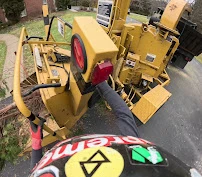
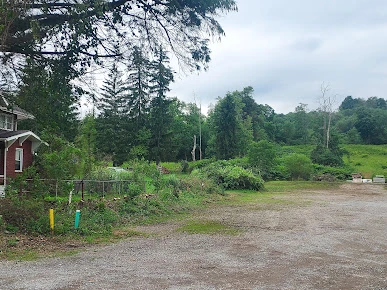
Our crew on North Hills properties. The chipper sits in the open, never in among the trunks.
Wooded back lots north of the rivers
The townships up here are where this work lives, because that’s where the lots still have real woods on them. Indiana Township properties often run several acres with an oak and hickory stand at the back that has been quietly filling in with honeysuckle for twenty years, and the owners still call it woods out of habit. In Kilbuck Township the ground drops hard toward the Ohio, so the wooded portion is a steep hillside where nothing on wheels belongs and the whole understory job stays on foot. Reserve Township sits closer in with smaller parcels, but the back thirty or forty feet of a lot up there is frequently a mature tree line choked at the base, sitting right where a fence and a neighbor meet.
Local conditions push it along. Our clay holds spring water, the deer browse the natives and leave the barberry and rose alone, and gaps opened by ash trees dying off over the last decade dropped sunlight onto forest floors that had been shaded for fifty years. Sun on bare ground in western Pennsylvania fills in with whatever is fastest, and fastest around here is invasive.
Cleared understory tries to come back, and there are two real answers. One is a return cut every year or two, which we can put on the calendar under vegetation management. The other is patience: as your keeper crowns spread into the gaps you opened, shade does the work for free, and shade is the only thing that has ever beaten multiflora rose.
Understory questions
Asked at the edge of the woods, usually while pointing at something thorny.
Will clearing the understory hurt my mature trees?
Not the way we do it. The risk in this work is machine damage at the base: a scarred trunk or a compacted, gouged root flare where the roots run shallow. So machines stay in open lanes and everything inside a keeper’s drip line gets cut by hand. Done that way, the trees you’re keeping come out of the day with more light and less competition than they went in with.
Why leave the cut vines hanging in the tree?
Because pulling a live vine out of a crown does more damage than the vine does. It strips bark, snaps small limbs, and drops deadwood on whoever is pulling. Once we sever it at the base, the top is dead and it dries, releases, and comes down in pieces over the next year on its own. Untidy for a season, and much easier on the tree.
How do you know which shrubs to keep?
We walk it and tag before anything gets cut, with you there so you can veto. Dogwood, spicebush, witch hazel, serviceberry, and any young oak or hickory coming up are worth keeping. Multiflora rose, barberry, bush honeysuckle, and climbing bittersweet come out. When something is ambiguous, we leave it standing and ask.
What happens with all the poison ivy?
Our crew handles it, dressed and equipped for it, which is the strongest argument against tackling a thicket like this yourself. Those wrist-thick hairy trunks running up the bark are mature poison ivy, and cutting one throws oil everywhere. We cut them low and high like any other climber and keep the material out of the chipper feed path.
How long before it grows back in?
You’ll see new shoots the following spring and a noticeable fill-in by the end of the second season. That’s just what disturbed ground does here. Your options are a return cut every year or two, or waiting on your canopy to close over the gaps and shade it out for you. We’ll tell you which is realistic for your stand before you spend anything.
What does underbrush clearing run?
It depends on how thick it is, how much of it is thorn, how many keepers we’re hand-cutting around, and whether a machine can reach any of it at all. Guessing over the phone would only mislead you. Chris walks the woods, reads the layers, and hands you an up-front number in writing. Set up a visit and you’ll usually have it within a day or two.
Walk into your own woods again
One walk-around, one written number, one crew day under the canopy, and the back of your property is somewhere you go instead of somewhere you avoid. One and done. In sawdust we trust.