
Read the tree first
Fox Chapel trees get an arborist’s eye, not a chainsaw’s
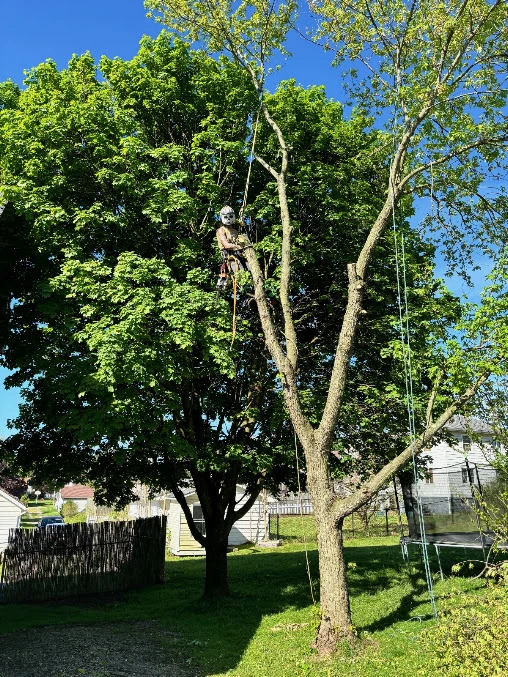
In 15238 the trees came before the houses, and most owners here know it. A white oak that was already old when the lane was cut is worth more standing than any three shrubs you could plant to replace it. So the first thing Chris does on a Fox Chapel property is walk it and look up, before anybody talks about taking anything down.
Preservation pruning, deadwood work, honest calls on the trees that are genuinely finished, and stump grinding after. Fully insured, one and done, and a number up front before the first cut.
Chris talks to a Fox Chapel owner the same way he talks to anybody: what the tree is doing, what it will do next, what it costs, and what he would do if it were in his own yard. No hedging, no upsell, no speech about your investment. Most people here have been sold to enough. They want somebody who climbs, knows wood, and says the thing out loud. Military discount applies here like it does everywhere else we work.
What we do in Fox Chapel
Every service on the truck runs here weekly. The links go deep on each one.
Removal
Large tree removal · Tree removal · 24/7 emergency response · Storm damage cleanup
Care
Tree pruning · Tree trimming · Cabling · Bracing
Health
Tree health · Disease treatment · Arborist services
Groundwork
Land clearing · Lot clearing · Brush clearing · Forestry mulching · Stump grinding · Stump removal
Commercial
Where the canopy is the property
Cross the Allegheny into the borough and the job changes character. Lots are big, lanes wind, and the houses sit back under a canopy that took a century to build. Owners here don’t describe their yards by square footage, they describe them by what’s growing on them: the twin hickories at the top of the drive, the beech the kids climbed, the row of old hemlocks screening the neighbor. That’s not sentiment, it’s value, and it changes how we work.
So most of what we do in Fox Chapel is care rather than clearing. Structural and preservation pruning on specimen oaks and hickories, deadwood out of the upper canopy before it finds a roof or a windshield, weight taken off a heavy lateral that’s gotten ahead of itself. Where a limb union looks suspect we say so and talk through support options with you instead of reaching for the saw. Plenty of Fox Chapel trees people assume are doomed have another few decades in them with the right work.
When a giant really is done, disease through the trunk, a root plate lifting, a failure that’s coming whether anybody likes it or not, we handle it quietly. Large tree removal here means rigging pieces down over lawn and drive rather than dropping anything, crane support when the reach calls for it, and mats or plywood under the equipment because ruts in a Fox Chapel lawn are their own kind of damage. Nobody should be able to tell we were there except that the tree is gone.
Ice is the other half of the story. High old canopy catches every storm that comes up the river valley, and when a load of ice sits on brittle wood, big limbs come down across driveways and private lanes. Long lanes are their own problem here: one limb across the wrong spot and a family is walking out to the road. We answer those calls at any hour, clear the way first so people can get out, then come back for the standing work in daylight, once we can actually see what else took damage up top. Same crew, same standard we hold everywhere in Allegheny County, applied to trees that people around Trillium Trail actually know by name.
Wind does quieter damage than ice, and it shows up later. A summer front comes through, nothing appears to happen, and six weeks on there’s a cracked union thirty feet up that nobody can see from the ground. Big spreading oaks with heavy horizontal limbs are the usual candidates, especially the ones standing alone in an open lawn with no neighbors to break the gust. If a storm has gone through and something feels off, a look from the ground costs you a phone call. Finding a split before it lets go is a very different job than cleaning up after it does.
The other thing worth saying plainly: soil and roots matter as much as anything happening in the crown. Old estate properties get regraded, drives get widened, patios get poured, and the tree that was there first ends up with compacted ground or fill over its root zone. Then it thins out on top and everyone blames the weather. When we see that pattern we tell you, because pruning a tree that’s actually struggling below ground just buys a little time. Sometimes the fix is nothing more complicated than keeping traffic and equipment off a root plate and letting it recover.
“Christopher and his crew arrived on time, worked safely and efficiently, and handled the entire process with real professionalism.”
Felicia Provenzano, Google reviewFox Chapel questions
What owners here ask before anybody climbs. More of the work is in the gallery.
Will you look at my tree before recommending removal?
Always. Chris walks the property, looks at the crown, the trunk, the base and the ground around the root plate, then tells you what he sees. Thinning at the top of a canopy can mean a dozen different things, and half of them are fixable. If the answer is pruning, or watching it through a season before deciding, that’s the answer you get. We’d rather keep a hundred-year oak on your property than earn a removal we didn’t need to do.
How do you keep equipment from tearing up the lawn and driveway?
Deliberately. We plan the access route before the first truck rolls in, lay mats or plywood over soft ground, keep the heavy machine on the drive where we can and stage brush on tarps instead of turf. On wet weeks we’ll push a non-urgent job a few days rather than leave ruts. Owners here notice ruts, and they should.
Do you work on old specimen trees, or only take things down?
Specimen work is a big share of what we do in the borough. Old oaks, hickories and conifers get treated differently than a fencerow tree: correct pruning cuts at the collar, no topping, no stripping the interior canopy bare, weight reduction rather than blunt shortening. We also work in the right season where it matters, since some species take pruning better at certain times of year than others. The goal is a tree that still looks like itself in ten years, not one that grew back into a mess of weak shoots because somebody cut it convenient instead of correct.
Can a very large tree come out without wrecking everything around it?
Yes, that’s the whole craft. Everything comes down in controlled pieces on ropes, with crane support when the piece is too heavy or the reach too long to swing safely. Beds, walls, drives and neighboring trees get protected on purpose. Then the stump goes below grade and the ground gets left ready to seed.
What does tree work cost in Fox Chapel?
It depends on the tree, the access, and what sits underneath it, so we don’t guess over the phone. Send photos or set up a walk-around and you’ll have an up-front number in writing, usually within a day or two, with nothing added after the fact.
Got a Fox Chapel tree worth a second opinion?
Call or send photos. Chris tells you straight whether it needs care or needs to come out, you get the number up front, and the crew finishes it in one visit. In sawdust we trust.