
The big ones
Large tree removal for Pittsburgh’s giants
The eighty-foot silver maple hanging over your roof. The dead red oak the last three crews looked at and politely declined. Bringing down big trees in tight Pittsburgh yards is the job Triple T built its reputation on, with climbers, cranes, and rigging that puts every piece exactly where it’s supposed to land.
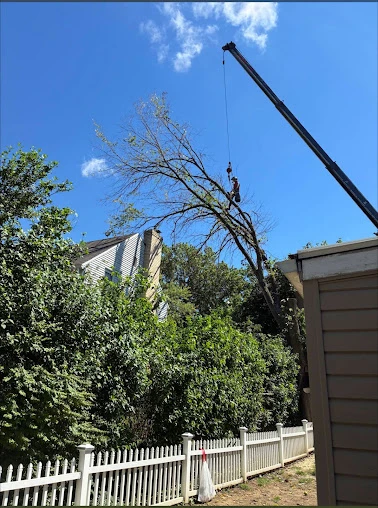
When a tree stops being a tree and starts being a liability
Around Pittsburgh, “large” usually means a tree that was planted two generations ago and never expected to share a lot line with a garage. Silver maples pushing eighty feet with three codominant leaders. Pin oaks dying from the crown down. Norway spruces planted as a living fence in 1965 that now lean over two properties at once. When a tree like that is dead, storm-cracked, or growing into your foundation, waiting doesn’t make it smaller.
A large removal is a different animal from a standard takedown. There’s no room to drop anything whole. Every limb gets roped, every trunk section gets calculated, and the drop zone might be a six-foot strip between a fence and a koi pond. That’s why we bring climbing gear, friction rigging, a grapple loader, a chipper that eats twelve-inch wood, and a crane when the numbers say crane.
The homeowner version of the story is simpler: we show up, the tree comes down in pieces, the wood leaves, the lawn gets raked, and the only evidence we were there is the sky where the canopy used to be. That’s the one-and-done promise, and it’s the reason most of our large removals come from referrals two doors down from the last one.
Dead trees don’t send invoices, they send branches
A dead or dying giant sheds limbs a little at a time, usually onto whatever is parked under it, and then one wet October night the whole thing lets go. Insurance companies know this, which is why a documented hazard tree can become a coverage fight after it falls. Getting ahead of it costs less than the deductible, and we put the number in writing before any saw starts. If you’re not sure whether your tree is a hazard or just ugly, ask. We’ll tell you the truth either way, and we’ve talked plenty of people out of removals their tree didn’t need.
The trees that scare people most around here have patterns. A dead red oak keeps its strength for a year or two and then goes brittle fast, which is why the crew wants to climb it sooner rather than later, and why the ones that sat for five years get rigged off a crane instead of a saddle. Silver maples fail at the union, not the trunk, so the danger reads from the crotch angles, not the diameter. Pin oaks die from the top down and look half-alive for years while the upper third turns to falling hazard. Twenty five years of watching Pittsburgh trees fail is exactly the education that tells us which giant gets climbed, which gets craned, and which one you should stop parking under this week.
And the equipment matters because big wood is unforgiving. A twelve-foot trunk section can outweigh a car, and lowering it into a strip of yard between a deck and a fence is a mathematics problem before it’s a chainsaw problem. That’s what the rigging gear, the grapple, and the crane time are for: making the heaviest part of the job the most boring part to watch.
What rides on the truck
Climbing and rigging gear rated for removal loads, a grapple loader for moving wood without trenching your lawn, a chipper, and crane support for over-house picks.
Fully insured, and a military discount for those who served.
See the equipment working in the gallery, or read about standard tree removal and emergency response for smaller and faster versions of the same discipline.
“Chris and his team removed a very tall, old poplar tree from my yard in just a few hours. The cleanup was excellent, they left it spotless.”
Moldir I., Google reviewHow a big removal actually goes
Two sides of the same job. Your side is short on purpose.
Your part
Call or send photos. Point at the tree during the walk-around and tell us what worries you. Get an up-front number in writing. Move the cars on the day. That’s the whole list.
Questions between the walk-around and the work day go straight to Chris’s cell, not a dispatcher reading a screen.
Our part
Read the tree: lean, decay, load paths, escape routes. Set the rigging plan and the drop zone. Climb and dismantle top-down, roping every piece that can’t free-fall clean. Crane the over-house sections when physics demands it. Chip, haul, grade the ruts if we made any, and rake the lawn like it’s ours.
When wires are anywhere near the work, we coordinate the utility side before the first cut. Storm emergencies jump this queue, day or night.

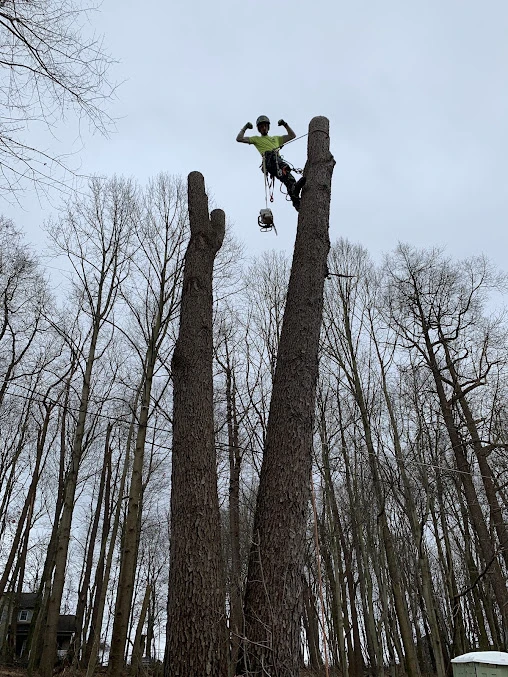
Both photos are our crew on North Hills jobs, not a stock library.
Big-tree country, steep-lot problems
Pittsburgh’s housing stock grew up alongside its trees, which is why so many of our large removals happen within arm’s reach of a structure. The hillside streets in Ross Township and West View stack houses below mature oaks, so a takedown has to account for slope as much as height. Out in Fox Chapel the trees are older, bigger, and often the whole reason the property looks the way it does, so we plan removals around what stays as much as what goes.
Clay soil, spring saturation, and freeze-thaw winters loosen root plates on the biggest trees first. If a large tree on your property has started to lean, heave soil, or drop leaders, that’s the tree telling you its schedule. Beat it by a season and the whole thing is a controlled, insured, surprisingly quick piece of work.
Large removal questions
Asked on porches across the North Hills, answered without the runaround.
How big is “large” in large tree removal?
Roughly sixty feet and up, or any tree whose size forces rigging and mechanical support no matter its height. A forty-footer wedged between two houses gets the large-tree treatment too, because the constraint is the drop zone, not just the tape measure.
Do you always need a crane?
No. Most large removals come down with climbing and rigging alone. A crane earns its place when trunk sections are too heavy to rope safely over a structure, or when a dead tree can’t be climbed at all. We tell you which plan applies and why before you commit to anything.
Will the equipment wreck my lawn?
The grapple loader moves wood so we’re not dragging trunks across your grass, and we plank sensitive ground where the machines travel. Some jobs leave light marks in soft soil. We grade and rake before we leave, and we tell you up front if your yard has a spot we can’t fully protect.
How long does a large removal take?
Most single large trees are a one-day job, often just a morning. Multi-tree removals or crane work with utility coordination can stretch to two days. Whatever the answer is for your tree, you’ll have it before we start, along with the number.
Does removal include the stump?
The takedown gets the trunk flush to the ground. Grinding below grade is its own step with its own machine, and most people add it. Read how it works on the stump grinding page, or just tell us to make the whole tree disappear and we’ll price both together.
What does a large tree removal cost in Pittsburgh?
It depends on height, access, rigging, and what’s under the tree, which is why we don’t guess over the phone. Chris walks the property, reads the tree, and hands you an up-front number in writing. Set up a visit and you’ll have it, usually within a day or two.
That big tree isn’t getting smaller
One call gets Chris on your property, one walk-around gets you a written number, and one crew visit gets the giant on the ground and gone. In sawdust we trust.