
One machine, one pass
Forestry mulching for Pittsburgh’s steep back ground
A mulching head chews standing brush and small trees down to a blanket of chips right where they grew. Nothing gets stacked, nothing gets burned, nothing rides away on a truck. You get walkable ground the same day and a mulch layer holding the hillside together while it settles.
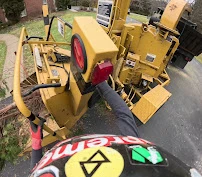
The debris never becomes a problem
Every other way of opening up ground creates a second job. You cut the brush, and now you own a pile. The pile has to be chipped, dragged to a landing, burned under a permit, or loaded and hauled somewhere that charges you by the ton. On a wooded back acre with no road to it, that second job can cost more than the cutting did.
Mulching skips it. The head runs across the standing growth and grinds it where it stands, and what falls behind the machine is a couple of inches of coarse chip spread flat across the whole area. There is no pile, so there is no hauling, no burn permit call to your township, and no gate wide enough for a dump truck to worry about. That is the entire economic argument, and on anything over a quarter acre it is a strong one.
The finished look surprises people the first time. It reads more like a groomed woodland floor than a cleared lot: chip underfoot, standing timber untouched, sight lines you did not have that morning. Chris will show you photos of what the ground looks like a week later and a year later, because those are two different pictures and you should see both before you decide. Ask during the walk-around and you will get a straight answer plus an up-front number in writing.
Chips on a slope beat bare dirt every time
Most of the ground we mulch around here tilts. Western Pennsylvania hillsides sit on clay that sheds water instead of drinking it, and the fastest way to start a gully is to strip a slope bare in March. Anything that scrapes the surface down to soil gives spring rain a clean surface to run on, and by June you have channels cut into the bank and silt in the neighbor’s swale.
The mulch layer is the whole difference. It sits on the surface, breaks the fall of the rain, slows the sheet flow, and holds the root mat of everything we ground off in place underneath. Those roots are still down there doing structural work while they decay, which is exactly what you want on a bank you are not planning to build on. Give it two seasons and the chip has knit into the top few inches of soil and darkened it up.
That is also why mulching pairs well with any slope you want to eventually seed. The chip breaks down, the ground stays put in the meantime, and you are not fighting erosion and germination in the same spring. If your goal is a lawn or a pad, though, the answer is different, and it is worth being blunt about that.
When hauling wins instead
Mulch stays. That is the feature, and it is also the limit. If you are pouring a garage slab, setting footers, laying a driveway, or planting grass this year, a chip layer is in your way. Contractors want mineral soil to work on, seed wants soil contact, and nobody wants to spend the first day of a build scraping our mulch off the pad.
For those jobs you want land clearing, where we cut, chip, and haul the material off so you are handed open dirt at the stakes. Same crew, different tool, different outcome. The short version: if the ground is staying wild, mulch it. If something is getting built or seeded on it soon, clear it. Say what the ground is for during the walk-around and we will point you at the right one, even when it is the cheaper one.
Grinding invasives on a schedule that works
Knotweed, multiflora rose, and autumn olive are the three names that come up on nearly every overgrown parcel in Allegheny County, and mulching handles all three the same way: it takes the top off completely and puts light back on the ground.
Be clear-eyed about what one pass does. It does not kill the root systems. Knotweed rhizomes and autumn olive stumps will push again, sometimes harder, because they are spending stored energy. What mulching buys you is a stand you can actually see and reach, and a starting line. Two or three passes across a couple of growing seasons, or one pass followed by targeted treatment while the regrowth is short and soft, is what actually drains those root reserves. Multiflora rose is the most satisfying of the three, since its arching canes give up quickly once the crown is gone and the thicket does not come back as a wall.
Anybody who tells you a single mulching pass ends a knotweed stand is selling you a repeat visit later. We would rather set the schedule with you now.
What the head handles
Standing brush, briar, vine mats, and saplings up to roughly six inches through the trunk. Bigger stems get dropped by the saw crew first and then run through.
Fully insured, PA HIC #163598, and a military discount for those who served.
Mulched ground and before shots are in the gallery. For hand-scale thicket work see brush clearing, and for a single problem tree in the middle of it all, tree removal.
“They were very responsive, scheduled quickly, and removed the tree efficiently. The cleanup afterward was excellent.”
LG, Google reviewSplitting up a mulching day
Your column is four lines long. That is on purpose.
Your part
Walk the ground with Chris and say where you want the machine to stop. Flag what stays standing, plus anything buried out there: old fence wire, a well cap, a septic lid, a survey pin, a stone wall under the briar. Approve the number. Keep the dogs in.
If a boundary is fuzzy, tell us early. We stop short of a line we cannot confirm rather than mulch somebody else’s ground.
Our part
Read the ground first: slope, wet spots, stem size, what species we are dealing with. Drop anything too heavy for the head with saws. Then run the machine in overlapping passes, working down the slope so the chip lays where it does the most good, and cut in the trails or sight lines you asked for.
Last pass is a walk-through: pull wire and trash the head kicked up, check the depth of the chip, and tell you honestly what will push back and when. Storm-wrecked ground jumps the line through emergency tree service.


Our crew, our machines, North Hills ground. No stock library.
Trails, boundary lines, and back acreage
Most of the mulching we do is not a whole parcel. It is a strip. People want a trail cut from the house to the back of the property so they can actually get there, or a boundary line opened up wide enough to find the pins and hang a fence, or the first fifty feet inside the woods line brought back so the yard has an edge again instead of dissolving into briar. A mulching head cuts a clean corridor at whatever width you point at, and the chip makes the trail walkable the same afternoon.
Big back lots in Plum are the classic version, where the mowed part ends and a couple of untouched acres start. Up in Indiana Township the parcels run larger and steeper, so slope dictates the machine’s travel more than acreage does. Out toward Findlay Township we see more open field edges going to autumn olive and rose, which is exactly the growth a mulching head is happiest in.
Season matters more than people expect. Late fall through early spring is the good window: leaves are down so we can see the stems, the ground is firm enough to carry the machine without churning ruts into your hillside, and nothing is nesting in the thicket. Wet spring ground is the one condition that makes us reschedule, because a machine that sinks does more damage in an hour than the brush did in five years.
One honest note about upkeep. Mulched ground stays open a long time if you keep an edge on it, whether that is a brush hog once a year or just walking the trail enough to keep it packed. Left alone entirely, Western PA closes it back in. We would rather say that during the walk-around than have you discover it in year four.
Mulching questions
What people ask standing at the edge of the woods line, answered straight.
How big a tree can the mulching head actually take?
Saplings and stems up to roughly six inches through the trunk go through standing. Anything heavier gets felled by the saw crew and then run over, which is still faster than chipping and hauling it. Full mature trees are a removal, not a mulching job, and we price those separately so you know exactly what you are paying for.
Do I need a burn permit or any township approval?
No burn permit, because nothing gets burned. That is one of the real advantages here, since burn windows in Allegheny County are narrow and every municipality writes the rules a little differently. Larger acreage, work near a stream or wetland, or anything tied to a construction project can still fall under local or county rules, so call your township before a big job. We are not your permit office and we will not pretend to be.
How deep does the mulch end up, and what happens to it?
Usually two to four inches, more where the growth was heavy. It breaks down over about two to three years depending on sun and moisture, feeding the soil as it goes. You can walk it right away, drive an ATV on it, or leave it as a permanent woodland floor. What you should not do is plant grass into it that same season.
Will one pass finish off my knotweed?
No, and anyone who says yes is not being honest with you. Mulching takes the entire stand down to ground level and puts you back in control of the site, but the rhizomes are still there and will push. Real suppression takes repeat passes across two or three growing seasons, or one pass followed by treatment while the regrowth is short. Autumn olive and multiflora rose follow the same pattern, with rose giving up fastest.
Can you mulch a hillside without tearing it up?
Steep ground is most of what we do around here, and it is the reason mulching is worth choosing. The machine works along the contour rather than straight up and down, the chip layer goes down behind it, and the root systems stay intact holding the bank. The real limit is moisture, not grade. If the ground is saturated we push the date instead of leaving ruts in your slope.
What is forestry mulching going to cost?
It comes down to acreage, stem density, slope, and how far the machine has to travel to reach the work, which is why nobody should quote you sight unseen. Chris walks the ground, reads the growth, and hands you an up-front number in writing. Set up a visit and you will usually have it within a day or two.
Point at the woods line and we will open it
One walk-around, one written number, one machine day, and the back of your property turns into ground you can actually use. One and done. In sawdust we trust.