
Trees where people shop
Retail tree care that lets drivers see your sign
A maple planted the year the plaza opened has spent two decades eating your pylon sign. Your anchor tenant is invisible from the road. The walkway from the lot to the door has deadwood over it. Triple T handles the trees on shopping centers and strip plazas around Pittsburgh, working the hours your doors are closed so nobody shopping ever sees a chipper.
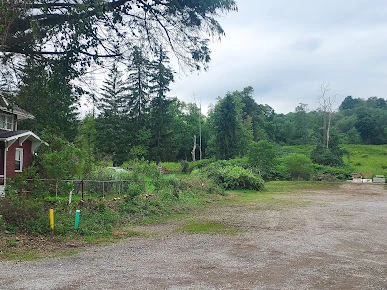
Sightlines are the whole ballgame
Retail runs on being seen. A driver doing forty on Babcock Boulevard gets about three seconds to register your sign, your storefront, and whether the turn is coming up. When a locust or a callery pear grows into that window, those three seconds turn into zero, and the customer keeps driving to whatever they can actually see.
This is why the trim on a shopping center is worth more than it costs. Cut the canopy back off a pylon sign and the sign starts working again. Raise the crown along the frontage and the row of storefronts behind the planting strip reappears. Owners notice it in foot traffic before they notice it anywhere else, and tenants stop sending the emails about how nobody can find them.
We read a retail property the way a customer does, from the road in. Where does the eye land coming from each direction? Which tenant sign is buried? Which entrance looks like an alley because a spruce grew across it? Then Chris walks it with you and puts an up-front number on the work, in writing, before anything starts. That’s the one and done approach on a commercial scale.
Working around a business that never really closes
The trees are the easy part on a retail site. The hard part is that a plaza has fifteen tenants, a delivery schedule, a fire lane the borough inspects, and a drive-thru that backs up at eleven in the morning. Nobody gets to close for us.
So we work the margins. Crews start at first light and are packed up before the first tenant unlocks. Cones go up on one bay at a time, never a whole row. The fire lane stays open, always, no exceptions, because a blocked lane is a citation and a fire marshal you’d rather not meet. If there’s a drive-thru, we work the far side of the lot during the morning rush and come back to the queue side when it’s dead. Chip trucks stage where they don’t strand anybody in a parking space they can’t back out of.
None of that is complicated. It just requires somebody who has run the job on an occupied property before instead of treating a plaza like a big backyard. Twenty five years in the trade around Pittsburgh teaches you to sequence a lot around shoppers. Dropping a tree and going home is the easy version of this job, and it’s the wrong one for a plaza.
Everything gets hauled the same day. Retail properties can’t have a brush pile sitting in a parking space until Thursday, because that pile becomes a dumping ground by Wednesday. Wood leaves with us, the lot gets blown clean, and the only thing left is a property that looks better than it did at closing time.
Before the doors open
Early starts, one bay coned at a time, fire lane never blocked, all debris off site the same morning.
Fully insured with a certificate of insurance on request, and Chris on site rather than a crew nobody introduced.
Property photos live in the gallery. For multi-site accounts see commercial tree maintenance, and for clearance work specifically see crown raising.
“Triple T came and fell a broken pine tree in my front yard. They were in and out in about an hour and left my yard looking better than ever.”
A Google reviewerTwo things retail owners get wrong about the calendar
Timing decides whether tree work is invisible or expensive. Here’s how we sequence a shopping center year.
The holiday freeze
Nothing disruptive happens on a retail property in November or December. That’s when your tenants make their year, and a chipper in the lot on Black Friday is a good way to lose them. We book plaza work for late winter, spring, and the late-summer window, then leave the fourth quarter alone unless something is actively unsafe.
Storm damage is the exception. If a limb comes down over an entrance in December, emergency response runs whatever day it is.
The plow line
Every winter your snow contractor pushes the same piles onto the same two islands, and those island trees die first. It isn’t the weight, it’s the salt sitting in the root zone through March, plus bark scraped off the low trunk by a blade that came in a foot too tight.
We flag which islands are taking the abuse, plan removals for the ones already lost, and tell you which trees can be saved by moving a pile thirty feet. Cheaper than replanting the same island every four years.
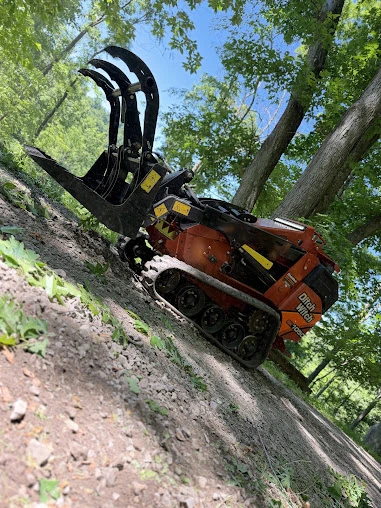
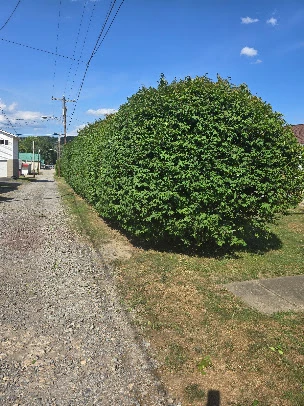
Our own crew and our own machines, on jobs around the North Hills.
Walkways, lot lights, and loading docks
Three things on a shopping center get people hurt or get an owner sued, and all three are tree problems. The first is the walk from the parking spot to the door. Deadwood hanging over that path is a liability with a date on it, and low limbs catch awnings, cart trains, and anybody carrying a box out of a store. We take entrance walkways up to real clearance so a stack of carts and a person with an umbrella both fit underneath.
The second is your lighting. Pole lights get specified to cover a lot evenly, and then a canopy grows into the fixture and turns a corner of the lot into a dark pocket that also happens to be a dead zone on your cameras. Trimming the canopy off the fixtures restores the coverage you already paid for, and it usually costs less than adding a pole.
The third is the back of the building. Dumpster enclosures and loading docks were sized for a box truck with a driver who is in a hurry, and a limb hanging at eleven feet turns into a torn trailer roof and an argument about who pays. Clearance back there is cheap. The claim isn’t.
We handle retail properties across the North Hills and the river towns, including plazas and storefronts in West View, Bellevue, and Avalon, where older commercial strips sit tight against the street and the planting islands are the only green on the lot. Those older properties are exactly where sightline problems compound, because nothing has been touched since the trees were planted.
What plaza owners ask
Straight answers for property managers, owners, and the tenant who finally called about the sign.
Can you work without closing the parking lot?
Yes, and we plan on it. We cone one bay at a time and move as we go, so shoppers always have parking and the fire lane stays open. On tight sites we start before opening and are off the lot by the time tenants unlock. Full closures are rare and we’d tell you well ahead if your property needed one.
My tenant’s sign is completely hidden. Can trimming fix it?
Usually yes. Most buried signage is a crown-raising and canopy-reduction problem, not a removal problem. We stand in the road from both approach directions, mark what’s actually blocking the sightline, and cut only that. Occasionally a tree is planted directly in front of a sign and removal is the honest answer, and we’ll say so.
Will you work around our drive-thru?
We schedule the drive-thru side around your rush. Morning rush means we’re on the opposite end of the property until the queue clears, then we come back. The line keeps moving and the tenant doesn’t lose a shift of sales because of tree work.
Do you carry insurance we can put on file?
Fully insured, and we send a certificate of insurance to your management company before the first visit. Most retail owners need it on file before anybody works on the property, so ask when you call and it goes out that day.
When is the worst time to schedule this?
November and December. We keep retail properties clear through the holiday season on purpose. Late winter is the best value window because the canopy is bare and the work is faster, spring and late summer both work fine, and anything genuinely unsafe gets handled whenever it comes up.
How do you price work on a commercial property?
Chris walks the lot with you, counts the trees, notes the access constraints, and hands you an up-front number in writing covering the whole property. No per-tree guessing over the phone and no surprise line items after. Set up a walk-through and you’ll have the figure in a day or two.
If they can’t see the sign, they don’t stop
One walk-through gets you a written price for the whole property, and one early morning gets the lot cleared before a single customer pulls in. In sawdust we trust.