
On the calendar, not on your mind
Vegetation management on a schedule that holds
Banks, fence lines, pond edges, detention basins, easements, and the back side of a commercial lot all grow whether anyone is watching or not. We put those edges on a visit schedule and keep them there, so nobody on your staff has to notice the problem before it gets handled.

The twelve months after a clearing decide everything
Most people meet this service the hard way. They pay to have an edge cleared, it looks terrific in November, and by the following August it is two thirds of the way back. Nobody did anything wrong. That is simply what cut ground does in Western Pennsylvania when the roots underneath it were never touched.
Here is the calendar as we watch it play out. Knotweed is up in April and pushing canes before most things have leafed out, and by the Fourth of July a cut stand is chest high again. Honeysuckle leafs out earliest and holds green latest, which gives it a longer working season than the natives it is crowding out. Grape, bittersweet, and porcelain berry spend one season running along the ground quietly and the next one climbing, which is why a vine problem always looks like it appeared overnight when it really took two years.
Once you have watched that cycle a couple of times, the math changes. A single cut every three or four years is not maintenance, it is a reset button you keep paying full price for, and the stand gets thicker and woodier each round. Cuts on a shorter cycle actually gain ground, because you are hitting the regrowth while it is soft, green, and spending stored energy instead of building it back. That is the entire premise of a management program.
What a standing agreement covers, and what it does not
A program is not a mystery. It is a defined set of edges, a defined width, and a defined number of visits a year, with the same crew showing up each time. Two visits is the common shape around here: a spring knockdown once the first flush is up but before it hardens off, and a fall reset after leaf drop when we can cut back to a real line for winter. Some properties want three, and basins with a stormwater inspection attached tend to key their visits to the inspection date rather than the season.
What you get in writing before anything starts is the map and the number. Which edges, how far back from the fence or the water, what stays standing, what season each visit lands in, and what the yearly cost is. Chris walks the property once, marks the scope with whoever manages it, and hands over an up-front number in writing for the whole rotation rather than a per-visit surprise.
What it does not cover is worth being just as clear about. This is not tree work. If a real tree inside your managed edge is dead, split, or leaning at something, that gets priced as its own removal, and we tell you at the visit rather than folding it in quietly. It also is not the first cut on ground that has gone completely feral. Ten years of untouched bank needs a knockdown before it can be maintained, and that opening pass is brush clearing work with its own number. The program starts after the ground is back to a line worth holding.
Reading the line between managed and abandoned
There is a specific look a property gets when its edges have slipped, and everyone recognizes it without being able to name it. The mow line stops being straight. The fence is visible in some stretches and swallowed in others. Vines are up the first eight feet of the boundary trees. Nothing is dramatic. It just reads as nobody is watching this place. For a property manager, an HOA board, or anyone leasing commercial space, that signal travels to tenants deciding whether to renew and to buyers walking the parcel.
The other half is what you cannot see from the parking lot. Vines strangle the fencing you paid for and eventually pull sections of it down. Growth in a detention basin cuts its holding capacity and turns a routine inspection into a correction notice. Woody growth in a utility easement becomes somebody else’s crew showing up with their own idea of how much to cut. Every one of those is cheaper on a schedule than as an emergency.
Who actually signs up for this
Property managers are the biggest group, because they are the ones getting the calls. A portfolio with six or eight sites has a dozen edges that each need attention twice a year, and running that through one crew on a set rotation is simpler than fielding complaints and finding somebody available in July. HOAs come next, usually the ones holding common ground that no individual owner is responsible for: the bank behind the townhouse row, the pond edge, the strip along the entrance road. Boards like this because it turns an argument at the meeting into a budget line.
And then there are the owners of larger parcels who lost a season once. They came back to a fence line that needed a machine instead of a saw, paid to fix it, and decided never again. Those are our most consistent program clients.
How a program is written
Edges mapped and measured, visit count set, seasons picked, and one price for the year handed over before the first crew day.
Fully insured, and a military discount for those who served.
Twenty five years in the trade around Pittsburgh, and a crew that shows up with real equipment rather than a trailer and hope.
Managed edges and before shots live in the gallery. For corridor and easement work specifically, see right-of-way clearing.
“Chris is a real stand-up guy! His professionalism and honesty are exceptional. Just a great guy to work with.”
John Smith, Google reviewHow a rotation runs once it is set
The first walk-around takes an hour. After that, most clients hear from us more than we hear from them.
Your part
Walk the edges once with Chris and say where the line should sit. Tell us what stays: the plantings, the sign, the pond bank you want left rough for the wildlife. Approve the scope and the yearly figure. After that, confirm the dates when we send them.
If your site has an inspection deadline, a lease turnover, or an event you want the frontage sharp for, say so at the mapping visit and we will build the calendar around it.
Our part
Map the edges and record what is growing in each one, because a knotweed run and a honeysuckle bank get cut on different timing. Set the visit calendar and hold it. Spring knockdown while the regrowth is soft. Fall reset after leaf drop, cutting back to the mapped line and clearing the vine work off fences and trunks.
Every visit ends with a note on what changed: where we gained ground, where a stand is fighting back, and anything we spotted that falls outside the program. Storm damage inside a managed edge jumps to emergency tree service instead of waiting for the next scheduled day.
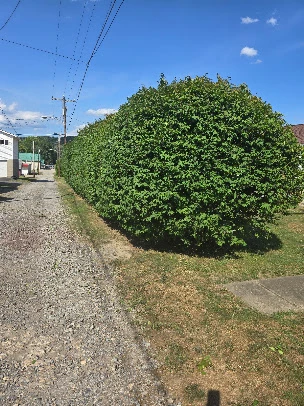
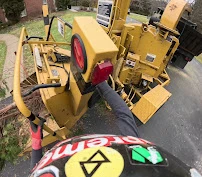
Our crew on managed properties around the North Hills, photographed on the day.
Basins, banks and back fences around the North Hills
Where this work lands depends on how a municipality grew. In Penn Hills the housing plans from the sixties and seventies left long common banks between streets that belong to everyone and nobody, and those are the edges that go first when an association loses track of them. Monroeville runs commercial: retail perimeters, office park frontage, and detention basins built when the lots were developed, which have to keep their capacity whether or not anyone has looked at them lately. Out in Plum the parcels are bigger and the problem shifts to fence lines and back acreage, where a season of inattention costs more ground than it would on a quarter-acre lot.
The regional constant is the growing season itself. Clay soil holds spring water, our summers are humid, and everything invasive that got introduced to this valley over the past century is thriving on it. That is why an edge here closes faster than the same edge would in a drier state, and why the schedule matters more than the equipment does.
One honest reframing on the shop motto. We say one and done, and on a removal that is exactly right. On a management route each visit is one and done, finished and cleaned up so nobody has to call us back about it. The program itself is standing, because the vegetation is too.
Program questions
What managers and boards ask before they put a rotation in the budget.
How many visits a year does a property actually need?
Two covers most sites: a spring knockdown and a fall reset. Three makes sense where the edge is high-visibility or the growth is aggressive, like a knotweed run or a pond bank. Four is rare and usually tied to a frontage somebody is judged on. We recommend the number at the mapping visit based on what is growing there, and we would rather talk you down to two than sell you four you do not need.
Can I start with one visit and see how it goes?
Yes, and plenty of people do. A single knockdown tells you what the ground does over the following year, which is useful information. Just know that one cut on its own loses ground over time, because the regrowth comes back stronger than what you removed. Most people who try a single visit call back the next season to put it on a schedule.
Does the crew need site access when nobody is there?
Usually not, but it makes scheduling easier. If you can give us gate access or a code, we can work the visit into a route without needing anyone from your staff to meet us. Otherwise we set a date and a window, and someone lets us in. Either way you get a note after the visit describing what was done.
Will you spray anything, or is this all cutting?
Our program is mechanical. Saws, brush cutters, and a chipper, with the cut material handled the same day. If a stand genuinely needs chemical treatment to be beaten back, we will tell you that plainly and point you toward a licensed applicator rather than pretending cutting alone will finish it.
What happens if the site changes mid-year?
Scope changes get repriced before we do the work, never after. New building, new fence run, a section sold off, a basin re-engineered: tell us and we adjust the map and the figure for the next visit. Nothing gets added to an invoice you did not agree to first.
How is a management program priced?
By the mapped scope: total edge length, how far back we are cutting, what is growing there, and how many visits a year you want. That is why nobody can give you a figure over the phone. Chris walks the site, measures the edges, and hands you a written figure for the full year. Set up a walk-around and you will usually have it within a day or two.
Put the edges on a calendar before spring does
One walk-around gets your edges mapped, your visit count set, and a written figure for the year. After that the dates come to you and the growth stops being your problem. In sawdust we trust.