
The tree year
Seasonal tree care on the Western Pennsylvania calendar
A tree job done in the right month costs less, heals better, and leaves your yard alone. Done in the wrong month it can cost you the tree. Chris has worked twenty five Pittsburgh tree years, and the calendar he keeps in his head is the most useful tool on the truck.

January to March is when the good work gets done
Most homeowners think about their trees in July, when the yard is green and something looks wrong. The crews who know what they are doing are thinking about your trees in February. With the leaves off, the whole skeleton is visible from the ground: the crossing limbs, the split union you could never see through foliage, the dead leader that spent all summer hidden behind live growth. You cannot fix a structure you cannot see.
Frozen or firm ground is the other gift. Pittsburgh clay in April turns to soup, and a loaded truck crossing a wet lawn leaves ruts you will be filling in for two years. In a cold stretch we drive across a yard and leave nothing behind but boot prints. That single fact is why we schedule the heaviest equipment work into the winter whenever the tree can wait for it.
Dormancy also happens to be the only safe window for oaks. Oak wilt travels on beetles that follow the smell of a fresh cut, and those beetles are not flying in February. So a red oak that needs work gets it in the cold and nowhere else. Elms follow the same logic for their own disease. Every bit of that is worked out in more depth on the tree pruning page, which owns the cut itself. This page owns the question of when.
The spring walk tells you what survived the winter
Once things leaf out, roughly late April into May around here, the yard hands you a free diagnostic. Everything that came back full and on time is fine. Everything that came back thin, late, with small pale leaves, or not at all has a story, and it is usually a story that started underground the year before. A limb that stays bare while the rest of the tree greens up is the plainest signal a tree gives all year.
That is why the spring visit is a walk, not a work day. We go around the property with you, note what leafed out and what did not, and sort the trees into three piles: fine, watch it, do something this year. Deciding what is actually wrong with the ones in the third pile is tree health work, and that page goes into the symptoms in detail. What the spring walk does is catch the list while there is still a whole season to act on it.
Spring is also when the ground gives up its secrets. Saturated clay after the thaw is when a compromised root plate finally shifts, so a tree that has quietly leaned another two degrees over the winter shows a heaved lip of soil on the uphill side. We look for that every spring on the big trees standing over houses, because a lean that moves is a different animal from a lean that has been there since 1994.
Summer is for watching, not for big cuts
June through August, the tree is running its whole factory. Every leaf is working, and taking a large share of the crown off in that state is a shock the tree has to pay for out of stored energy it was counting on for winter. So the summer rule is restraint: we take out what is dead, what is broken, and what is genuinely in the way, and we leave the structural work for the cold.
Summer does give you one thing the other seasons cannot. Against a full green canopy, deadwood shows plainly. A gray limb in a wall of leaves is impossible to miss, and it is the easiest month of the year to build an honest deadwood list. Plenty of our winter schedules get written in July from exactly that.
Then there are the storms. Western Pennsylvania summer thunderstorms come through hot and fast with straight-line winds, and they find the weak union on the silver maple every time. Storm work does not wait for a season. It goes to emergency tree service, day or night, and that is the one part of the calendar we never argue with.
The two-visit rhythm
Once after leaf-out to see what came back, once after leaf-drop to see the structure. Two short walks a year catch nearly everything while it is still small and cheap to deal with.
Insured, twenty five years in the trade, and a military discount for those who served.
Season by season on real Pittsburgh properties in the gallery, or ask Chris to put your yard on the list at the contact page.
“Chris is a real stand-up guy! His professionalism and honesty are exceptional. Just a great guy to work with.”
John Smith, Google reviewOctober is when Pittsburgh breaks its trees
The single most damaging weather event for trees in this region is not a summer storm. It is early wet snow landing on a canopy that still has its leaves.
Why it happens
An October or early November snow around here comes in heavy and wet, and it lands on maples, oaks, and pears that have not dropped yet. Every leaf becomes a shelf. A limb that would shrug off eight inches of January powder can be carrying several times its own weight in an hour, and it fails at the weak union it has had all along.
The trees that go are almost always the ones with a known defect nobody got around to addressing: a codominant stem, a long overextended limb, a dead leader.
What we do about it in September
Walk the property before the leaves turn. Pull the deadwood, shorten the limbs reaching too far over the roof or the driveway, and flag anything with a split union so it can go on the winter list. That short fall visit is the highest-value hour on the whole calendar.
Then, once the leaves are down, the structure is naked again and we are back into the good season. Anything the snow does get to overnight goes to emergency service.

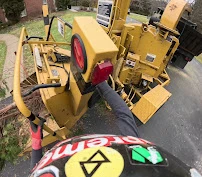
Left: the growth rings read like a weather record, wide years and lean ones. Right: fall brush going through the chipper, our crew, our photos.
Same month, different yard
Our calendar shifts a little street to street, because the terrain around here does not hold one schedule. Down in the valley through East Pittsburgh, the older lots sit close together with mature trees squeezed between houses, so winter access matters more than anywhere else. Firm ground and bare limbs are often the only way a truck and a rope plan fit into that space at all.
In Chalfant, the small borough lots mean a fall walk is mostly about what is reaching over a neighbor’s roof rather than your own. Getting those limbs shortened before the first wet snow has settled more property-line conversations than anything else we do.
Up through Wilkins Township, the bigger yards and old field edges carry hedgerow trees that were never pruned by anybody, so the spring walk turns up more surprises: whole limbs that never leafed out, ash under long borer pressure, wild cherry splitting at the base. Those properties benefit most from the twice-a-year rhythm, because there is simply more tree to keep track of.
Across all of it, the local constants are the same. Clay soil that saturates in spring and bakes by August. Freeze-thaw cycles that work at root plates all winter. Hillside lots where a tree’s load is never straight down. Twenty five years of watching those conditions play out is what turns a generic seasonal checklist into a plan for your specific yard.
Timing questions
What people ask when they are trying to decide between now and next month.
What is the best month overall for tree work in Pittsburgh?
February, if the tree can wait for it. The structure is visible with the leaves off, the ground is usually firm enough to keep equipment off your lawn, and the tree seals its cuts as soon as it breaks bud in spring. It is also the only safe window for oaks. If your tree is dead, broken, or leaning over something, none of that applies and you should call now.
Is it too late in the year to have work done?
Almost never. We work the full twelve months. What changes with the season is which jobs we recommend doing now and which ones we tell you to hold. If you call in July about a big structural job on a healthy maple, we will likely put you on the winter schedule and explain why. If you call in July about a dead limb over the deck, we come out.
How urgent is the fall visit really?
More urgent than most people think. The wet snow that lands on trees still holding their leaves is the tree-breaking event of the year in this region, and it usually arrives before anybody feels ready for it. A short September or early October walk to pull deadwood and shorten the limbs over your roof is the cheapest insurance on the calendar.
Can you do anything useful in the middle of summer?
Yes. Deadwood removal, storm damage, clearance off the roof and the wires, hazard reduction, and honest looks at trees that have you worried. What we hold until dormancy is heavy structural pruning on healthy trees and any cut on an oak that is not an emergency. That is not us being difficult about scheduling, it is what keeps the tree alive.
What does the twice-a-year rhythm actually involve?
Two short walks. One after leaf-out in late spring to see what came back and what did not, and one after leaf-drop in fall to read the structure and the deadwood. Most visits end with nothing to do, which is the point. The ones that turn up something catch it while it is still a limb rather than a removal.
How far ahead do I need to book winter work?
The dormant season fills up, so the people who call in the fall get the January and February slots. If you want winter work, the conversation happens while the leaves are still on. Chris walks the property, tells you what belongs in which season, and hands you a written price for the whole plan. Set up a visit and you will usually have it within a day or two.
Get on the calendar before the calendar decides for you
One walk-around gets your whole property sorted into seasons, with an up-front number for whatever you decide to do and no pressure on the rest. One and done, in sawdust we trust.