
The clock nobody hears ticking
Dead tree removal before the wood gives up
A dead tree is not a frozen picture. It is a countdown. Year one it still holds rope like a living tree. Year three the same trunk is a tree-shaped column of cornflakes and nobody is climbing it. Triple T reads where your tree sits on that clock and takes it down while the answer is still easy.

What actually happens inside dead wood
The day a tree dies, almost nothing changes. The fibers are still long, the cell walls are still intact, and the trunk carries load about as well as it did the summer before. That is the trap. People look at a bare tree in April, see that it did not fall over the winter, and file it under “deal with it eventually.”
Underneath the bark, the decay fungi have already started eating. What they leave behind is wood that still looks like wood and no longer behaves like it. Strength does not drain out evenly either. A dead tree can sit through two winters barely changed and then lose half its holding power in the third, because that is when the rot pockets finally connect to each other.
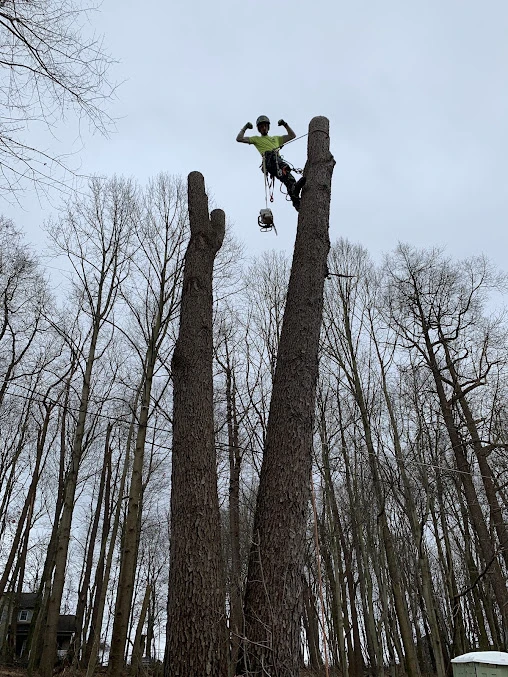
That is why the honest answer to “how long do I have” is never a number. It is a species, a set of conditions, and a look at what the tree is already telling us. The cost of waiting is not that removal gets more expensive on some price sheet. It is that a job Chris could have finished in a morning with a saddle and a rope turns into a job that needs a crane, a bigger crew, and a lot more caution, because nobody sane climbs cornflakes.
Different trees rot on different schedules
Twenty five years in the trade around Pittsburgh teaches you to sort dead trees by species before you even walk the property, because the same amount of dead time means very different things.
White and red oak are the slow ones. Dense, high in extractives, and stubborn about giving up structure. A dead oak often stays climbable well past the point where the neighbors have started asking about it. Maple goes the other direction and goes there fast. Silver and red maple hold a lot of water, rot moves through them quickly, and the unions that were already weak in life turn into the first thing to let go.
Ash is its own category since the emerald ash borer swept through Allegheny County. Borer-killed ash does not decline, it flips. The tree goes from dead to structurally unreliable in a single season, the outer wood turns punky, and limbs shed without warning or wind. We treat standing dead ash as a no-climb tree by default. Pine and spruce are more theatrical about it. The bark plates start dropping off in sheets, the trunk goes silver-gray, and it looks like it has years left right up until the root collar fails and the whole thing tips as one piece.
Locust and cherry sit in the middle, and dead hemlock in a shaded North Hills ravine holds moisture and rots faster than the same tree in an open yard. The species tells us where to start looking, and the tree itself finishes the sentence.
How we decide whether anyone is going up it
Before a climber commits body weight to a dead trunk, it earns the trust. That check is hands-on and takes a few minutes.
Bark adhesion comes first. Living bark stays married to the wood underneath. On a tree well into decay it slips, lifts in slabs, or is already lying in a ring around the base. Bark on the ground means the layer just under it has already been consumed. Then we sound the trunk, working a mallet or the back of an axe up the stem and listening. Solid wood answers with a tight crack. Hollow or punky wood answers with a dull thud that carries, and it is unmistakable once you have heard the difference a few hundred times.
Where the sound is questionable, a small-diameter drill settles it. Resistance tells the story: firm all the way through, or the bit suddenly falling into a void that should have been holding your climbing line. And we read the fungi. Bracket conks on the trunk mean the decay is well past starting. A ring of honey mushrooms at the root flare means the root plate is compromised, which is the one that matters most, since a tree with sound wood and rotten roots is exactly the kind that comes over whole.
If the tests come back clean, we climb it and dismantle top-down, which is faster and easier on your yard. If they do not, nobody argues with the tree. It gets worked from a bucket, or picked apart by crane with the climber never leaving the ground, and that call is made in the driveway, out loud, so you know what you are getting and why. Chris will also tell you plainly when a dead tree is standing in the back corner of a wooded lot bothering nothing, and can be left alone as habitat. Not every dead tree is an emergency. We have talked people out of removals more than once.
Signs the clock is late
Bark sheets on the ground. Woodpecker holes deep enough to reach into. Bracket fungi on the trunk. Mushrooms at the root flare. Limbs shedding on still days. Any of those means call sooner.
Insured, and a military discount for those who served.
See dead-wood work in the gallery, or read up on hazardous tree removal and standard tree removal for the living-tree version of the same work.
“Chris and his team removed a very tall, old poplar tree from my yard in just a few hours. The cleanup was excellent, they left it spotless.”
Moldir I., Google reviewClimb it, bucket it, or crane it
Three ways to take down a dead tree, picked by what the wood can be trusted with. Here is who does what.
Your part
Call, or send a photo of the trunk and the base. Tell us how long it has looked like that, since dead time is the single most useful thing you know about your tree. Get an up-front number in writing before anything starts. Clear the cars and the patio furniture on the day.
If the tree already dropped a limb, say so on the phone. That moves you up the list.
Our part
Test the wood: bark, sound, drill, fungi, root flare. Pick the method the tree earns instead of the one that is convenient. Set rigging that never asks a rotten stem to hold a shock load, because dead wood fails in sudden snaps rather than slow bends. Take it apart top-down, keep every piece under control, then chip, haul, and rake the ground clean.
When the tree came down on its own first, that is a storm emergency and we run it day or night.

Right, the cut face that explains everything: the outside looked fine from the driveway.
Why standing dead trees pile up around here
Two things stacked up on this region at once. The ash borer emptied out a huge share of the canopy, and a run of wet years pushed root rot and canker diseases through oaks and maples that were already stressed. The result is a lot of neighborhoods carrying more dead standing wood than they did a decade ago, much of it within reach of a roof.
In Hampton Township we pull a lot of borer-killed ash off wooded property lines where nobody noticed the tree until the leaves stopped coming back. Wexford lots tend to be newer and more open, so the dead trees there are usually construction casualties, roots cut or compacted during a build and the tree taking six or eight years to finally quit. Older Franklin Park properties bring the big legacy oaks, the slow decliners that hold together long enough to lull people into leaving them.
Pittsburgh weather does the rest. Freeze-thaw cycling drives water into every check and crack in dead wood and then expands it, so our winters open up a standing dead trunk faster than a milder climate would. That is the local version of the brittleness clock, and it runs a little quicker than the textbook.
Dead wood, answered straight
The questions we get standing under bare branches, without the runaround.
My tree died last year. Does it need to come out right now?
Probably not this week, and that is exactly the window worth using. A tree in its first year of dead time is usually still sound enough for a straightforward climbing removal. Two or three more winters of freeze-thaw and the same tree may need mechanical support to come down safely. Nothing about waiting makes the job simpler.
How do you know a dead tree is too far gone to climb?
Bark that lifts or has already dropped, a dull hollow sound when we work up the trunk with a mallet, a drill bit that meets no resistance, bracket conks on the stem, or mushrooms at the root flare. Any combination of those and the climber stays on the ground while the tree comes apart by bucket or crane instead.
Is a dead ash different from a dead oak?
Very. Borer-killed ash turns unreliable in about one season and sheds limbs with no wind at all, so we treat standing dead ash as a no-climb tree by default. Oak is dense and slow to decay and often stays climbable much longer. Maple sits closer to ash than to oak. Species is the first thing we sort by.
The tree still has green on one side. Is that a dead tree removal?
Sometimes. Half-alive trees are common with root rot and with trunk decay that only took out part of the vascular system. The living side can be holding the tree up while the dead side is already brittle, which makes the rigging plan more particular. We look at it as one tree with two conditions and plan around both.
Can I just leave the dead tree standing for wildlife?
Yes, if it is out in a wooded corner where nothing gets hurt when it comes down. Snags are genuinely good for woodpeckers and owls. The test is the fall zone: if the tree can reach a house, a driveway, a fence, a power line, or anywhere people walk, then it is a target situation and it should come out. Chris will tell you honestly which one you have.
What does dead tree removal run in Pittsburgh?
It comes down to how far the decay has gone, since that decides between a climbing job and a crane job, plus what is standing underneath. Nobody can read that over the phone. Chris walks the property, tests the wood, and hands you an up-front number in writing. Set up a walk-around and you will usually have it within a day or two.
Every winter makes that tree harder to take down
Call while the wood is still sound and it is a morning of work with a saddle and a rope. One call gets Chris on the property, one walk-around gets you a written number, one visit gets the tree gone. In sawdust we trust.