
Train it young
Structural pruning: build the tree you want in 40 years
Every giant that has to come down over a roof was once a fifteen-foot tree with two stems fighting for the top, and nobody settled the argument. Structural pruning settles it early. We pick the leader, space the branches, cut out the fork that would have split, and do it while the wood is thin enough to take with hand pruners.

One leader wins. The rest is negotiation.
A young shade tree wants a single dominant stem running up the middle with side branches hanging off it. Left alone in an open lawn with full sun on every side, plenty of them decide to grow two stems instead, side by side, both racing for the top. Nurseries do not fix this, because a fat bushy tree sells better off the lot than a skinny one with one stem and short branches. So it arrives in your yard already carrying the flaw, and it gets a little worse every year you leave it.
Two stems of the same size growing out of the same point is what the trade calls a codominant union, and it is the most reliable way a healthy tree eventually breaks itself in half. The stems press against each other as they thicken and the bark gets folded down into the joint instead of wood knitting across it. That folded bark is a seam, not a weld. Twenty or thirty years of ice loading and wet spring snow works on the seam until one February morning the homeowner walks out and half the tree is on the driveway, with a long pale wound running down to the ground on what is left.
Structural pruning at year five is a completely different job. The competing stem is maybe as thick as a pencil or a broom handle. It comes off in one cut, or it gets shortened over two seasons so the tree does not lose too much leaf area at once, and the remaining leader just takes over. Nobody climbs. Nothing gets craned. The tree does not know anything happened. Twenty five years in this trade has mostly taught Chris which small trees are about to become expensive, and how little it takes to redirect one before it commits.
Spacing, angles, and the branches that never belonged
Picking the leader is only the first decision. After that we are looking at how the permanent scaffold branches sit on the trunk, because those are the limbs the tree carries for the rest of its life. We want them spread out going up the trunk, roughly a foot and a half or more apart on a shade tree, rotating around the stem instead of stacking three limbs at the same height like spokes on a wheel. Three limbs at one point makes a weak spot at that height that shows up as a failure decades later.
We also read the angle where each branch meets the trunk. A branch that leaves the trunk at a wide, open angle builds a real collar of overlapping wood and holds enormous weight. A branch that hugs upward at a tight angle traps bark in the crotch and never builds that connection. On a young tree you can simply choose the wide ones and remove the tight ones, and there is no drama in it. On a forty year old tree the same problem gets solved with steel, which is what our cabling and bracing work exists for. Hardware is a fine answer when it is the only answer left. It is a strange thing to install on a tree that could have been pruned for the cost of an afternoon.
The last category is branches that are simply in the wrong place: temporary low limbs that are shading out the trunk, sprouts coming off the base, anything growing back toward the center. A lot of these stay on purpose for a few years, because low branches feed trunk taper and a skinny whip with no low growth grows a weak, wobbly stem. So we take them gradually rather than stripping the trunk clean the first visit, which is the mistake most well-meaning homeowners make with a new tree and a fresh pair of loppers.
Best years to start
Two to five years after planting is the sweet spot. Anything under about twenty five feet is still fully trainable, and we keep working trees into their twenties.
Most young trees need a short visit every two or three years, not annual attention. Insured, military discount for those who served.
See before and after work in the gallery, or read about mature-tree tree pruning if your tree is already grown.
“Fantastic service! Would highly recommend! Very prompt and professional and did a great job cleaning up.”
Jamie Forrester, Google reviewThe subdivision problem nobody warns you about
Whole streets were planted in the same year with the same trees, and they are all coming due at the same time.
What happened
A builder finishes a plan, drops two trees per lot from the same nursery order, and moves on. Usually red maples, callery pears, or whatever was cheap and fast that spring. Nobody trains them. Fifteen years later every one of them has the same double stem at the same height because they were the same tree with the same habit.
Pears are the loudest example. They are famous for tearing themselves apart around year twenty, and when a storm rolls through a plan of them, they go down as a batch.
What we do about it
Walk the yard, sort the trees into what is still correctable and what is already past it, and be honest about which is which. Train the young ones. Watch the middle ones. For anything already committed to a bad fork, the choices narrow to hardware or a planned removal and a replant with a species that belongs in that spot.
Neighbors talk, and these trees are identical, so we often end up doing four houses in a row on the same afternoon. Ask us for the price on the block and we will work with you.
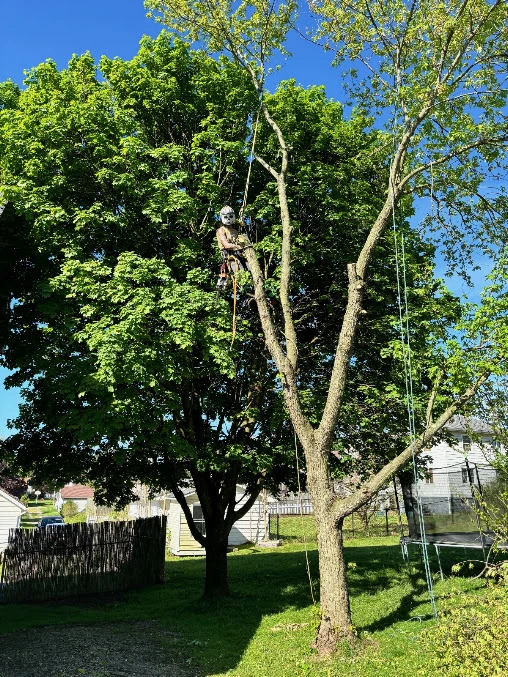
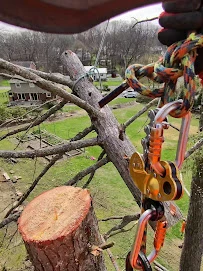
Left: what a trained trunk looks like at maturity. Right: the hardware answer, for trees nobody got to in time. Our crew, our photos.
Newer plans, younger trees, better odds
The older Pittsburgh neighborhoods are full of trees that are decades past the point where any of this helps. Where structural pruning genuinely pays is out in the newer housing, and in the pockets of infill and rebuilt streets closer in. Homes in Braddock Hills and East Pittsburgh have seen a lot of replanting on lots that lost their old canopy, which means yards full of ten and fifteen year old trees that are still completely trainable. Same story on the small lots in Chalfant, where a tree that grows up crooked will be leaning over a neighbor’s roof rather than an open lawn, so getting the form right early matters more than it would with room to spare.
Our clay soil and freeze-thaw winters make the case sharper. Roots here spread shallow and wide because the heavy soil holds water and stays cold late, so a Pittsburgh tree tends to carry a big crown on a root system that is not as anchored as it looks. Add a wet March snow to a crown with a bad fork in it and the math stops being theoretical. Trees with one solid leader and wide, spaced unions ride out the same storm without complaint, which is the entire point of doing this work in the first place.
If you planted trees when you bought the house and they are now taller than the gutter, that is the window. Have us walk the property once, get a plan for each tree and an up-front number for the visit, and most of the time the whole thing is one short morning with hand tools.
Young-tree questions
What homeowners ask once they realize the tree in the front yard has a decision to make.
How young does a tree have to be for this to work?
Anything from a couple of years after planting up to roughly twenty five feet tall is prime territory, which usually means a tree somewhere in its first fifteen to twenty five years. Past that you can still improve a tree, but you are managing a flaw instead of preventing one, and the cuts get big enough that the tree pays for them.
What exactly is a codominant stem?
Two stems of roughly equal size taking off from the same point, both acting like the main trunk. Because they press against each other as they thicken, bark gets folded down into the joint instead of wood growing across it. That seam is where the tree splits, usually under ice or heavy wet snow, decades after anybody could have fixed it easily.
Can I just cut the low branches off my new tree myself?
Please do not strip it. Low temporary branches feed the trunk and build taper, and a young tree with a bare pole for a trunk grows thin and floppy and needs staking forever. Low limbs come off gradually over several seasons as the tree gains height. The stem to worry about is the one competing at the top, and that one is worth a second opinion before you cut.
How often does a young tree need this?
Roughly every two to three years while it is establishing form, and each visit is short. Once the leader is set and the scaffold branches are spaced the way we want, the tree mostly carries itself. Compare that to a mature tree with a bad fork, which needs inspection, hardware, and monitoring for the rest of its life.
My tree already has a split fork. Is it too late?
Depends on the tree, and we will look before we say. Sometimes we can slowly reduce the weaker stem over two or three seasons and let the good one pull ahead, which is the best outcome. Sometimes the union is already failing and the honest answer is cabling to buy years, or planning a removal on your schedule instead of a storm’s.
What does structural pruning run for a young tree?
Far less than any work on the same tree at maturity, which is the whole argument for doing it. It comes down to how many trees, how tall they are, and whether we can reach everything from the ground. Chris walks the yard, tells you which trees are worth the visit and which ones to leave alone, and hands you an up-front number in writing. Set up a visit and you will usually have it within a day or two.
An hour now, or a crane in 2050
Nobody ever called us because their tree was trained correctly at year five. That is exactly the point. One walk-around, one written price, one short morning with hand tools. In sawdust we trust.