
The stuff along the house
Shrub trimming that keeps the plant, not just the shape
Yews swallowing the front windows. Boxwoods that went brown in the middle. Azaleas nobody dares touch because last year somebody pruned off all the flowers. Foundation plantings get cut by hand here, one branch at a time, so what grows back is a shrub instead of a green shell over dead wood.
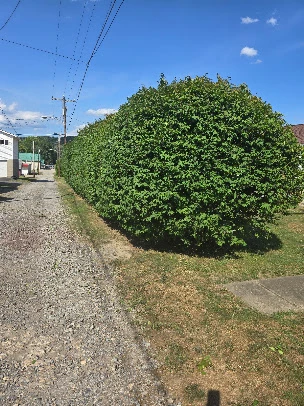
Why sheared shrubs go hollow in the middle
Almost every foundation planting around Pittsburgh is one of the same dozen plants. Yews and boxwoods on the north side, rhododendrons and azaleas under the shade, a burning bush at the corner of the driveway, arborvitae standing at the property line, hydrangeas somewhere near the porch. They were put in when the house was built, they were fine for about eight years, and then somebody started running a gas shear over them every June.
Shearing cuts everything at the same distance from the plant, which is exactly what a shrub responds to worst. Every cut stem answers with two or three new shoots right behind the cut, so the outer inch of the plant gets denser every single year. Dense outside means dark inside. Dark inside means the interior leaves drop, the inner twigs die, and after a few seasons what you own is a stiff green crust wrapped around a nest of bare gray sticks. Push your hand into an old sheared yew and your fingers disappear into nothing. That hollow is the whole problem, because the day a limb breaks or a plow throws salt on one side, there is no live wood underneath to fill the hole back in.
Selective hand pruning works the other direction. Instead of cutting the outside evenly, we reach into the plant and take individual stems out at a joint, back where the cut disappears. That opens holes in the shell, lets light down into the middle, and wakes up the interior buds that have been sitting dormant in the dark. The shrub keeps a natural outline, it fills in from the inside rather than the surface, and it stops needing the same haircut on the same schedule forever. The plant does more of the work and we do less of it every year, which is the opposite of how a shearing contract is built.
None of this means shears are always wrong. A clipped line along a walk is supposed to be a flat plane, and that work belongs on the hedge trimming side of the shop. The mistake is running a hedge tool over plants that were never meant to be walls: a rhododendron, a spirea, a viburnum, a hydrangea.
Renovation on the yews that ate your windows
The single most common call we get on this service is a pair of foundation yews or a juniper mass that has grown up past the window sills and out over the walkway, and the homeowner has been told the only fix is a backhoe. Usually that is not true. Yews, boxwoods, hollies, privet, and most viburnums tolerate hard renovation cuts because they carry live buds on old wood, which means you can cut a yew back to a knee-high stump of bare brown branches and it will push new green out of that old wood by midsummer. Chris has taken forty-year-old yews back to the frame and had them looking like real plants inside two seasons.
Renovation gets done one of two ways depending on how much ugly you can live with. All at once, in late winter before the buds break, gets the whole planting back to a controlled size in a single visit and looks rough for a couple months. Staged over three years takes a third of the oldest stems out at ground level each season, which never looks bad and never looks finished either. Older houses selling in the spring usually want the fast version. People who plan to stay usually want the slow one.
The plants that will not take it are the ones we tell you about before we start. Most conifers, meaning your arborvitae, your dwarf spruces, and your junipers, have a dead zone inside where no green remains. An arborvitae cut back to bare wood stays bare wood forever. So the honest answer on one that has outgrown the spot is either a light annual trim that holds it where it is, or a swap for something the right size, which is a conversation about taking the plant out. We would rather say that to your face than hand you a bill for a haircut that cannot work.
What we bring for shrub work
Bypass hand pruners, loppers, a folding saw for old yew wood, and tarps. Shears come out only when a plant is genuinely a formal shape. No machinery on your beds.
Insured. Military discount for those who served. Twenty five years of Chris reading plants, six under this name.
Related work: hedge trimming for the formal lines, bush removal when a shrub has to go, ornamental pruning for the small trees above them. Finished beds in the gallery.
“Best tree cutting around! And the clean up was amazing! Thank you Triple T Tree!!!”
Juli, Google reviewBloom timing, or how to lose next spring by accident
Half the shrubs in a Pittsburgh yard are grown for flowers, and the calendar decides whether you get them.
Cut after they flower
Azaleas, rhododendrons, forsythia, lilac, weigela, mock orange, and old-fashioned bigleaf hydrangeas all set next year’s flower buds during the summer on wood they grew this year. Trim them in fall or late winter and you are cutting off the show while it is still invisible. These get worked in the short window right after the petals brown, usually mid-May into June around here.
The tell on a butchered rhododendron is a plant that looks healthy and green and has not bloomed in four years. That is almost never a fertilizer problem. That is a timing problem.
Cut before they leaf out
Panicle and smooth hydrangeas, spirea, potentilla, butterfly bush, and roses of Sharon bloom on the current season’s growth, so they get cut in late winter while everything is still asleep and they flower on schedule anyway. Evergreens without flowers, meaning yews, boxwoods, and hollies, also prefer early spring before the new growth pushes.
Deadwood on any shrub comes out whenever we see it. If you cannot remember which of yours is which, take a photo and send it over. Sorting that out on the phone takes about a minute.
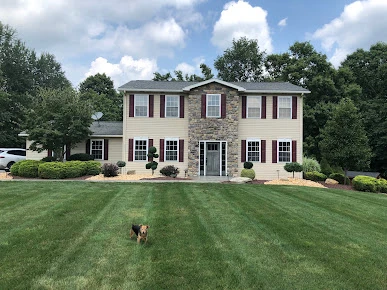

Left: beds and plantings after a visit, cut down off the sills and pulled back off the stone. Right: a clean cut face, which is what every pruning cut on your shrubs looks like at a smaller scale.
Old brick, close foundations, wet clay beds
Shrubs planted tight against a Pittsburgh house cause a specific set of problems, and they are the reason we keep plantings a hand’s width off the wall. Wet foliage against siding holds moisture where it does not belong, vinyl behind a burning bush stays damp for days after a storm, and mortar joints on the older brick homes take the worst of it. Anything growing above a window sill also gives you a dark front room and a nice ladder for whatever wants to climb it. Below the sill and clear of the wall is not a style preference around here. It is maintenance.
The neighborhoods east of the city are full of exactly this housing stock. The plantings around Forest Hills tend to be original to the house, which means yews and rhododendrons at forty and fifty years old with real trunks on them and real renovation potential. Properties in Churchill sit on bigger lots with mixed borders, so the work is usually thinning shrubs that have grown into each other along a property line. The tighter streets in Edgewood put beds two feet from the porch and the sidewalk both, where the whole job is holding size without shearing.
Then there is the clay. Our soil holds water, drains slow, and stays cold late, so shrubs here root shallow and sulk in a wet March. Add road salt spray along the street-side beds and you get a lot of plants carrying dead interior wood they never shed. Pulling that out does more for a struggling foundation shrub than anything you can pour on it. If the trees over it are part of the problem we can look at raising the canopy to get light back down into the beds.
Shrub questions
What people ask standing in the mulch, pointing at something brown.
My landscaper already trims my bushes. Why call a tree company?
Because they are different jobs with different tools. A mow-and-blow crew is on your property for forty minutes and shears everything to a shape, which is fine for a formal hedge and slowly destroys everything else. Pruning a shrub for health means reaching into it, choosing stems, and cutting at joints. It takes longer, it happens once a year instead of three times, and it is the same skill set we use on trees, just at a smaller scale.
Can an overgrown yew be cut back hard, or do I have to replace it?
Yews take hard renovation better than almost any plant in your yard. Cut back to bare brown wood in late winter, a healthy yew will push new green out of the old stems by midsummer and look like a real shrub the following year. Boxwood, holly, privet, and most viburnums do the same. Arborvitae and juniper do not, and we will tell you that before we cut.
Why hasn’t my rhododendron bloomed in years?
Nine times out of ten it was pruned at the wrong time. Rhododendrons and azaleas set next spring’s buds in the weeks right after they finish flowering, so a fall or winter trim removes the buds while they are too small to notice. Give it one season pruned right after bloom and the flowers come back on their own.
What’s the best time of year to have shrubs trimmed?
It depends on the plant. Spring bloomers get cut right after the flowers fade, roughly mid-May through June. Summer bloomers and plain evergreens get cut in late winter before growth starts. If your beds have both, we usually make two short visits rather than compromise on one, and dead wood comes out any time of year.
Do you haul the clippings or leave them?
Everything goes on tarps and leaves with us. Beds get blown clean, walks get swept, and the mulch gets put back where the tarps disturbed it. One and done, the same as on a removal. In sawdust we trust.
What does shrub trimming cost around Pittsburgh?
It depends on how many plants, how far gone they are, and whether the job is a yearly maintenance trim or a renovation. Chris walks the beds, tells you which plants are worth saving, and hands you an up-front number in writing before anybody touches a pruner. Set up a walk-through and you will have that figure in a day or two.
Get the yews off the windows this year
One walk around the house tells us which shrubs are worth renovating, which need a light hand, and which one is never going to fit that corner. You get the plan and the price in writing before the tarps come off the truck.