
The part you can’t see
Root removal for roots that are causing you a problem
Roots in the sewer lateral. Roots pushing on a foundation wall. Roots from a tree that came down four years ago still throwing shoots across the yard. The tree half of that problem is our half, and cutting the right root at the right distance is a very different skill from cutting a trunk.
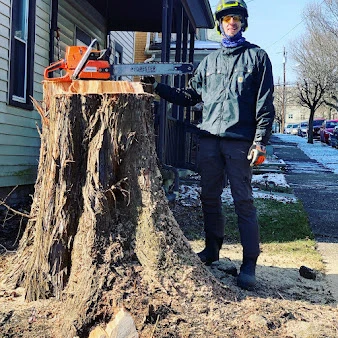
Why roots find your sewer line and not your neighbor’s
Roots do not smell a pipe and go hunting for it. They grow where the water and the air are, and a leaking joint in an old lateral puts both of those things in the soil right next to it. A hairline root finds that damp spot, slips into the gap, and then thickens season after season until it’s a rope of wood filling the pipe.
The reason this is so common around here is the pipe itself. Big parts of Pittsburgh and the older river boroughs are still running vitrified clay laterals laid in short sections with mortared or gasketed joints, and a century of freeze-thaw and settling has opened most of them a little. That is a joint every few feet from your house to the street, each one a possible door. Newer PVC with glued joints does not offer nearly as many invitations, which is why the house built in 1968 backs up and the one built in 2004 next door never does.
Here is the honest part. If your line is already cracked or offset, the fix is a plumber’s fix, and we are not going to pretend otherwise. A camera down the line tells you where the intrusion is and what shape the pipe is in. Cutting or jetting the roots clears the blockage for a while. What none of that touches is the tree that keeps sending new ones. That’s our end of it, and it’s usually the reason a homeowner is on their third clearing in six years.
What we do about it depends on what you want to keep. Sometimes the answer is taking the tree out, because a mature silver maple sitting eight feet off the lateral is going to keep winning. Sometimes it’s cutting and severing the offending roots on the pipe side and setting a barrier so the regrowth goes somewhere else. Chris looks at the species, the distance, the pipe route, and how much of the tree’s root system we would be taking, then tells you which of those is real for your yard. You get an up-front number in writing before anybody starts.
Foundations, slabs, and what roots actually do to concrete
The myth is that roots crack foundations by muscling through them. They mostly don’t. Roots follow the path of least resistance, and poured concrete is not the least resistance. What happens instead is more boring and more expensive. A root wedges into a crack that was already there and then widens it as it grows. A root running under a sidewalk slab or a driveway apron lifts it, because there’s nothing above it but a few inches of concrete and a couple hundred pounds. And on our clay soils, a thirsty tree pulls so much moisture out of the ground during a dry stretch that the clay shrinks and the footing settles unevenly, which is a soil problem the tree caused rather than a root pushing on anything.
That distinction changes the fix. A root under a walkway can be cut and the slab reset. A root in a foundation crack means the crack gets addressed by a mason and the root gets severed and blocked so it doesn’t reoccupy the space. Moisture-driven settlement is a drainage and species conversation, and in some cases the answer really is that the tree is too big for where somebody planted it in 1974.
We say that out loud rather than selling a root cut that won’t hold. Twenty five years on Pittsburgh properties will teach you which of these is worth doing and which is money you’ll spend twice.
What this job covers
Root exposure and severing near lines, walks, and walls. Selective root pruning on trees that are staying. Barrier installation after a cut. Chasing and killing leftover laterals that keep sprouting.
PA One Call ticket filed before any digging. Insured, military discount, 25 years in the trade.
Root work in progress is in the gallery. If the whole root ball has to leave, that’s stump removal. If it’s lawn-level roots tripping people, see surface root grinding.
“They were very responsive, scheduled quickly, and removed the tree efficiently. The cleanup afterward was excellent.”
LG, Google reviewCutting roots on a tree you want to keep
This is where root work goes wrong on other people’s jobs. A tree that loses the wrong roots does not die that year. It falls three years later.
The rule we work to
Distance is everything. The working guideline is to stay at least three times the trunk diameter away from the trunk before you cut anything, and five to six times is safer on a tree that’s already stressed. A twenty inch trunk means the cut line sits five feet out at the absolute closest. Inside that circle you are into the structural roots that hold the tree up.
The buttress roots flaring out of the base never get cut. Not for a pipe, not for a patio, not for a fence post. Those are the anchors, and severing one on the windward side of a mature tree is how a healthy-looking oak ends up on a roof in a February storm.
How we do the cut
We expose the root first rather than blind-trenching through it, usually by hand or with air where the situation is tight, so we can see what we’re about to sever and how many others run alongside it. Then it’s a clean saw cut at the outer edge, square, not a torn end, because a ragged break is where decay walks into the rest of the root system.
One side of the tree at a time, never a ring around it, and never more than a modest share of the root plate in a single season. If the number of roots in the way means we would take too much, we say the tree cannot be saved on that route and give you the choice. Full removal is honest work when the alternative is a tree we quietly destabilized.
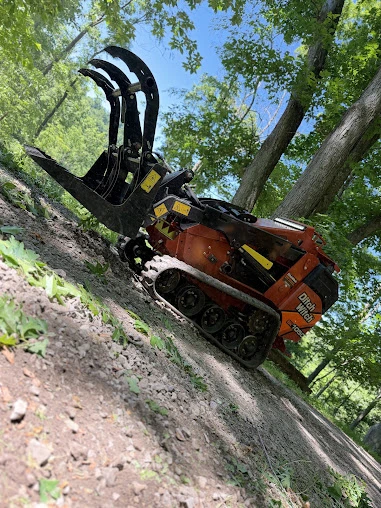
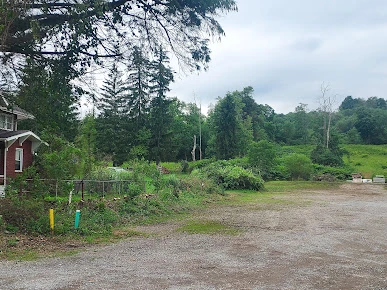
Our machines on our own jobs. Root wood goes out on the truck the same day it comes up.
The tree is gone and it’s still growing
This one surprises people. A tree came down years ago, the stump got handled, and every spring there are shoots coming up along a fence line or in the middle of the lawn, sometimes thirty or forty feet from where the trunk stood. Those are suckers off a lateral root that never died. Tree of heaven is the worst around here and it is everywhere in the alleys and hillsides of this county. Black locust does it too, and both of them will respond to being cut by sending up more. What ends it is finding the runners, cutting them out of the ground, and staying on the resprouts until the root reserves are spent, which is a season or two of work rather than one afternoon.
Barriers matter on the ones you want to prevent. After we sever roots near a lateral, a walk, or a wall, a rigid root barrier set vertically along the cut line deflects new growth down and away instead of straight back into the same space. It only works if it goes in at the time of the cut and deep enough to matter, which is why it belongs in the same visit rather than as a callback.
Older housing stock means older buried everything, and the pattern shows up hard in Kennedy Township, McKees Rocks, and Coraopolis, where clay laterals, narrow lots, and street trees planted a lifetime ago all share the same few feet of soil. Every dig here starts with a PA One Call ticket at 811 and a wait for the locates, because gas and water run shallow in these neighborhoods and 811 does not mark private lines like irrigation, dog fence, or a run out to the garage. Tell us where those are and we work around them. When you’re ready, book the walk-around and we’ll sort out what’s actually happening under your yard.
Questions about problem roots
What people ask after the plumber leaves.
Can you clear the roots out of my sewer line?
Not from inside the pipe. Cutting, jetting, and camera work belong to a drain contractor, and a good one will also tell you whether the lateral itself needs repairing. What we handle is the source: the tree feeding roots into that joint. Clearing without dealing with the tree is why people end up on the same call every couple of years.
How close to my house can a tree root safely be cut?
Distance from the trunk is what governs it, not distance from the house. Three times the trunk diameter is the tight limit, five or six times is safer, and the buttress roots at the base are never cut at any distance. If the pipe or wall you’re protecting sits inside that circle, cutting is off the table and we talk about removal instead.
Will cutting roots kill the tree?
It can, and it can also leave a live tree that is no longer anchored, which is worse. Done properly on one side, outside the structural zone, with clean cuts and no more than a modest share of the root plate, most established trees recover. Done at the trunk or all the way around, you have created a hazard that shows up in a storm two or three years later.
Why do shoots keep coming up years after the tree was taken down?
Live lateral roots. Tree of heaven and black locust in particular treat a cut trunk as a signal to send suckers off the remaining root system, and those roots can run a long way. Mowing them just prunes them. Getting rid of it means locating the runners, taking them out, and staying after the regrowth for a season or two until the roots run out of stored energy.
Does a root barrier actually work?
Yes, when it goes in with the cut and goes in deep. A rigid panel set vertically along the cut line pushes new root growth downward and past the thing you’re protecting rather than back into it. Loose fabric or a shallow strip does nothing. Retrofitting one years later means digging the same trench twice, so we install at the time of the work.
What does root work cost in Pittsburgh?
Access, how deep the roots run, how many are in the way, whether a barrier is going in, and what has to be dug by hand all move the figure. No one can answer that over the phone honestly. Chris walks the property, looks at the tree and the route, and puts an up-front number in writing. Set up a visit and you’ll have it quickly.
Deal with the roots, not the symptom
One walk-around tells you whether the tree can stay, what can be cut, and what a barrier will buy you. One crew handles the digging, the cutting, and the cleanup. In sawdust we trust.