
The tree is fine. The limb is not.
Emergency limb removal for hangers and widow-makers
The tree is still standing, and something in it is not. A broken lead caught forty feet up in its own canopy. A limb lying across your shingles. A union that cracked open in the wind and is holding on by a strap of bark. That piece has to come out of there, and it has to come out without a second impact.

A limb that fell is trash. A limb that did not is a problem.
When a branch tears off and hits the ground, it is over. Somebody rakes it up on Saturday. The dangerous version is the one that broke and never landed, because it is still up there carrying all of its weight in a position nothing designed it for. The trade calls those hangers, or widow-makers, and the second name is not for color.
A hung limb is loaded like a spring. It broke under force, the fibers tore in a direction nobody can read from the driveway, and now it is wedged into a crotch or hooked over another branch that bends under it a little more every day. It can release with no wind, no rain, and no warning, four days after the storm that broke it.
The other half of the problem is the path. A branch still attached to the tree will not drop straight down when it lets go. It swings on whatever is still holding it, or it pivots off the branch it is resting on, and it can travel fifteen or twenty feet sideways before it hits anything. That is why the safe zone under a hanger is much wider than people think, and why standing off to one side to look up at it is not the safe move it feels like.
Getting it out without hitting anything twice
The whole craft here is one idea: the limb comes down under control, not under gravity. Cutting a hanger free and letting it fall gives you a second impact, and on a limb suspended over a roof or a car the second impact is often worse than the first, because now it is falling from height with nothing slowing it.
So a rope goes on the piece before a saw does. The climber sets a line above the break on sound wood, ties into the limb itself, and the ground crew holds the tension. Then the cut releases it into the rope instead of into the air, and the piece gets lowered at walking speed. On a limb that has hooked itself into the canopy, the sequence often runs in reverse: we cut the small end first to unhook it, take the weight off in pieces small enough to hand down, and never ask one cut to solve the whole thing.
When there is a bucket truck route to it, that changes the job for the better. A bucket puts a person beside the break instead of below it, on a stable platform rather than a saddle hanging off the same tree the broken piece is in. On tight North Hills lots there is often no way to get a bucket into position, and then it is a climb, which is exactly the kind of judgment Chris has been making for 25 years.
Lifting off a roof, never dragging across it
A limb resting on shingles is its own specialty. The instinct is to pull it off, and pulling it off is how a bad afternoon becomes a roof replacement. Dragging a branch across asphalt takes the granules with it, catches every seam, and lifts courses on the way past.
Everything we take off a roof goes up and over. The rope comes from a point above, the limb gets cut into pieces light enough that the line can lift them clear of the surface, and each piece travels off the edge of the roof through open air. Slow, unglamorous, and the difference between a cleanup and a claim. We photograph the roof before and after, so if there is damage under where the limb sat, you have evidence of what was already there when we arrived.
Cars and fences follow the same rule for the same reason. A limb across a hood is a dent. A limb dragged across a hood is the whole panel. Fence sections take the load off before we cut, so the picket line is not carrying the weight when the piece releases.
While you wait, do this
Stay out from under it, and further out than feels necessary. A hanger swings before it lands.
Move the cars and keep pets and kids off that side of the yard. Rope off the walkway if it goes under the limb.
Then stop. Do not throw anything at it, do not pull on it, do not put a ladder under it. That is the entire homeowner list.
Insured, military discount, phone answered 24/7. Rigging work is in the gallery. Related: emergency tree removal and storm damage cleanup.
“I had a tree damaged by wind and close to falling. Triple T came out within an hour and cut it down.”
Peter Cardone, Google reviewReading the break before touching it
Two jobs happening at once. Yours takes about a minute.
Your part
Call and tell us what the limb is hung on and what is underneath it. If you can photograph it from a window or from well back on the lawn, do that. Never from directly below.
Then clear the ground under it and stay clear yourself. If the limb is over a walkway to the door, use the other door until we get there.
Our part
Find the break and read which way the fibers tore, because that tells us where the piece wants to go. Set a tie-in on sound wood above it. Rope the limb before the first cut, take it in pieces if the whole thing is too heavy for one lower, and keep everybody out of the swing path the entire time.
Then look at the rest of the crown for the ones you did not see, chip the wood, and rake up. If the failure says the tree itself is finished, we tell you, and the conversation moves to taking the whole tree down.

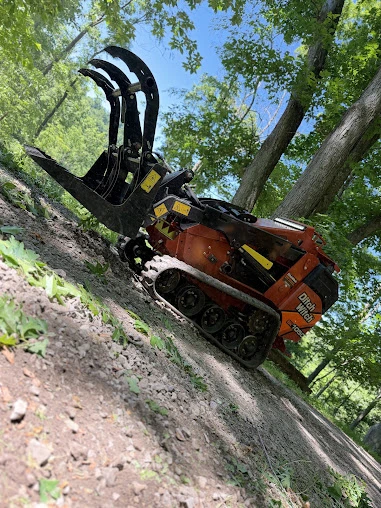
Left, a climber working above the break. Right, the grapple picking limb wood up off the lawn instead of dragging it.
When the limb is the warning, not the accident
Most of the time a broken branch is just a broken branch. Sometimes it is the tree telling you what happens next, and knowing the difference is most of what you are paying us to know. A single limb torn off in a downburst on an otherwise healthy crown means the wind won that round. But when a limb tears out and takes a strip of trunk bark down with it, when the break exposes soft brown punky wood instead of clean fiber, or when it is the third limb off the same tree in two seasons, the limb was the symptom.
Codominant unions are the classic one around here. Silver maples especially grow two competing stems out of one crotch with bark trapped in the seam between them, and that seam is a crack waiting for a reason. When one of those halves goes, the remaining half is holding a wound that runs down into the trunk, and the honest answer is that the tree is on a countdown. We will say so on the spot rather than take money for a limb job on a tree that needs an emergency removal.
We run these calls through the river boroughs and the North Hills, including Avalon, Ben Avon, and Emsworth, where the lots are narrow and the street trees are old enough that their crowns reach across two roofs and a driveway at once. On those streets a hung limb rarely has anywhere neutral to fall, which is why the rope matters more here than it would in open country. If something is hanging over your house right now, get us out there and you will have a straight answer plus an up-front number for the work.
Hanging limb questions
What people ask while standing in the yard looking up at it.
The limb is stuck up there but nothing is under it. Can it wait?
It can wait longer than a limb over your kitchen, but not indefinitely. A hanger loses its grip gradually as the bark it rests on dries and shrinks, so the thing holding it today is weaker next month. If nothing valuable is underneath, you have time to schedule it properly instead of paying for a night call. Rope the area off and tell us it is not urgent when you phone.
Can I pull it down myself with a rope from the ground?
Please do not. Pulling from the ground means you are standing in the one place the limb can reach, and a limb that releases under a pull comes fast and rarely straight. The other common version, throwing a rope over it from the driveway, tends to unhook one end and swing the piece toward the house. If it were safe to pull down from below, nobody would pay for a climber.
Do you have to take the whole tree down to get one limb out?
Almost never. A hanger comes out of a healthy crown as its own small job, and the tree keeps growing. The exception is when the break exposed decay or split a union down into the trunk, which means the structure is compromised rather than just the branch. We will walk you around the tree and show you what we are seeing before anybody suggests a removal.
There is a limb on my roof. Should I move it before you arrive?
No. Leave it exactly where it is, and stay out of the rooms below it. A limb sitting still on shingles is doing far less damage than the same limb dragged sideways off the edge, and moving it can also open a hole that was sealed by the branch itself. We lift it off through the air, and if there is a puncture we can coordinate a tarp before the next rain.
How long does it take to get a hanging limb out?
Most single hangers are a couple of hours from arrival to raked lawn, including setup, because the rigging takes longer than the cutting does. A limb tangled through several other branches over a roof runs longer since it comes out in pieces. You will hear the realistic window on the phone rather than a number designed to sound good.
Is a broken limb covered by homeowners insurance?
Usually only if it damaged something. Carriers tend to treat removing a limb that hit your roof differently than removing one hung up in the tree, and the specifics belong to your policy. We photograph everything on site and hand the documentation to you either way. Reach out and Chris will tell you what the work involves and what the price looks like before you talk to anybody about a claim.
Anything hanging over your house should not stay there
Tell us what broke and what is under it. We rope it, lower it, clear it, and check the rest of the crown while we are up there. One call, one crew, one and done. In sawdust we trust.