
Sight down the line
Hedge trimming that holds a straight, plumb face
A hedge is a wall you grew instead of built. Sixty feet of arborvitae along the property line, a privet screen between you and the neighbor’s driveway, a yew row hiding the block foundation. We cut them flat, level, and green all the way to the ground, because a hedge that goes bald at the knees stops being a wall.
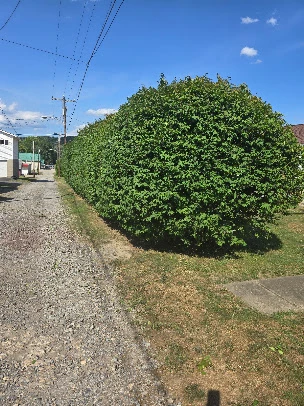
Eyeballing a sixty-foot run is how hedges end up wavy
Everybody can cut the first ten feet of a hedge straight. The trouble starts around foot twenty, when your eye has been following the plant instead of a line, and the hedge quietly starts telling you where to cut. Come back a week later and you can see the belly in it from the street. That drift is not a skill problem, it’s a physics problem: your head moves as you walk, the ground under a Pittsburgh yard is never flat, and the top of the hedge is already whatever shape last year’s trim left it.
So we don’t trust our eyes on a long run. String goes up first. A line pulled tight between two stakes at the finished height gives us a reference the hedge can’t argue with, and a second line down the face keeps the front plumb instead of leaning back the way an untrained cut always does. On sloped yards, and around here most of them are, the string either follows the grade in a clean parallel or steps down in deliberate sections. Both look intentional. What looks bad is a top that wobbles because it split the difference.
The result is the thing you actually notice from the sidewalk: a face you can sight down like a piece of lumber. That’s the whole job on a privacy screen. Length, height, and one flat plane holding it all together.
Wider at the bottom, or you lose the bottom
Here’s the rule most homeowners have never been told, and it explains almost every sad-looking hedge in Allegheny County. A hedge should be slightly wider at its base than at its top. Arborists call it batter. Maybe an inch of taper per foot of height, barely enough to see, but it changes everything, because sunlight comes down from above. Cut a hedge with dead-straight vertical sides and the top shades the bottom every single day. The lower branches get less light each season, the interior thins, and eventually you have a green cap sitting on bare woody legs. People blame the plant. It was the geometry.
Getting the batter back on a hedge that already went bald at the knees takes patience rather than one aggressive afternoon. We reduce the top first so light can reach down again, hold the sides in that slight taper, and give the lower growth a season or two to fill back in. On arborvitae specifically we’re careful, because arborvitae will not push new growth from old bare wood the way privet and boxwood will. Cut a Thuja back past its green and that spot stays brown permanently. Knowing which plant forgives a hard cut and which one holds a grudge is most of what twenty five years in the trade buys you.
Bringing a fourteen-foot privet back down to a wall
The other call we get a lot: a hedge that hasn’t been touched in six or eight years and is now closer to a row of small trees. Fourteen feet of privet leaning over the driveway. An arborvitae row that was planted as a four-foot screen and is now blocking the second-floor windows and the gutter behind it. At that size a hedge stops behaving like a hedge, catches wind and wet snow, and starts splaying open down the middle every winter.
A height reset is real work, not a trim. We take the top down to a height that makes sense for the site and for what you want it to hide, then rebuild the face and the taper from there. On broadleaf hedges like privet, forsythia, or burning bush, a hard reset is genuinely good for the plant and it comes back thick. On conifer rows the reset has to stay inside the living green, so we tell you honestly what height is achievable before we start rather than after. Either way it looks rough for a few weeks and then noticeably better than it has in years. If a plant is too far gone to save, taking it out is its own conversation, and bush removal covers what that involves.
Individual foundation plants are a different discipline with different goals, and those live on the shrub trimming page. This page is about the ones standing shoulder to shoulder doing a job.
What shows up in the truck
Hedge shears, string lines and stakes, pole units for the tall stuff, tarps for the clippings, and platforms or ladders rated for the slope we’re standing on.
Insured, military discount, and an up-front number in writing before the first cut.
Finished hedges are in the gallery. For the woody stuff overhead, see tree trimming and tree pruning.
“Absolutely fantastic work, carefully executed, highly recommend.”
John Seifert, Google reviewThe gap in the row, and your honest options
One dead plant in a line of twenty is the most common hedge question we get. Here’s the straight answer.
Why it happened
Rows fail one plant at a time for boring reasons. A downspout dumping on one root zone. Road salt at the end nearest the street. A buried chunk of construction fill under that exact spot. Root rot in the low corner where the clay holds water all spring. Arborvitae in a tight row also compete with each other, so the weakest one loses first.
Finding the cause matters, because if it’s drainage or salt, a replacement plant dies in the same hole.
What you can actually do
Option one, patch-plant: pull the dead one, fix the reason it died, put in the biggest matching plant that fits, and accept that it will read as a patch for three to five years before it blends. Option two, live with it and cheat the neighbors in. We can steer growth from both sides toward the hole over a couple of seasons and close a small gap without planting anything.
What we won’t do is sell you a whole new row when eighteen of twenty plants are healthy. Have Chris look at it and you’ll get the version with the tradeoffs left in.
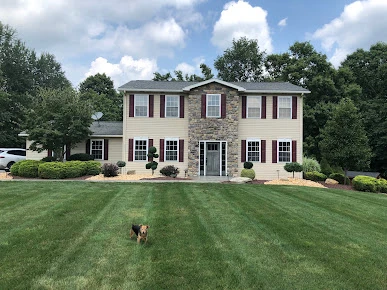
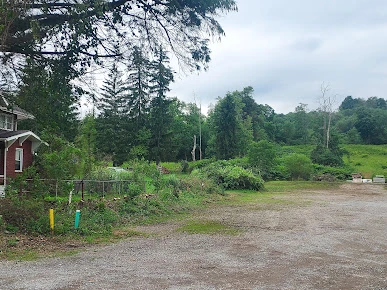
Our crew, our jobs, shot around Allegheny County.
Privacy, light, and the neighbor twenty feet away
Hedges in this part of Pennsylvania are usually solving a lot-line problem. Houses in Swissvale and Wilkinsburg sit close enough that a screen is the difference between a usable back yard and a fishbowl, and the yards in Braddock Hills tilt enough that a hedge can be head-high on your side and waist-high on theirs. That’s the conversation worth having before we set the string: every foot of screen you gain is a foot of afternoon sun somebody loses, sometimes you, sometimes them, sometimes the tomatoes on the other side of the fence.
We’ll tell you where that line falls on your particular slope, and we’ll cut to a height you picked on purpose. Old borough lots also hide things inside hedge rows, chain link swallowed by growth, retaining walls, a gas meter, the occasional clothesline post. We find those before the shears do.
The safety side matters on the tall ones. A twelve-foot hedge on a graded bank means ladders on uneven ground with a running blade at chest height, which is exactly the combination that sends homeowners to the emergency room every summer. We work off proper platforms, we tie in when the height calls for it, and we’re insured for the day it goes sideways. Chris walks the row with you first, points out what’s coming out and what’s staying, and hands over the price before anything gets cut.
Hedge questions
The ones people ask standing at the end of the row.
How many times a year does a hedge need cutting?
Formal privacy screens and privet want two cuts, one in late spring after the first flush and one in midsummer, to hold a crisp face. Arborvitae and yew rows are usually fine with one annual cut. If you only want it to look tidy rather than sharp, once a year keeps most Pittsburgh hedges in line.
Can you make my hedge taller than it is now?
Yes, by leaving the leaders alone and only cutting the sides until it reaches the height you want. It takes seasons, not one visit. Tell us the target height at the walk-around and we’ll trim toward it instead of holding it where it is.
My arborvitae are brown inside. Will trimming fix that?
Interior browning on arborvitae is often normal shedding of old needles. Brown on the outer face is different and usually means winter burn, salt, or deer. Trimming won’t turn brown wood green again on a conifer, so the fix is reducing the top so light gets in, and time.
What happens to all the clippings?
They go on tarps as we cut and leave on our truck. A long hedge throws a surprising amount of debris into the beds and the lawn, so we rake and blow the whole run before we pull out. One and done means you don’t spend Sunday with a leaf bag.
Is there a wrong time of year to cut a hedge?
Avoid heavy cutting in late fall, because new growth pushed that late gets killed by the first hard freeze and the hedge goes into winter with damage. Deep dormancy work in winter is fine on broadleaf hedges. Also, if birds are nesting in the row, we come back rather than cut through it.
What does hedge trimming run in the Pittsburgh area?
It depends on the length of the run, the height, how far past due it is, and whether we can reach it from the ground. That’s why we look before we price. Set up a walk-around and you’ll get an up-front number in writing, no pressure attached to it.
Let’s get that line straight again
Send a photo of the row or have Chris stop by. You’ll get a real read on what your hedge can do, a written price, and a crew that leaves the yard cleaner than the hedge. In sawdust we trust.