
The look of the thing
Canopy shaping for trees that lost their good side
Some trees hold up a whole property. Others sit out front leaning hard to the left because a storm took half of them, or because the neighbor’s oak came down and suddenly the survivor has nothing to grow toward. Shaping is the slow, careful work of putting a crown back into balance so the tree looks like it belongs to the house again.
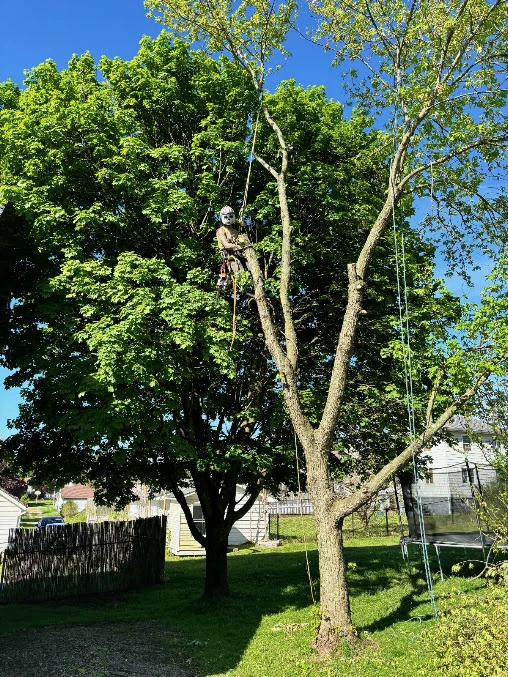
A crown is a silhouette before it is anything else
Drive down almost any street in Shaler or Ross and you can pick out the trees somebody thought about. They sit centered over the lawn, the weight spread evenly around the trunk, the outline reading against the sky like it was drawn on purpose. Then you pass a house where the front maple is all shoulder on one side and bare on the other, and your eye snags on it every single time. That is the entire subject of this page. Not how big a tree is, not how thick the interior sits, not how high the lowest limbs hang. How the thing looks from the sidewalk.
Trees go lopsided for a handful of very ordinary Pittsburgh reasons. A summer storm rips one major limb out of a three-limb crown and the tree is instantly two-thirds of itself. A garage or a fence blocks light on the north face, so twenty years of growth all pushed south. Somebody takes down the tree next door and the one that stayed spent decades leaning away from a competitor that no longer exists. Every one of those trees is healthy. Every one of them looks wrong.
Chris has been reading crowns for twenty five years, and the first thing he does on a shaping walk-around is stand back at the curb where you actually see the tree from. Not under it. The problem lives at a distance, so the plan gets made at a distance, and then we climb.
Repairing what a cheap trim did to it
A depressing share of the shaping calls we get are repair work. Somebody with a ladder and a pole saw came through, charged very little, and cut every branch back to a stub at the same height, which is the tree equivalent of a bowl cut. Two seasons later that tree has thrown a dense mess of thin, weakly attached sprouts off every one of those stubs, and the outline is now a lumpy hedge sitting on top of a trunk.
Those trees are usually salvageable. Not in one visit and not into what they were, but into something with a real form again. The work involves picking which sprout on each stub is going to become the new leader, cutting the rest off clean, and then waiting a year for that choice to take hold before touching it again. It is unglamorous and it takes patience most crews will not sell you. We will tell you honestly whether your tree is worth the effort or whether you would be better served by a removal and a replant that will look right in a decade.
The best example of the philosophy in our portfolio is a weeping ornamental we worked on locally. Before, it was a tangled dome with dead wood buried inside and no visible line to it. After, the same tree read as a shape: the interior opened up, the deadwood gone, the natural cascading habit finally legible instead of hidden. Nothing was forced. The form was already in there. Our job was subtraction, and you can see the pair of photos on the tree pruning page.
Framing the view instead of fighting it
Shaping is also how you get a tree and a view to coexist. Plenty of properties around here look out over a valley, a hillside, or the city skyline, and there is one tree sitting square in the middle of it. The reflex is to take the tree out. The better move is usually to open a window through the crown: remove the specific limbs that block the sightline, keep the ones that frame it, and end up with a view that has a tree in the foreground instead of a view with nothing in it. Done right, that framed version looks considerably better than the empty sky would have.
The same logic applies to a house’s own lines. A low, wide-spreading crown over a tall narrow colonial fights the architecture. A tight upright form next to a long ranch does the same thing in reverse. We shape toward whichever silhouette makes the house look intentional, working with what the species will naturally do rather than against it, because a tree pushed into a shape it does not want will spend every season trying to grow back out of it.
What shaping is not
It is not topping, not a hedge trim, and not a way to make a tree smaller. Height and spread belong to crown reduction. Interior density belongs to thinning. Clearance under the canopy belongs to raising. Shaping is about outline and balance.
Fully insured, military discount for those who served.
See finished crowns in the gallery, or read up on crown reduction when the real problem is size.
“Absolutely fantastic work, carefully executed, highly recommend.”
John Seifert, Google reviewWhy good form takes more than one visit
The single most useful thing to understand about shaping: it happens across seasons, not in an afternoon.
Visit one
We correct the obvious. Dead and broken wood comes out, the heaviest limbs on the overloaded side get shortened back to a healthy lateral, and any competing leader that is going to ruin the outline gets settled. That is usually as far as we go, because a tree can only give up so much live wood in one season before it panics and throws sprouts everywhere.
Visit two and sometimes three
A year or two later we come back and read what the tree did with the room we made. The light side responds, the thin side fills, and now the remaining corrections are small and precise. Most crowns are where we want them by the second visit. A badly abused tree might need a third.
Nobody is upselling you here. Ask any crew that promises perfect shape in one day what the tree looks like in year three. Get an up-front number for the first visit and we will tell you honestly whether a second one is likely.

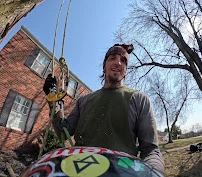
Shaping happens from inside the crown, on a rope, one cut at a time. Our crew, our jobs, our photos.
Old boroughs, front-yard trees, tight sightlines
Shaping work makes the most difference on properties where the tree is part of the address. In Turtle Creek the lots run narrow and the front trees sit close enough to the porch that a lopsided crown is the first thing anybody sees. Up the hill in North Braddock the steep streets mean half the trees are viewed from below and half from above, so what reads as balanced from one neighbor’s yard reads as heavy from the other. Down in Braddock we run into a lot of survivor trees, the ones still standing where three others came out over the years, and those are the classic candidates for rebalancing.
Mill-town lots also mean a lot of trees grew up shouldering away from buildings that are no longer there, and that history is written into their shape. You cannot undo it in a season, but you can steer it. The trees around here are older and more interesting than most people give them credit for, and a crown with the right outline turns an ordinary property into one people slow down for.
Shaping questions
The ones that come up at the curb, while we are both squinting at your tree.
Can you make my lopsided tree symmetrical?
Balanced, yes. Perfectly symmetrical, no, and you would not want it anyway because a mirror-image tree looks manufactured. What we can do is shorten the heavy side back to good laterals, encourage growth on the light side, and get the visual weight sitting over the trunk instead of hanging off one shoulder. From the street it reads as even. Up close it still reads as a tree.
Why can’t you finish the shape in one visit?
Because a tree that loses too much live wood at once responds by throwing dozens of fast, weak sprouts, and you end up further from good form than when we started. Taking a conservative amount, letting the tree answer, then correcting again is the only way form actually holds. Rushing shaping is how trees end up looking worse a year later.
Someone butchered my tree years ago. Is it fixable?
Often, yes. We select which of the sprouts on each old stub becomes the new branch, remove its competitors, and let the tree rebuild an outline from there. It takes two or three visits spread over several years. Some trees are too far gone or too structurally compromised to bother, and we will tell you that straight rather than take your money for a lost cause.
Will shaping hurt the tree?
Done at a reasonable scale with clean cuts at the right points, no. Every cut is a wound the tree has to seal, so the discipline is taking the fewest cuts that accomplish the most, and placing each one where the tree can close it. That is the reason we spread the work out instead of doing everything at once.
Can you open up a view without taking the tree down?
Usually. We identify the specific limbs blocking your sightline, remove those, and keep the ones that frame the opening. The result is a view with a tree in the foreground, which most people end up preferring to bare sky. Come out and look at what you want to see and we will tell you whether the tree can give it to you.
What does canopy shaping cost around Pittsburgh?
It comes down to the size of the crown, how much correction it needs, and how the access looks. No guessing over the phone. Chris walks the property, stands where you look at the tree from, and hands you a written price before anything gets scheduled. Book a walk-around and you will have that figure in a day or two.
Your tree already has a good shape in it
Most of the time the form is already there, buried under storm damage, dead wood, or somebody else’s bad cuts. Chris will come stand at the curb with you, tell you what is recoverable, and give you a straight number for the first visit. In sawdust we trust.