
The limb nobody is watching
Deadwood removal, before the calm day it picks
Your tree is alive. Green top to bottom, no complaints. Somewhere up in that crown are three or four limbs that died years ago and are still up there, dry, hard, and waiting. Climbers call those widow-makers and they do not wait for a storm. Triple T goes up, finds every one of them, and cuts them out while a rope still has something to hold.

Healthy trees carry dead limbs on purpose
This is the part that surprises people. A tree does not keep every branch it grows. As the crown fills in, the lower and inner limbs stop getting light, stop paying their way, and the tree quietly cuts them off. That is called shading out, and it is normal. The limb dies, holds on for a few years, and eventually falls. In a forest nobody notices. In a backyard, the ground under that limb is where your kids eat dinner.
Shading out is only one source. Squirrels strip bark off a branch and girdle it without meaning to. A storm nicks a limb, does not break it, and the wound lets in decay that finishes the job over two seasons. Ice loads bend a branch past its fiber limit and it never recovers. Old pruning cuts left too long leave a stub that dies back into the collar. And as a maple or oak lifts its crown over thirty years, the whole bottom tier goes dead more or less on schedule. Six different causes, one result: hard, dry wood hanging in a healthy tree with no living tissue holding it anywhere.
None of that means your tree is sick. Deadwood in a live crown is usually a sign the tree is doing fine and just managing its own budget. What it means is the tree has no plan for where those limbs land, and you do.
Why they let go on the quietest day of the year
A live branch has leaves. Leaves catch wind, the limb flexes, the whole thing moves and gives and tells you something is happening. A dead limb has no leaves and no flex. Wind mostly passes right through it. So instead of failing from a gust, it fails from the inside: the wood at the union where it attaches to the trunk keeps rotting, year after year, until the remaining fibers cannot hold the weight of the limb itself. That day arrives on its own schedule. Sun, rain, a wet snow, or nothing at all.
Chris has stood under trees on windless mornings and heard the crack. Twenty five years in the trade will do that. A live branch that fails gives warning: cracks, sag, a hanger you can see. A dead one already failed, years ago, and is just finishing the paperwork.
Wet stretches make it worse around here. Water sitting in the rot pocket at the branch collar adds weight to the exact joint that is already the weak point. Which is why our phone tends to ring the morning after a soaking rain with no wind in it at all.
What is under the limb decides what we cut first
When we walk your property, we look up, and then we look straight back down at what is sitting directly beneath every piece of dead wood in the crown. That is the over-target audit, and it sets the whole order of work. A four-inch dead limb hanging forty feet over an open side yard is a low priority. Trim it eventually. The same limb over a patio table, a swing set, a hot tub, the spot where the car sits every night, the walk from the back door to the driveway, or the neighbor’s fence line is a different conversation entirely. Same branch, same size, completely different urgency, and the difference is only what is underneath.
So the walk-around goes like this: we mark the deadwood over targets, we mark the deadwood over nothing, and you get told which is which in plain language along with an up-front number in writing. Plenty of people book the over-target work now and leave the rest for a future visit. That is a fine answer and we will say so out loud instead of pushing the bigger job. It is also worth saying that this page is about dead limbs inside a living tree. If the whole tree is gone, that is dead tree removal and a different plan entirely.
Deadwooding is how a mature tree earns more years
Every dead limb still attached is an open door. The rot working through it is also working toward the trunk, and once decay gets past the branch collar into the main stem, you are on a much shorter clock with a much bigger removal at the end of it. Cutting the dead wood off at the collar closes that door and lets the tree seal the wound the way it evolved to.
Keeping the dead weight out of the crown is also what lets a big tree stay a big tree instead of becoming a removal nobody wanted. We have watched clients get another fifteen or twenty years out of a legacy tree that a different crew would have talked them into taking down. Cheaper for them, better for the street, and honestly more interesting work for us.
Deadwooding also pairs naturally with structural work. If a tree needs its live crown thinned or lifted, we handle that on the tree pruning side and often do both in one climb, since the climber is already up there.
What we cut and what we leave
Out: dead limbs, hangers already broken and caught, stubs from old cuts, and anything dead sitting over a target. Left alone: live wood we have no reason to touch. A deadwood job should not thin your tree.
Fully insured, and a military discount for those who served.
Climbing work is all through the gallery if you want to see how the crew moves before you call.
“Best tree cutting around! And the clean up was amazing! Thank you Triple T Tree!!!”
Juli, Google reviewA morning in the crown, start to finish
Deadwooding is climbing work, not bucket work, on most Pittsburgh lots. Here is how the day splits.
Your part
Call or send a photo looking up into the crown. Tell us what sits under the tree: patio, swing set, parked cars, the dog run. Get the up-front number in writing. Move whatever is portable on the morning of, and keep pets inside while the saw is running.
If a limb has already come down on its own, mention it. That usually means there are siblings still up there.
Our part
Set a line and climb, because a climber can reach the interior deadwood a bucket never gets to. Work the crown systematically instead of grabbing the obvious ones. Cut at the branch collar so the tree can close the wound, never flush to the trunk. Rope down anything that cannot free-fall clean over what is below. Then chip, haul, and rake until the lawn looks untouched.
Storm damage does not wait in line. That runs through emergency tree service, day or night.
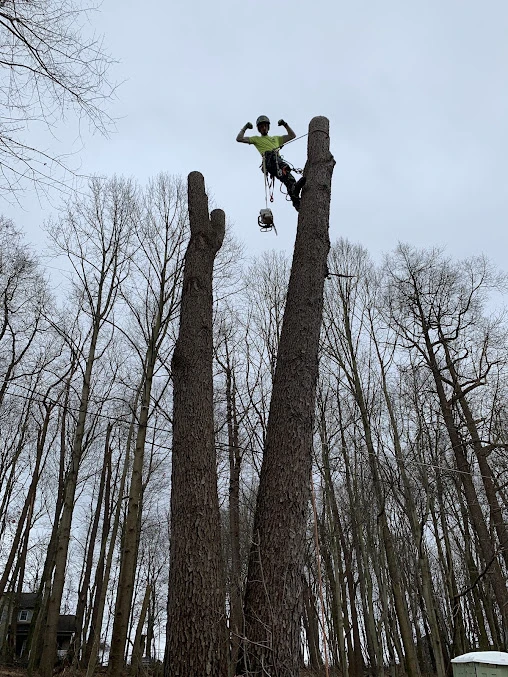

Left, why we climb: the dead limbs worth worrying about live in the middle of the crown where a bucket cannot reach.
Old canopy, small yards, short fall distances
The North Hills and the river boroughs are full of trees older than the houses under them. Lots are narrow, the crowns have grown together over the street, and the distance between a dead limb and something that matters is often twenty feet. That geometry is why deadwood is such a common call here compared to open suburban builds.
In Trafford the older borough lots stack garages and driveways tight against big silver maples, which drop interior deadwood steadily and put it right over the parking. East McKeesport has the hillside back yards where a crown hangs over a patio one level down, so anything that lets go picks up speed before it lands. Out toward Robinson Township the mix runs to oaks and locust on larger parcels, and the deadwood tends to sit high and interior where you never notice it from the driveway.
Freeze-thaw does the same thing to a dead limb that it does to a road. Water gets into the checks, freezes, expands, and opens the crack a little wider every winter. By spring, wood that held last October is measurably weaker. That is the local reason our deadwooding season starts early and stays busy.
A last honest note. Deadwood work is the best first job to hire a tree company for. It is small, it is finite, and it shows you everything: whether the crew shows up when they said, how they treat the lawn, and whether the number you were given is the number you pay. That is how most of our long-term customers started.
Deadwood questions, answered plain
What people actually ask while standing in the yard pointing at the crown.
My tree looks completely healthy. Why does it have dead branches?
Because that is what healthy trees do. As the crown fills in, the inner and lower limbs stop getting light and the tree shuts them down to spend its energy up top. Add squirrel damage, old storm nicks, and ice loads over the years and a thriving oak or maple can easily be holding six or eight dead limbs. Deadwood is a maintenance item, not a diagnosis.
Is this the same as dead tree removal?
No, and the difference matters. Deadwooding means the tree is alive and we are pulling dead limbs out of a living crown, so the tree stays and gets better. If the whole tree has died, that is a takedown, and you want the dead tree removal page instead. On the phone we usually sort out which one you have in about thirty seconds.
How can a branch fall when there is no wind?
Dead limbs have no leaves, so wind passes through them without doing much. They fail from decay at the attachment point instead, and decay does not care what the weather is doing. When the last fibers at the union give out, the limb comes down under its own weight, on whatever day that turns out to be.
Do you have to take out every dead limb?
Not necessarily. We run an over-target audit, which means we look at what sits under each piece of dead wood. Deadwood over a patio, a swing set, a walkway, or the spot the car parks gets handled first. Dead limbs high over an open corner of the yard can often wait for a later visit. You will hear which is which and you decide how much of it we do.
Will cutting the dead wood out hurt the tree?
The opposite, when it is done right. Dead limbs are entry points for decay heading toward the trunk. Cutting them at the branch collar, never flush, lets the tree seal the wound and closes that door. We do not remove live wood during a deadwood job unless you have asked for pruning too, so the tree looks the same afterward except for what should not have been there.
What does deadwood removal cost around Pittsburgh?
It comes down to tree height, how much of it is dead, and how tight the drop zones are underneath. Chris walks the property, looks up, looks down, and hands you a written price before anyone ties in. Set up a walk-around and you will usually have that number within a day or two.
Get the widow-makers out while it is still a small job
One climb clears the crown, and it is done in a morning on most trees. One call gets Chris on the property, one walk-around gets you a written price, one visit gets the dead wood on the ground and gone. In sawdust we trust.